
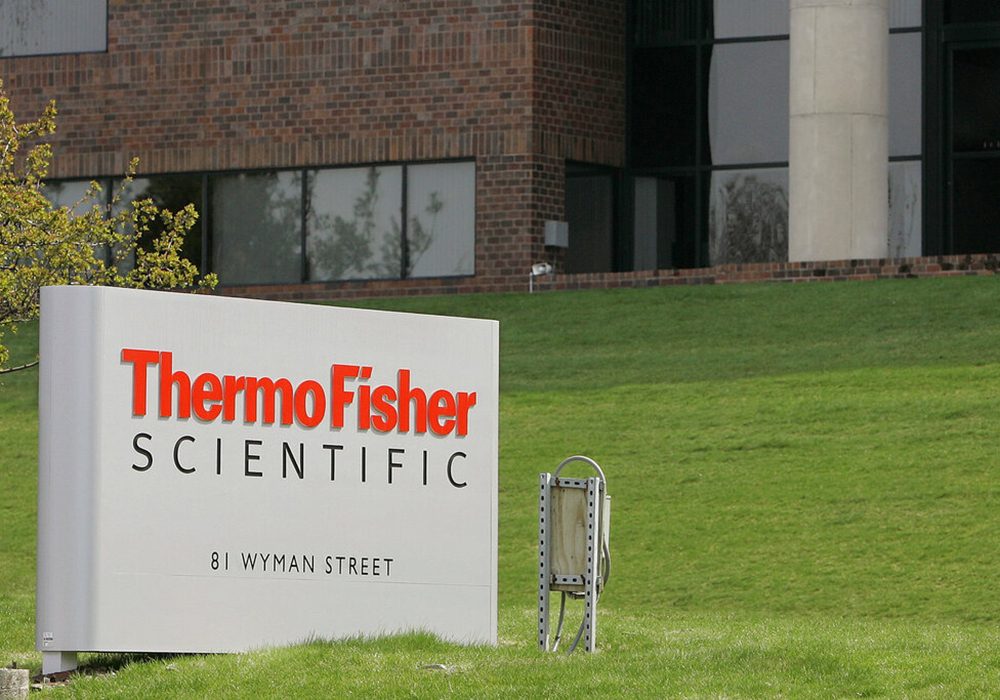
This April 26, 2007, file photo, shows the exterior of Thermo Fisher Scientific Inc., in Waltham, Massachusetts. (AP photo/Stephan Savoia, file)

A scientist in New York is suing an industry-leading life sciences company over its refusal to provide a retirement plan option that omits investments in fossil fuels, which he holds violate his Christian beliefs.
The lawsuit, filed Aug. 4 in the U.S. federal court for the Western District of New York, presents a test to the extent companies must honor employees' religious accommodations following a 2023 U.S. Supreme Court decision in which the justices unanimously ruled such requests should be granted so long as they don't present substantial costs. If successful, attorneys in the case say it could create a pathway for millions of Americans to access employer retirement options in alignment with their religious or moral beliefs, including on climate change.
Andrew Hartley, a statistical science director at Thermo Fisher Scientific, alleges in the suit the $200 billion multinational corporation refused his request for a religious accommodation to provide a 401(k) fund option that excludes fossil fuel companies.
A member of the United Methodist Church, Hartley in court filings cites Christian teachings to steward and care for the earth. Those obligations, he said, extend to refraining from investing in or profiting from fossil fuels, which when burned releases greenhouse gases that are the primary driver of climate change.
"Dr. Hartley believes that investing his retirement money in ecologically and socially destructive fossil fuel companies violates his religious beliefs, including his belief that it is deeply immoral to personally profit from and hold an ownership stake in the fossil fuel companies that are contributing to the climate crisis," the lawsuit states.
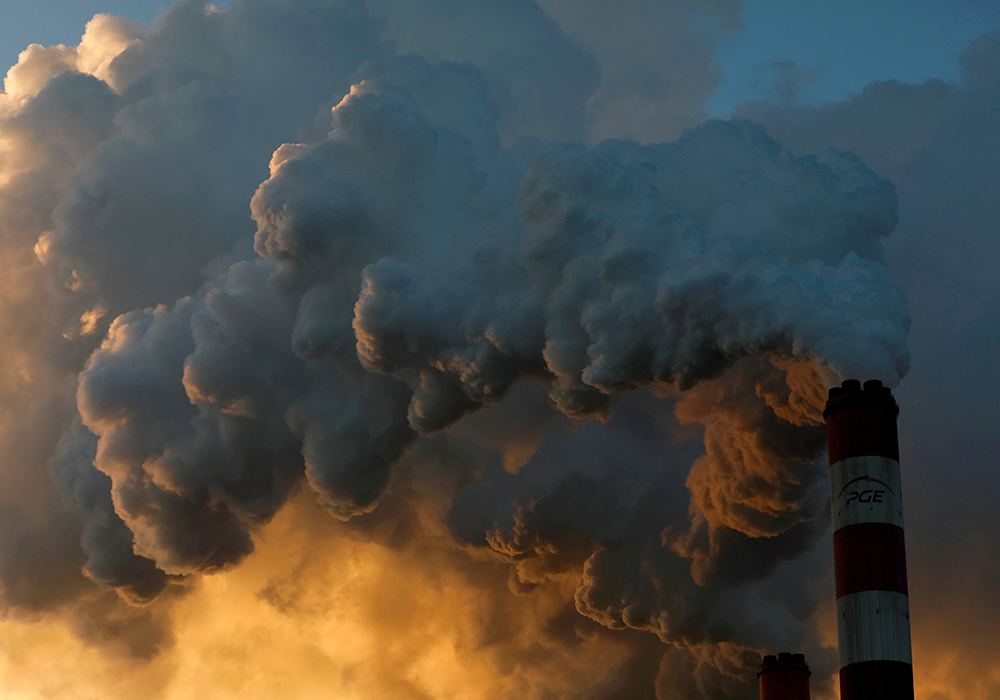
A coal-fired power plant is seen in this illustration photo. (CNS/Reuters/Kacper Pempel)
Christianity, along with many of the world's religions, holds environmental care as a central tenant of the faith. In his 2015 encyclical "Laudato Si', on Care for Our Common Home," Pope Francis wrote that "Living our vocation to be protectors of God’s handiwork is essential to a life of virtue; it is not an optional or a secondary aspect of our Christian experience."
Increasingly, many faith leaders have framed the obligation to preserve the created world in response to climate change, which they say along with destroying ecosystems disproportionately harms those who have done the least to contribute to the rising emissions heating the planet, notably economically poor communities, developing countries and those on society's margins.
Faith-based organizations have been at the vanguard of the global fossil fuel divestment movement, accounting for more than one-third of the 1,700-plus organizations that have sought to cut off financing for coal, oil and gas extraction and processing. More than 350 Catholic institutions globally have pledged to divest or refrain from investments in fossil fuels, and the Vatican and leading church officials have promoted divestment as a faithful response to Laudato Si'.
Parts of the United Methodist Church too have pushed for fossil fuel divestment, though its General Conference in 2024 declined to do so. For decades, the UMC Council of Bishops has called members to become just stewards of creation, including by reducing their carbon footprints. In a 2016 statement on climate change, they listed among actions for followers to take, "Prayerfully explore lifestyle changes as individuals and faith communities that would reduce greenhouse gas emissions and support a cleaner, healthier future."
An estimated $863 billion from 401(k) and other retirement vehicles in the U.S. are invested in fossil fuels, according to an analysis by shareholder advocacy group As You Sow.
According to the complaint, Hartley first requested on religious grounds a fossil fuel-free 401(k) investment option in October 2024. Thermo Fisher responded days later that his request didn't meet the criteria for a religious accommodation.
Hartley continued to pursue a fossil fuel-free investment fund over several months. At one point, he provided a list of potential funds as well as a legal argument for his request, the lawsuit states. In December, he filed a religious discrimination charge against Thermo Fisher with the Equal Employment Opportunity Commission, which in July determined he had a right to sue the company.
Hartley currently invests for his retirement on his own while using the company 401(k) plan in a limited way.
A spokesman for Thermo Fisher said the company does not comment on pending litigation.
In the lawsuit, Hartley alleges the lack of an investment option with fossil fuels deprived him of fully taking part in his employee benefits and represented a violation of Title VII of the 1964 Civil Rights Act. That law bars employers from discriminating against individuals because of their religion, extending to all aspects of observance, practice and belief, and requires accommodations be made unless doing so presents "undue hardship" on the company.
Advertisement
In April 2023, the Supreme Court clarified what constitutes undue hardship, ruling that an employer denying a religious accommodation needed to demonstrate that granting it would result in "substantial increased costs." That 9-0 decision came in the case Groff v. DeJoy brought by a rural Pennsylvania postal worker who requested as an evangelical Christian to abstain from mail delivery shifts on Sunday, the Lord's Day.
Prior to Groff, employees had a higher bar to clear in seeking religious accommodations, which an employer could deny if it posed a more than a de minimis or minor cost, said Richard Garnett, a leading expert on religious freedom and director of the University of Notre Dame Law School’s Program on Church, State and Society.
"Basically, an employer could say 'I'm not going to provide the accommodation because it would be a little bit of a bother to us.' And now that's not enough," he told EarthBeat. "Now, the employer has to show that it wouldn't be reasonable" and present substantial costs to constitute undue hardship.
"That's a better standard for the employee," Garnett said.
Similar cases have pursued retirement investment packages that complied with Muslim teachings, with most of those settled out of court.
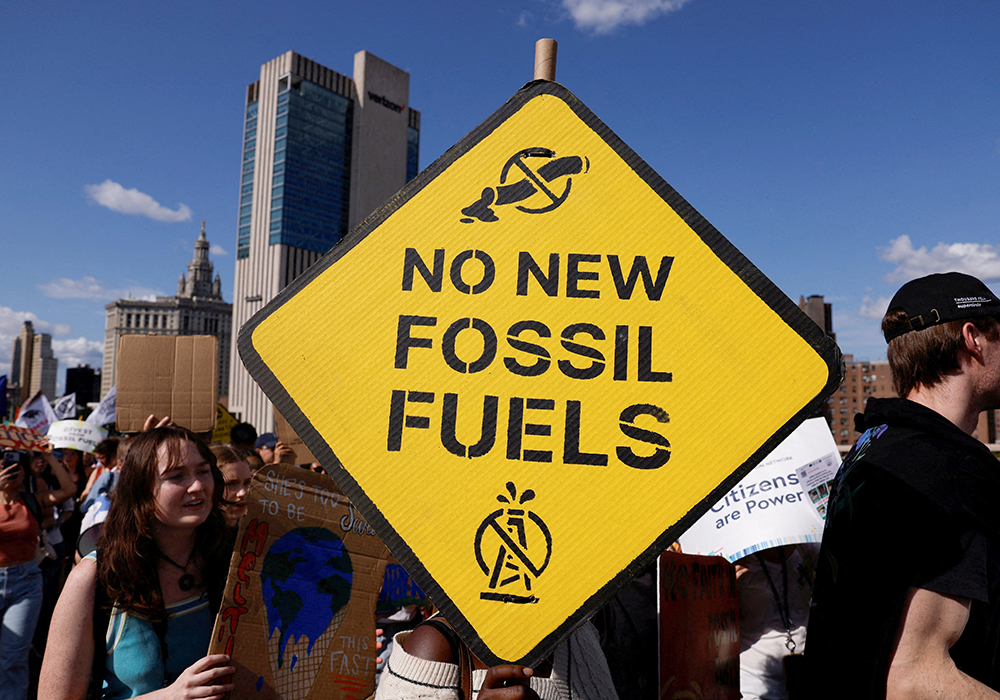
Demonstrators march across the Brooklyn Bridge in New York City Sept. 20, 2024, to call for an end to the era of fossil fuels. (OSV News/Reuters/Shannon Stapleton)
After the Groff decision, ClientEarth, a California-based environmental legal organization representing Hartley in the lawsuit, sought an opportunity to challenge whether religious accommodations extend to individuals looking to avoid investments in the fossil fuel industry.
Ben Segal, the attorney representing Hartley, said that ClientEarth sees this case as holding impact beyond Thermo Fisher's employees, potentially opening access to fossil-fuel free and other ethically aligned investment funds for millions of Americans.
"We're hoping to make it so that that becomes a thing that more people see, and then they have an option to make a choice that is better aligned with their values," he said.
Garnett, who signed onto an amicus brief in the Groff case organized by Notre Dame's Religious Liberty Clinic, said if successful, the lawsuit when combined with other similar cases could demonstrate that lower courts are responding to the Supreme Court's instructions.
"The change in standard should send a message to employers, to regulators and to courts — and for that matter to employees and their lawyers — that federal policy in the workplace is that religious accommodations are a good thing," he said.