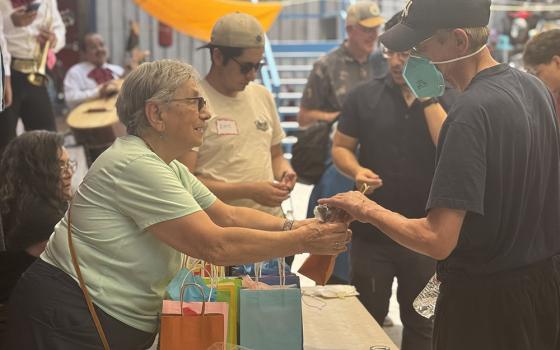
Katie Holler, a Catholic mother of two, had for months been following news of the Trump administration's increasingly hardline immigration policies, but she still remembers when she felt compelled to do something more.
One expert said that Nemesio Oseguera Cervantes' case reflects not so much a traditional Christian religious fervor, but rather a "popular religiousness, a religiousness of the immediate, of everyday life."
Bishop Aldo Berardi, apostolic vicar of northern Arabia — who shepherds the estimated 2.2 million Catholics — urged the faithful "to remain calm, united in prayer, and attentive to the safety of everyone."
The U.S. bishops' conference and the Catholic Legal Immigration Network filed one brief, while several U.S. women's religious orders, Hope Border Institute and Network Lobby for Catholic Social Justice filed another.
The Diocese of Syracuse, New York, has formally closed out its long-running bankruptcy, funding a victims' trust with more than $176 million to settle claims.
Two American cardinals and the Vatican's ambassador to the U.S. denounced the mass deportations in Minnesota under the federal government's immigration crackdown, but they urged everyone to repair strained relations and work together toward humane solutions.
From a perch on the op-ed page of The Washington Post from 1969 to 1997, Colman McCarthy became what the Washingtonian Magazine called the "liberal conscience" of the paper.
A Catholic legal network and other opponents of the Trump administration's suspension of immigration from 75 countries are calling into question a key claim the government made in support of that policy.
Religious men and women in the borderland region accompany migrants on a daily basis in the federal courthouses and in immigration detention centers, seeking to provide solace, comfort and support.