

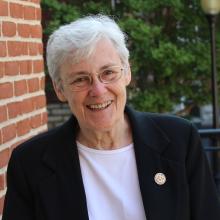
Mary M McGlone, a Sister of St. Joseph of Carondelet, gives retreats and days of reflection and is a writer and interpreter/translator. She may be reached at [email protected].
Scripture for Life: Holy Week is overwhelming. It bursts with liturgy and symbols to lead us ever deeper into the mystery of our faith. One way to take that in is to contemplate different depictions of Christ's passion.
What do you think about death? About your death? It is a subject that we often try to avoid — a reaction that only strengthens its ability to disturb us. Have you noticed that while lots of TV shows depict death — be it in gun battles, car crashes, murder, mayhem, war or “justifiable homicide,” entertainment rarely depicts a funeral?
Scripture for Life: Blessed are we when we believe what Pope Francis said of the moment of our death: "There hope will end and it will be a reality, the reality of life."
Lex orandi, lex credendi! This ancient dictum states that “The law of prayer is the law of belief.” Interpreted in a general way, it means that the way we pray is a very good sign of what we believe, or that our prayer forms our belief. It is a pretty solid principle, much like the advice that if you want to know how a guy will treat his future wife, watch how he treats his mother and sisters.
Scripture for Life: When Jesus speaks of his being lifted up as our salvation, as a light and a path to life, we begin to realize that he is talking about the cross as the ultimate revelation of love.
John loves to hide hints to deeper meaning in his Gospel, thus enticing his readers to go back and find more each time they encounter it. In this story, Jesus arrives at the temple area and calls it his Father’s house; with that he is claiming to be God’s Son as described in Psalm 2.
Scripture for Life: Jesus' "cleansing of the Temple" was more than just a violent reaction against attempts to sell grace. It was actually his first proclamation about who he was and what his mission would entail.
Today we hear the Genesis account of God’s test of Abraham. Often when we think of Abraham as the man of great faith, we are remembering his leaving everything behind in order to go to the land God was preparing, in order to receive the promise that his descendants would be as uncountable as the stars.
Scripture for Life: This week's readings give us a Lenten invitation to contemplate the image of God they present. Instead of calling us to say, "Here I am," God tells us, "Behold me in the Son."
In today’s psalm, we pray to learn God’s ways. We sing of God’s compassion and mercy, of God’s love and goodness. Then, we blithely ask to share those. As Jesus warned James and John, we may not know what we are asking.
Spiritual Reflections: The offer Jesus made to people was really very simple — and life changing: "Repent and believe." What that really meant was "Take on a new perspective! Believe what I am saying about God and about humanity!"
Mark tells the story of Jesus and the man with leprosy with moment-enhancing emotion. Perhaps it is because Jesus had just told his disciples that going out among the people was the very reason for which he had come.
Spiritual Reflections: Coming before God with a willingness to be nothing other than ourselves and to expose our need will take us into the realm of thick time.
Today, St. Millie, one of the seldom noticed model disciples in Mark’s Gospel, is going to show us what happens when one is touched by Jesus. Mark didn’t actually tell us her name, he only identified her as the mother of Peter’s wife.
Spiritual Reflections: Mark used the word serve sparsely in his Gospel. The next time Mark uses this word he is quoting Jesus himself. Jesus used the word when he described his own vocation.
“What have you to do with us, Jesus of Nazareth?” That’s the first question put to Jesus in the Gospel of Mark. It is really the core question of the Gospel.
Spiritual Reflections: "What have you to do with us, Jesus of Nazareth?" That's the first question put to Jesus in the Gospel of Mark. It is really the core question of the Gospel.
A little more than a year ago, Thomas Friedman published the book Thank You For Being Late. The book deals with the unprecedented pace of change our whole world is experiencing. Friedman says that humanity has known nothing like this since the days when Johannes Gutenberg invented his press which put the Bible, and much more, in the hands of the public.
Spiritual Reflections: If we wish to understand and implement Jesus' vision today, we must pause from our frenetic activity to contemplate our own reality, to cultivate what Pope Francis calls "serene attentiveness" and gratitude to God.
“What are you looking for?” That is the question today’s liturgy puts before us. It is a question addressed to us, but also one we address to God. It is the question of vocation. Put another way it asks, “What do you and God want to do with the life you have been given?”