

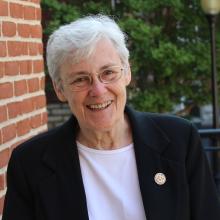
Mary M McGlone, a Sister of St. Joseph of Carondelet, gives retreats and days of reflection and is a writer and interpreter/translator. She may be reached at [email protected].
Life often demands focus on what we deem important, how we spend our time, what sacrifices we are willing to make and how much it will cost. The rules and resolutions we make are often good indicators of what we consider central to our livelihood.
The money of the United States bears the official national motto: “In God We Trust.” It’s a curious and sometimes contentious part of our history. Apparently, the motto first appeared on coins during the Civil War, a not so subtle assertion that God was on the side of the Union.
Spiritual Reflections: Caesar, the common good, society, can all make legitimate claims on us. We are responsible to create societies that serve the good of all. That's what we owe to Caesar.
Scriptural Reflections: The feasters included bad and good alike. What was the entrance requirement? The chosen are the ones willing to receive God's surprising and free offers.
Today’s parable of the landowner and tenants used a situation familiar to the audience. A wealthy landowner wanted his due, the tenants rebelled and got the crazy idea that if they eliminated the owner’s servants and son, they would be the winners taking all.
Scriptural Reflections: When we listen to the parable of the mutinous tenants, instead of thinking of "those people," suppose we heard it addressed to all of us as stewards of Earth.
While we may have never tried to draw God’s picture, we all have implicit images of God, some of which we have articulated, some of which are all the more powerful for not having been brought to consciousness.
Scriptural Reflections: "If you want to know what God looks like, look to this man." Jesus' mode of portraying God in human form had nothing to do with shows of power.
Isaiah quotes God as saying, “My thoughts are not your thoughts, nor are your ways my ways.” There’s probably no sincere believer who would claim to understand God.
Spiritual Reflections: Today's vineyard is a globalized economy, which means that the demands of justice and responsibility for the common good now know no national, ethnic or religious boundaries.
Sometimes it’s hard to figure out if the Lectionary addresses us as a philosophy class or as kindergarteners. Our reading from Sirach offers a little philosophy mixed with psychology, all under the heading of wisdom.
Spiritual Reflections: Forgiving what others have done may be a small price to pay for the privilege of living in a world where the compassion of God appears "77/over and again/now and forever/Amen!"
The Lord told Ezekiel: “I have appointed you watchman for the house of Israel.” It would be one thing if that simply meant that Ezekiel was to tattle on the people.
Spiritual Reflections: "Do I have a deal for you! Do this, and you've got it made for life! No more debts to anyone for anything!" That's Paul's pitch to the Romans this week.
Today we see Jeremiah at his best and bordering on blasphemous. He accuses God of seducing him into a life that has brought him nothing but hardship and rejection.
Spiritual Reflections: Our road to Jerusalem offers us glimpses of religious persecution, of refugees turned away from shelter and of billboards advertising a philosophy that proclaims that we will make a better world by putting ourselves first.
Spiritual Reflections: Jesus’ question, “Who do you say that I am?” may make us uncomfortable. It also turns the tables and asks us, “Who do you say you are?”
Experts in spirituality, at least in the mainstream Catholic tradition, will tell us that we don’t pray to change God’s mind but to grow in relationship with God and learn how to conform ourselves to God’s will.