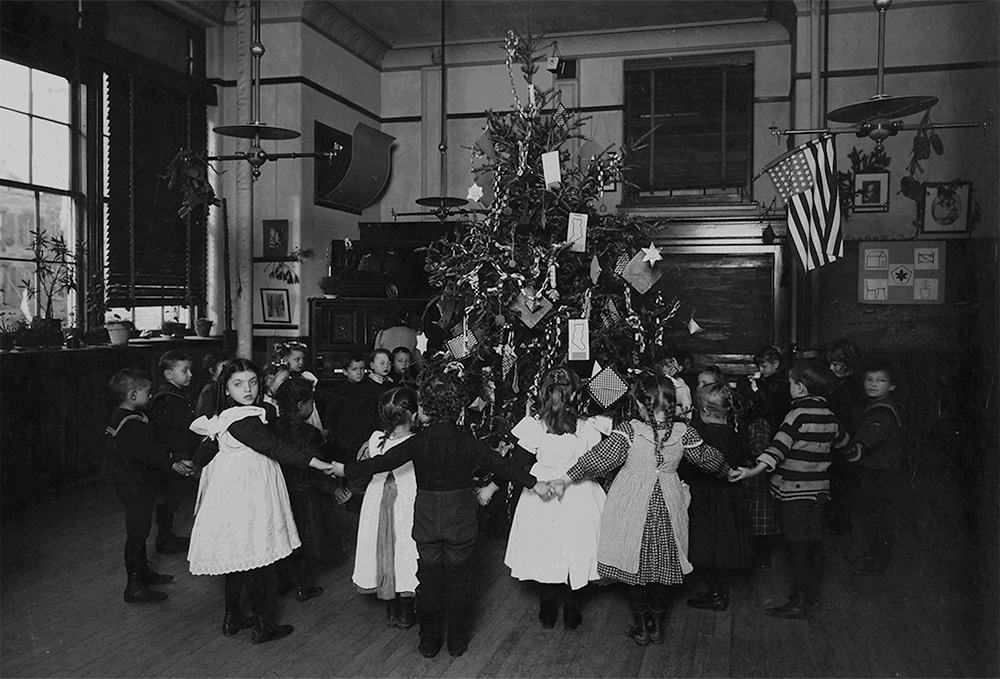
Children hold hands around a Christmas tree at a New York City school, circa 1900 (seligmanonline/The New York Public Library)

by Tom Deignan
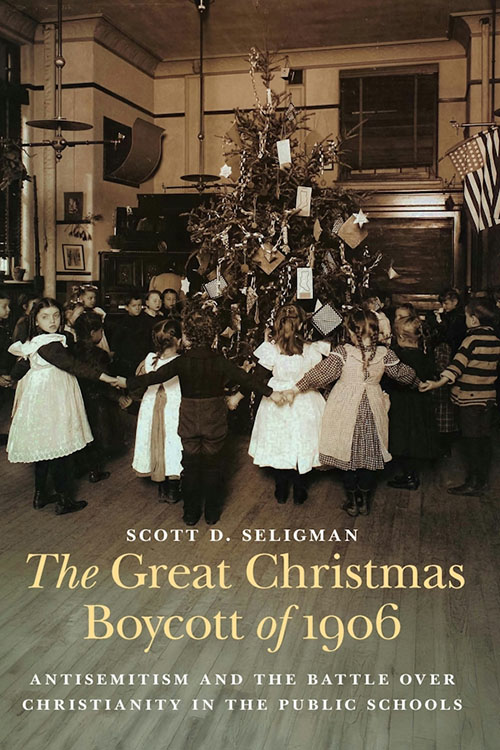
Christmas can get us lost in a sense of glorious nostalgia, but when it comes to U.S. history, nostalgia is a lot messier.
One reason we're fighting so fiercely about immigration right now is because of deep misunderstandings across the ideological spectrum about what immigration used to be. You might say we're haunted by ghosts of immigration's past.
Scott Seligman's new book, The Great Christmas Boycott of 1906: Anti-Semitism and the Battle Over Christianity in the Public Schools, is a great reality check, both for Republicans who believe past immigrants easily assimilated and Democrats who believe anti-immigrant hate has never represented "who we are" as a country.
In the last decade of the 19th century, Ellis Island had just opened and the federal government was now in charge of immigration processing. Most of the huddled masses arriving daily were from Southern and Eastern Europe: Catholics from Sicily, Orthodox Christians from Greece, Jews from Russia.
Educating the youngest of these new arrivals was inevitably going to lead to some kind of culture clash. By the mid-1890s, a top New York City police official had already criticized Jews and their "criminal instincts," "clannishness" and "stubborn refusal to yield to American ideas," Seligman notes.
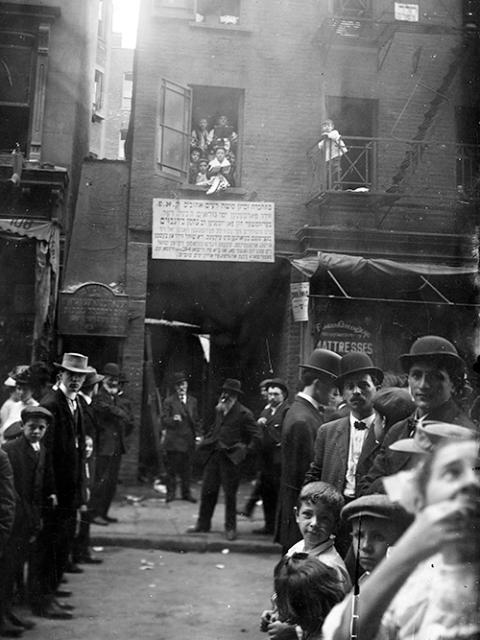
Jewish people gather for a Rosh Hashanah celebration at a synagogue in a tenement house in New York City, Sept. 9, 1907. (Library of Congress/George Grantham Bain Collection)
That's also when a coalition calling itself the Orthodox Union began demanding changes to Christian societal norms and traditions. These activists called upon "the federal government to deploy Jewish chaplains in the armed services and offer furlough to Jewish soldiers on the high holy days," Seligman writes. They also challenged Sabbatarian laws that set aside Sundays for worship and reflection, and "forbade everyone — Jews included — from doing business."
But it was in urban schools, especially New York City's, where some of the most intense culture clashes would unfold.
Jewish immigrants were merely following in the footsteps of earlier Irish newcomers, who charged that mid-19th-century education was explicitly anti-Catholic. Critics like New York Archbishop "Dagger John" Hughes demanded taxpayer money to open alternative Catholic schools. In other words, past immigrants — Jewish and Catholic alike — wanted Americans to change their normal way of doing things.
Every year, Seligman notes, Jewish public school students had to sing Christmas carols, read New Testament passages and perform in explicitly religious pageant shows. Whispers of opposition grew louder, especially in the Brooklyn and Manhattan neighborhoods, where student bodies had become almost exclusively Jewish. Long-simmering tensions boiled over as Christmas 1906 approached.
The center of this showdown was PS 144 in Brownsville, Brooklyn, where Jewish community leaders accused the principal of "establish[ing] a policy to systematically Christianize children born and raised in the Jewish faith."
A public meeting attracted 1,500 impassioned souls on all sides of the debate, which spilled out across the entire city — and country. One side argued that the U.S. was, in fact, a "Christian nation" and it was perfectly acceptable to reflect this in classrooms. Others believed that Christians were free to worship however they wanted in their own churches and homes, but not in public schools.
Both sides, naturally, claimed the Founding Fathers as their allies.
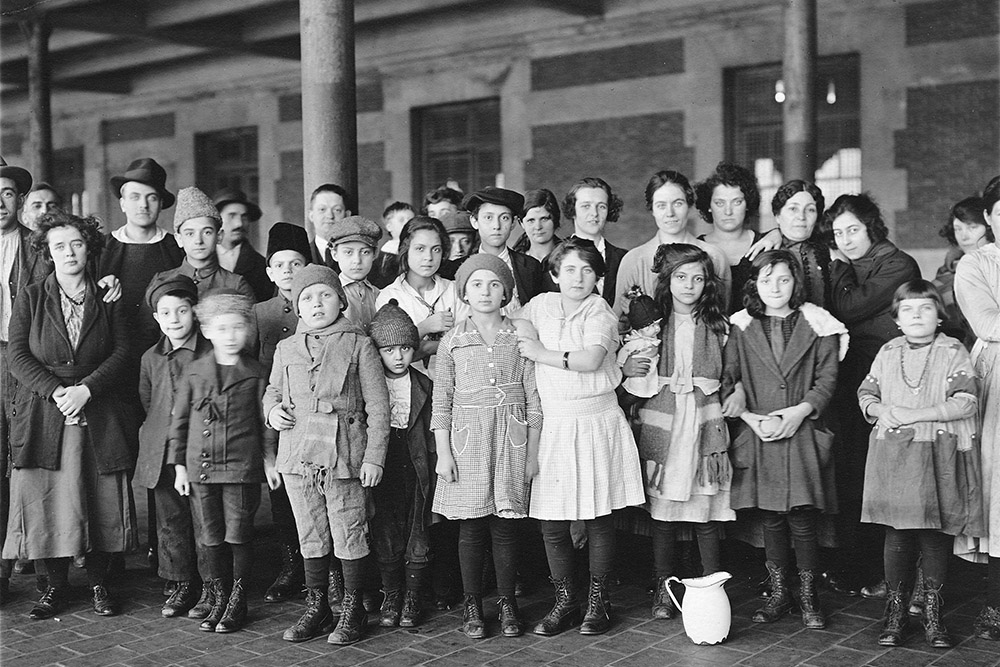
Immigrant children on Ellis Island, New York, in 1908 (Wikimedia Commons/National Archives)
Tensions worsened when New York schools made doctors and nurses available to impoverished students. In the wake of the COVID-19 pandemic, we should not be surprised that some took this well-intentioned health initiative as a plot to harm children.
"Such tales percolated through the Jewish Lower East Side," Seligman writes, "and like most rumors became exaggerated in the retelling."
"The Christs are murdering our babies!" one parent howled.
By December 1906, all of these roiling issues came to a head. Activists told Jewish students to, as Seligman writes, "decline to participate in any Christmas celebration in their school."
Reports and rumors suggested that thousands of Jewish students might stop going to school altogether. To some, this was further proof that Jews could never be true Americans, and that the Board of Education should show "some Puritan backbone instead of displaying the cowardice of nervous weaklings," as a critic put it.
This left other folks feeling that the holidays just weren't as much fun as they used to be.
"The beautiful spirit of Christmas time is crushed," lamented an editorial in Michigan's Flint Journal.
Following the 1906 debacle, city officials and faith leaders conferred to avert future conflicts.
Advertisement
The resulting proposals sought to emphasize various shared spiritual values and were promptly deemed an "insult to all Christians," at least according to the Knights of Columbus Catholic Affairs committee.
Then, as now, Americans were much more passionate about their own rights than the rights of others. These are optimum conditions for an endless cycle of culture wars that have now morphed into demands to "Keep Christ in Christmas" from folks who've removed Christian values from pretty much every other facet of life.
In a brief afterword, Seligman confronts several 21st-century church-state conflicts and makes his own stance quite clear.
There "is a stronger than ever case to be made for [a] bright red line ... to keep officially sanctioned devotional prayer, religious celebrations proselytizing and sectarianism out of the schools."
This has led many evangelical Protestants to the ironic conclusion that "Dagger John" and the Catholics were onto something: Let's just keep the evil government out of our lives and educate our own children.
So long as taxpayers foot the bill, of course.
There are various problems with the contemporary drift toward homeschooling — theological silos, if you will — starting with the slow but sure retreat from communal aspirations in America. But what about the wonder of discovering shared values and visions? The strength and inspiration of interfaith ideas and activism?
Such talk elicits a response with special resonance this time of year: Bah, humbug.