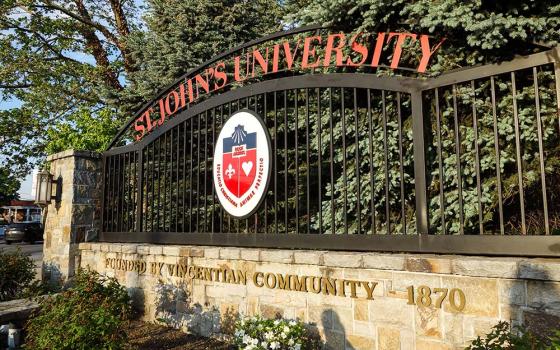
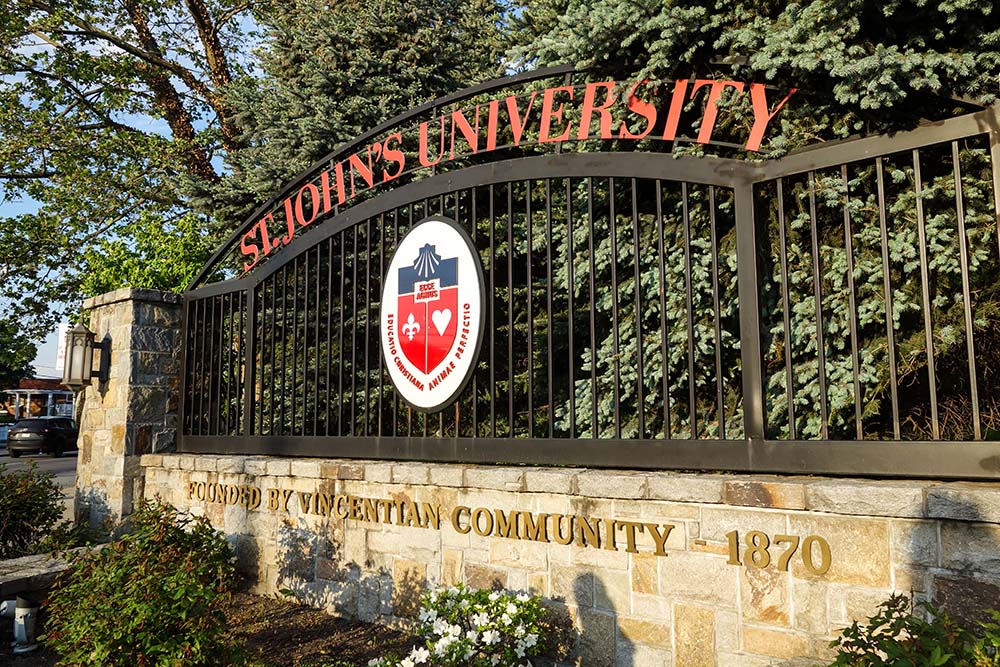
The gate sign at the west end of the St. John's University campus in Queens, New York (Wikimedia Commons/Tdorante10)

by Brian Fraga
Staff Reporter
St. John's University in Queens, New York, notified employees on Feb. 19 that it will no longer recognize the two unions that have represented faculty members at the Catholic university in collective bargaining since 1970.
In an internal email to faculty members, St. John's University leaders said the decision to withdraw recognition of the unions had not been made "lightly or rashly," but that it was done to secure the university's long-term future.
"First and foremost, we believe in the right to organize and the right of free association. At the same time, we must make decisions that are in the best interests of St. John's if collective bargaining burdens the university's goals that advance the common good," said Dominican Fr. Brian Shanley, university president, and Simon Møller, provost and senior vice president for academic affairs.
It had become "clear" in recent years, Shanley and Møller further wrote, that the university did not have "the flexibility required to fulfill its Catholic-centered mission while its core academic decisions are entangled in a collective bargaining relationship."
In a separate statement provided to National Catholic Reporter, a spokesperson for St. John's University said the decision to no longer recognize the unions was necessary for the 155-year-old Vincentian university to advance its organizational mission.
"This will allow St. John's the flexibility required to innovate while continuing to support our faculty and, most importantly, deliver on our promise to our students," said university spokesperson Brian Browne.
The presidents of the two faculty unions at St. John's University told NCR that they were disappointed by the administration's decision.
"Our response is that the administration of St. John's cannot unilaterally dissolve a collective bargaining unit that has existed for 56 years," said Christopher Denny, a theology and religious studies professor who serves as president of the university's Faculty Association.
Advertisement
"We are certified by the State of New York and St. John's is going to have to honor that legal relationship that it has consented to for over half a century," said Denny, who added that the unions' attorneys "are going to be fighting this, at whatever level of the judiciary."
"We are prepared for a long-term legal battle should that be necessary, but it would be far better for the administration to realize that a productive forward-thinking university would be far better served by withdrawing its unilateral declaration," Denny said.
Fred Cocozzelli, a government and politics professor who serves as president of the St. John's University chapter of the American Association of University Professors, told NCR that the university's announcement felt "like something that didn't need to happen."
"I'm just tremendously disappointed in the university's response," Cocozzelli said. "We're ready to get back to bargaining. That's what our goal has been, to get a good, fair contract. We do it to make the university stronger."
The unions and the university had been negotiating for about a year on a new contract to replace the collective bargaining agreement, which expired on June 30, 2025. In their Feb. 19 email, Shanley and Møller said there would be no further contract negotiations.
While adding that the contract talks had been difficult, Cocozzelli said he felt both sides were "actually pretty close" to an agreement. He said the unions still want to "address all the issues" that Shanley and Møller noted in their email.
"We want to make the university agile," Cocozzelli said. "We just want to do it in the way that we've collaborated over the years."
Union leaders have organized a Feb. 25 press conference and rally at the university's main campus in Queens, to protest the administration's move to withdraw recognition of the unions. Students, faculty and community members are expected to attend.
"This shameful attack on the St. John's faculty union betrays the university's history and most deeply-held Catholic values. It's outrageous that religious leaders are joining in the assaults on higher education that are happening nationwide," Todd Wolfson, president of the American Association of University Professors, said in a prepared statement.
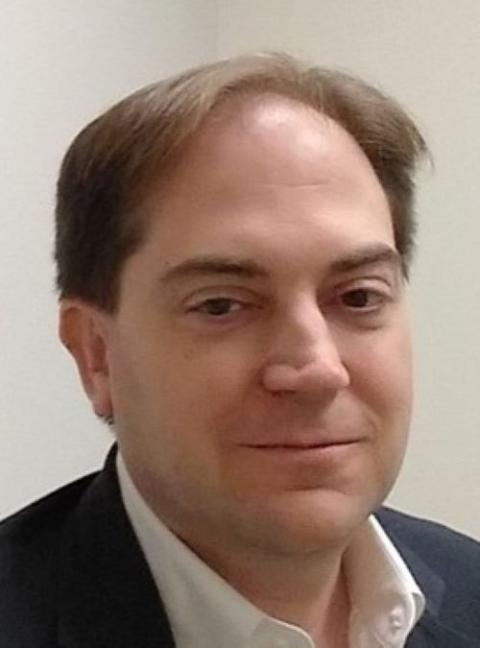
Christopher Denny, a theology and religious studies professor at St. John's University (Courtesy of Christopher Denny)
Denny and Cocozzelli had expressed concerns about the university's intentions for the unions in November, shortly after St. John's attorneys filed a response to an unfair labor practice complaint that the unions had brought against the university during contract negotiations.
Asserting its identity as a religious institution of higher education, attorneys for St. John's University argued that New York's Public Employment Relations Board lacked jurisdiction over the university on First Amendment grounds. The university also said that faculty members were "managerial employees" of the university and "therefore must be excluded from any bargaining unit."
The university's response further argued that the state board was "preempted" from asserting jurisdiction under the federal National Labor Relations Act.
In recent years, a handful of Catholic universities and colleges across the country have used a similar playbook to undermine unionization efforts and to halt recognition of faculty unions on campus. Those institutions claimed a religious exemption from the jurisdiction of the National Labor Relations Board, an independent federal agency that investigates unfair labor practices and that safeguards employees' rights to organize and collectively bargain.
Emboldened by the NLRB's 2020 decision that it does not have jurisdiction over religious schools, Catholic colleges and universities have cited the exemption in a manner that labor organizers say amounts to union busting on their campuses. Institutions that have claimed the exemption include Boston College, Duquesne University, St. Leo University, Marquette University and, most recently, Loyola Marymount University.
Denny, the president of the Faculty Association at St. John's University, said the right of workers to organize and collectively bargain is a tenet of Catholic social teaching.
"As a theologian, I would challenge Fr. Shanley to say where exactly 'flexibility' ranks in the social teaching of the Catholic Church," Denny said. "In their statement, we don't have anything about human dignity. We don't have anything about the importance of health care for employees, but we do for flexibility."