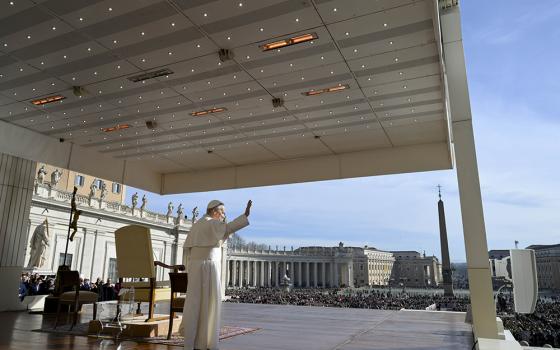
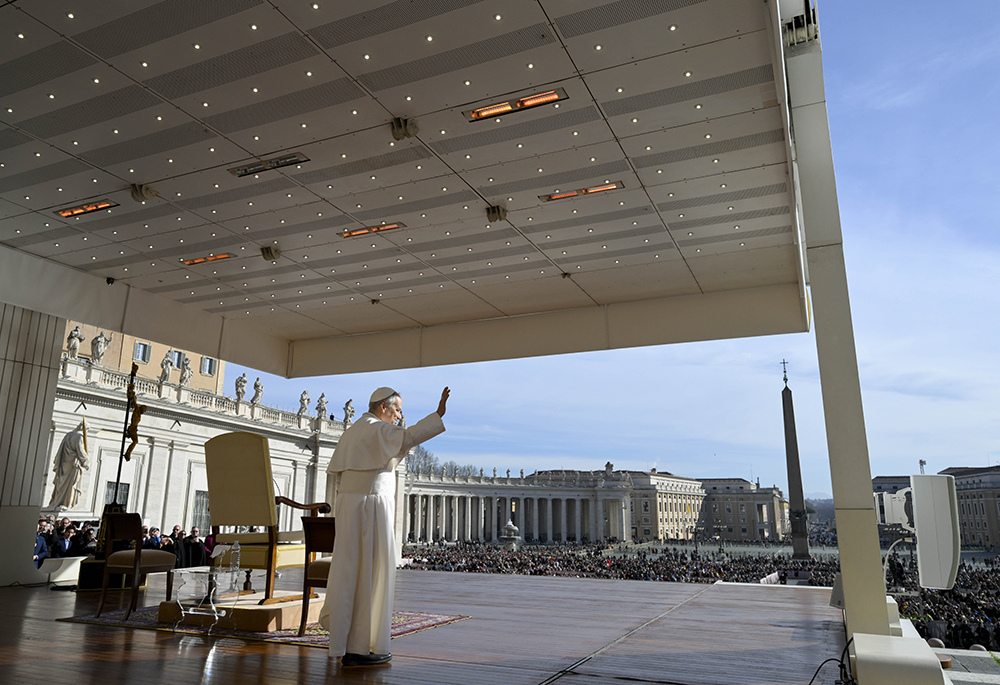
Pope Leo XIV waves to the crowd before leading his general audience in St. Peter's Square at the Vatican Feb. 18, 2026. (CNS/Vatican Media)

I have been linking to Pope Leo XIV's ongoing catechesis on the teachings of the Second Vatican Council since he began them at the start of the year. Last week (Feb. 18), he began examining Lumen Gentium, the Dogmatic Constitution on the Church, and it deserves more than a mere paragraph.
The pope began by noting how Lumen Gentium reflected the council fathers' desire to explain the origins of the church. They chose the Pauline word "mystery." Leo clarifies: "By choosing this word, it did not intend to say that the Church is something obscure or incomprehensible, as is commonly thought when the word 'mystery' is heard. It is exactly the opposite: indeed, when Saint Paul uses the word, especially in the Letter to the Ephesians, he wishes to indicate a reality that was previously hidden and is now revealed."
Revelation is our Christian data. Yes, we should still be attentive to the promptings of the Holy Spirit, who calls us still. The circumstances we face are often far different from those St. Paul and the Ephesians faced. But we test our thoughts and our deeds to see if they warrant the adjective Christian by examining them in the light of revelation. As I have noted often, just because a Christian has an idea does not mean it is a Christian idea.
The Holy Father then goes on to explain that the mystery is God's plan "to unite all creatures thanks to the reconciliatory action of Jesus Christ, an action that was accomplished through his death on the cross. This is experienced first of all in the assembly gathered for the liturgical celebration: there, differences are relativized, and what counts is being together because we are drawn by the Love of Christ, that broke down the wall of separation between people and social groups (cf. Ephesians 2:14)."
If I had 10 minutes with Leo, one of the questions I would ask him is why he began this catechetical series with Dei Verbum, the Dogmatic Constitution on Divine Revelation and not with Sacrosanctum Concilium, the Constitution on the Sacred Liturgy, which was the first constitution issued by the Second Vatican Council. Chronology is an easy organizing tool. What is clear, however, is that the pope recognizes these constitutions are all intertwined, and you can't really grasp the richness of any of them without seeing them as a whole.
Advertisement
More importantly, the pope here places the liturgy, which is a foretaste of that heavenly banquet for which we yearn, at the center of the church's self-understanding. Everything else we say and do in the realm of church organization, or social and sexual ethics, or theological development, everything flows from the paschal mystery which is made present at each and every Mass in a unique and unassailable way. It is this which brings us, properly, of necessity, to our knees.
It has been well said that the opposite of Catholicism is not Protestantism but sectarianism. In his catechesis, the pope leans into the universalism of the Christian message. "Precisely because [the Church] is brought about by God, this convocation cannot be limited to a group of people, but rather is destined to become the experience of all human beings." Later he states, "Union with God is reflected in the union of human beings. This is the experience of salvation."
Leo is not advocating any kind of empty-headed universalism. This son of Augustine does not shy away from the enormity nor the explicitness of the Christian claims about God. Perhaps there was a misunderstanding, but unlike the founders of other religions who died in old age and having largely achieved their goals, we Christians do not claim our founder was a learned teacher or wise sage but God himself and that this God permitted himself to be crucified as a criminal. You gotta admit it is pretty different.
Leo is also, however, encouraging us to resist the temptation to paint our fellow Catholics with caricatures, to dismiss them and their concerns as wrongheaded or even anti-Christian, and to recognize that all of us have the task of living in such a way that our lives give testimony to Lumen Gentium's claim: "The Church is in Christ like a sacrament or as a sign and instrument both of a very closely knit union with God and of the unity of the whole human race."
Oftentimes, especially under the influence of the lens provided by the social sciences, it is easy to forget that the church is founded upon the mystery revealed by Jesus Christ. It is easy to forget that every Mass is a miracle. It is easy, in a polarized time and when religion is invoked to justify politics of all varieties, to minimize the powerful call to unity that is at the heart of the church's self-understanding as it is made especially manifest at Mass. Easy and lethal.
I hope, oh, how I hope, that all Catholics, left and right, devout and lapsed, will take a moment and hear what Leo is highlighting for us. These short catechetical reflections invite us to become a part of the renewal to which Vatican II pointed, a renewal that is no new-fangled ideology but something very old and ever new, the revelation of God in Jesus Christ.
You are reading a selection from Michael Sean Winters' weekly newsletter. To get the full edition — including the "In the News" link roundup — delivered 24 hours before it appears online, sign up here!