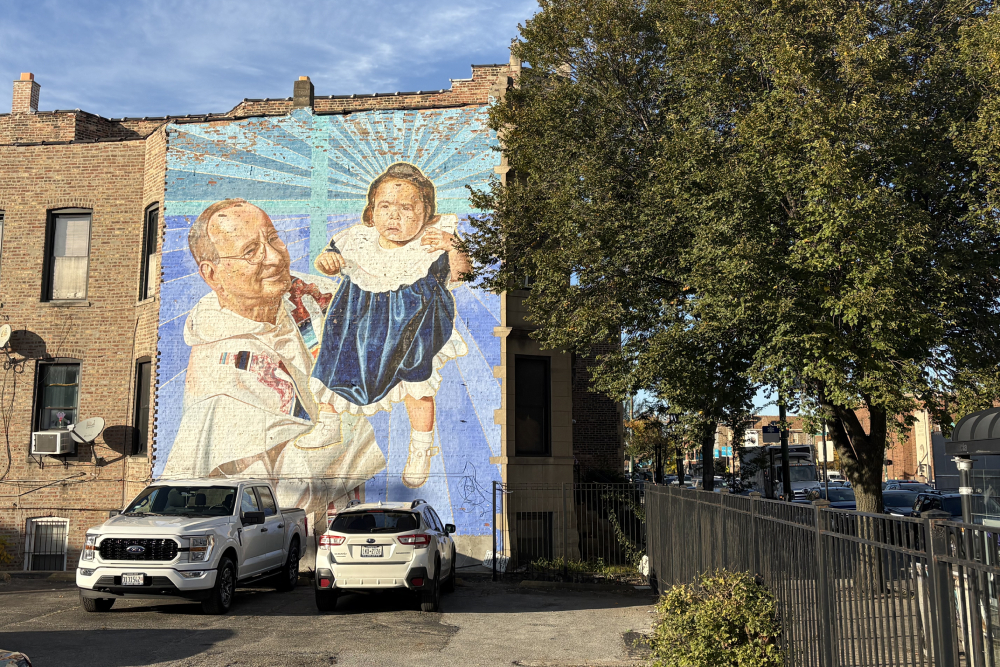
A weathered mural depicting the founder of The Resurrection Project, Dominican Fr. Charles Dahm, in Pilsen, Chicago's Mexican neighborhood. (NCR photo/Camillo Barone)

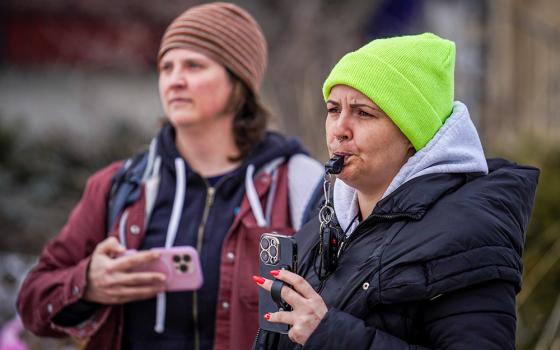
A blue whistle dangles from the rearview mirror of Dominican Fr. Brendan Curran's car, swinging gently beside a wooden rosary as the priest drives through the shiny streets of Pilsen, Chicago's Mexican neighborhood. The whistle is more than just a keepsake or a symbol of solidarity.
"We use it every time we see ICE in the neighborhood," he said. "It's what immigrant supporters have been doing lately — to warn people, to protect them."
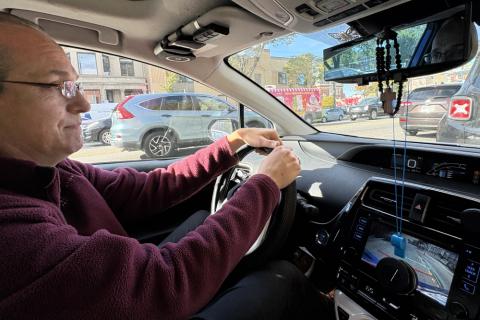
A rosary and a blue whistle hang around the rearview mirror of Dominican Fr. Brendan Curran’s car. Chicago residents have been using this kind of whistle to alert local immigrants of ICE raids, he said. (NCR photo/Camillo Barone)
Outside the car windows, murals of the Virgen de Guadalupe and banners reading "Mi barrio - Pilsen" flash by. Above, the low hum of helicopters drifts through the early afternoon air. Curran pauses mid-sentence to listen. "They've been flying over our heads for weeks now," he said, his voice tightening. "This is very recent and worrisome."
A Dominican friar born and raised in Chicago, Curran serves as director of interfaith partnerships at the Resurrection Project, a community organization founded by six local parishes 35 years ago to address affordable housing, health care and immigrant rights. He is also a member of the International Dominican Commission for Justice and Peace, linking his local work in Chicago to a global movement for human dignity.
In Pilsen, where old Mexican bakeries meet newly built gentrifying coffee shops, the tension between sanctuary and surveillance is almost tangible. "What was once about helping new arrivals get settled," Curran said, "has now become about protecting the people who are already here."
The urgency of his work mirrors the vision of Dominican Fr. Charles Dahm, the priest who founded the Resurrection Project decades ago. Dahm was born in Chicago and raised in the suburb of Elmhurst, but after doing ministry work in Bolivia, he returned to Chicago to co-found a peace and justice center, working on social issues like redlining and supporting refugees from Central America.
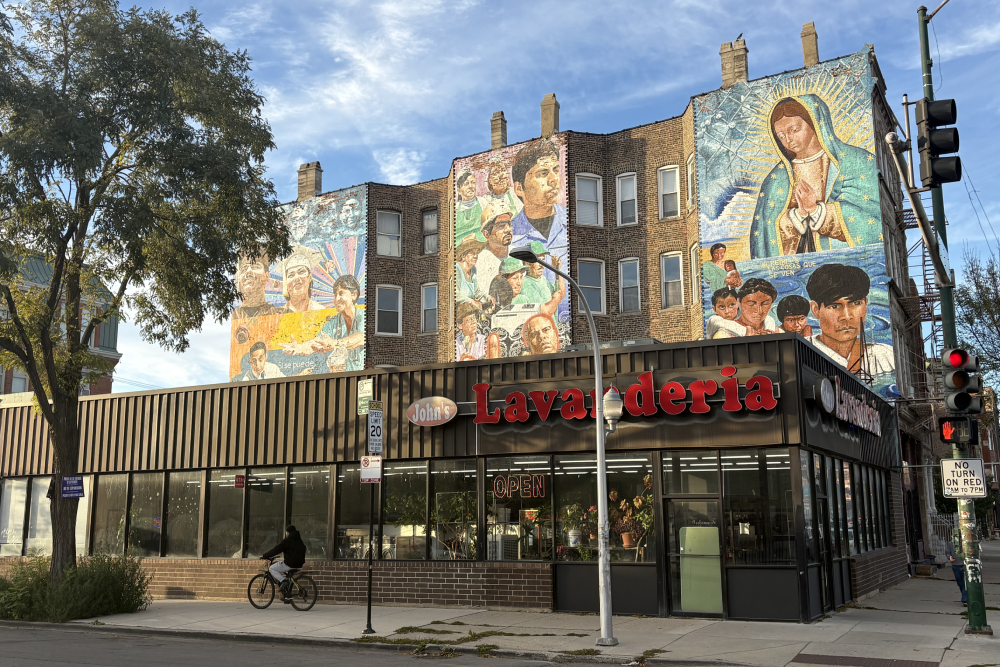
Murals depicting Mexican Catholic themes in Pilsen, Chicago, Oct. 27, 2025. (NCR photo/Camillo Barone)
In Pilsen, he helped establish the interfaith community organization and affordable housing programs, eventually merging them into the Resurrection Project.
Dahm recalled earlier waves of undocumented migration, but he said the current crisis is unprecedented. Residents stay home, paralyzed by fear of sudden raids. The organization has scaled up rapidly, channeling state funds into legal assistance and deploying lawyers to help families navigate detentions across multiple states.
"So much suffering"
In Pilsen, fear runs deep. Curran parks the car outside a modest two-story home, where two Mexican women — both undocumented — are waiting for him. He has known them for years through St. Pius V Parish, where much of his ministry is rooted.
In their small garden, surrounded by blooming geraniums and the clucking of hens, they serve sandwiches and tall glasses of agua con pepino, espinaca y apio, or cucumber, spinach and celery water. Hens, roosters and pigeons wander around the table as the women speak softly in Spanish.
They both asked to remain anonymous to protect their identities and ensure confidentiality.
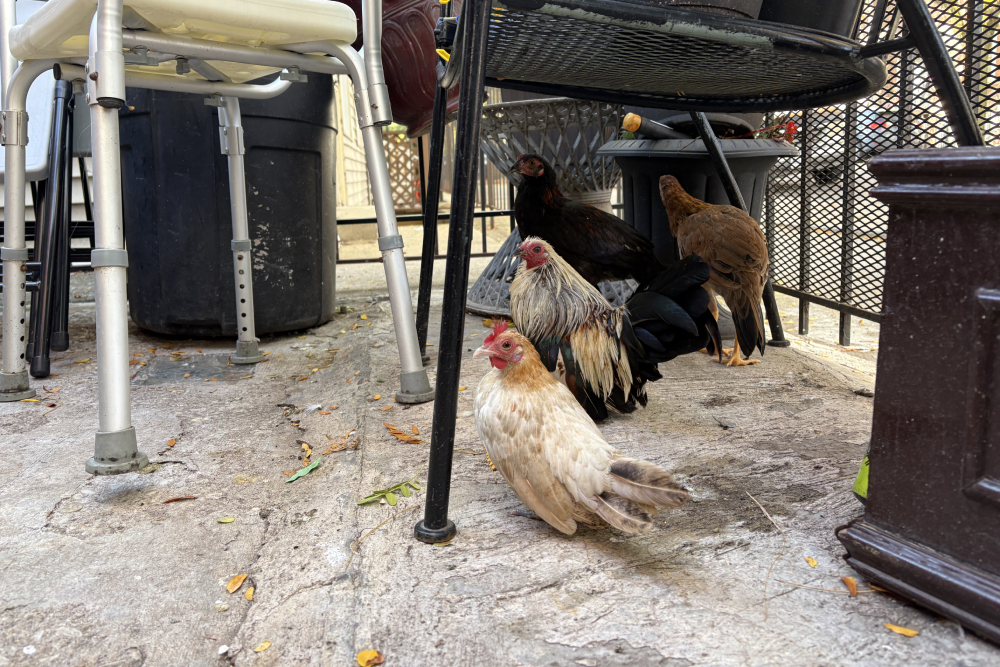
Hens and roosters in the front yard of the house where two Mexican immigrants are being interviewed in Pilsen, Chicago, Oct. 27, 2025. (NCR photo/Camillo Barone)
As the first woman, 49, begins to tell her story, the thrum of helicopters interrupts the conversation. Curran looks up, shading his eyes. "This is the new world we're living in now," he said quietly. "This is a military helicopter. This is quite scary, like we're in a war zone. They're also trying to surveil. At night they use laser beams and take pictures to identify residents."
When the sound of the helicopter finally fades, the woman folds her hands on the table and begins again. She left Guanajuato in 2001 with her husband and their three young children, determined to find a future they couldn't imagine back home. "We arrived in Chicago relatively well," she said quietly. "Everything was different from how it is now."
They crossed through Mexicali, she recalled, the first attempt ending in capture by border guards. A week later, they tried again and made it through. In Chicago, her husband found work in construction while she stayed home to raise the children. Her sons now work alongside their father, rebuilding homes across neighborhoods.
Her voice drops as she explains that she remains undocumented. "I've been in the process of getting a visa," she said, "because in 2017 I was assaulted by a man with a knife while I was going to church once."
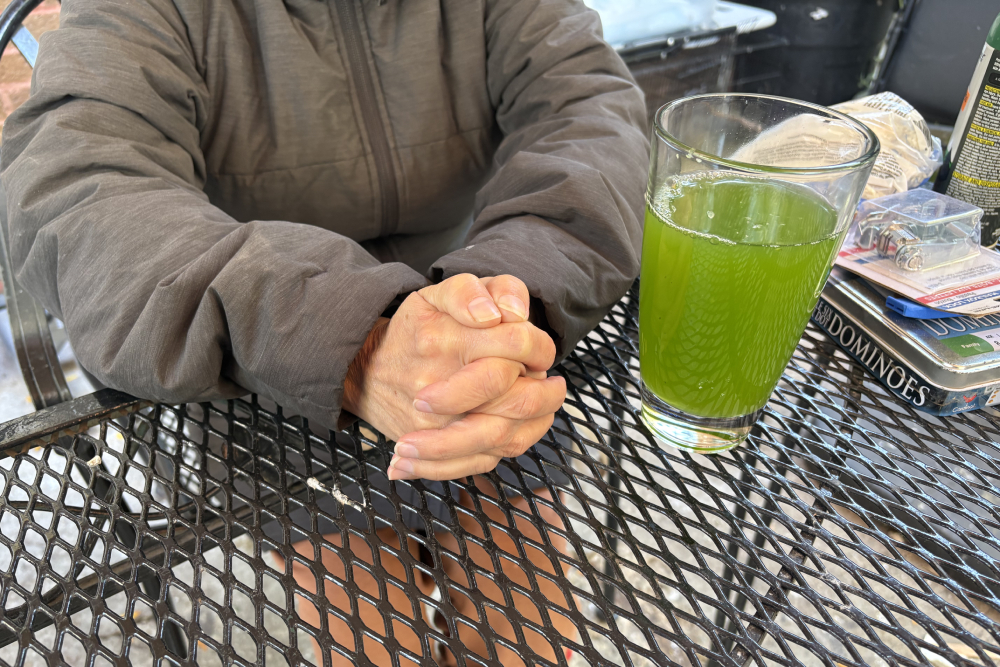
An immigrant woman being interviewed while sipping agua con pepino, espinaca y apio, or cucumber, spinach, and celery water, at a house in Pilsen, Chicago, Oct. 27, 2025. (NCR photo/Camillo Barone)
That attack changed everything for her. It left her with fear, but also with eligibility for a special visa for victims of crime, giving her temporary work authorization and a Social Security number, she said. Her husband and children are tied to the same application, still waiting.
She takes a sip of water before continuing. "2025 has been a year of profound stress, worry and isolation," she said. "I continue to have hope for change. But I no longer have peace. I feel like I am living in a time of eternal frustration."
Then she described Oct. 16 — a morning that still makes her tremble, she said. She had been at a flea market three miles south of St. Pius V Parish, selling clothes and small household items to make extra money. Around 10:30 a.m., a swarm of about 30 ICE officers swarmed the aisles.
"Everyone started running away. Some were caught," she recalled.
Among those caught was her friend, a woman with two children, one of them seriously ill. "She's in a detention center in Indiana now," the woman said, her eyes distant. The memory floods back in fragments: the chaos, the fear, the voices rising above the noise.
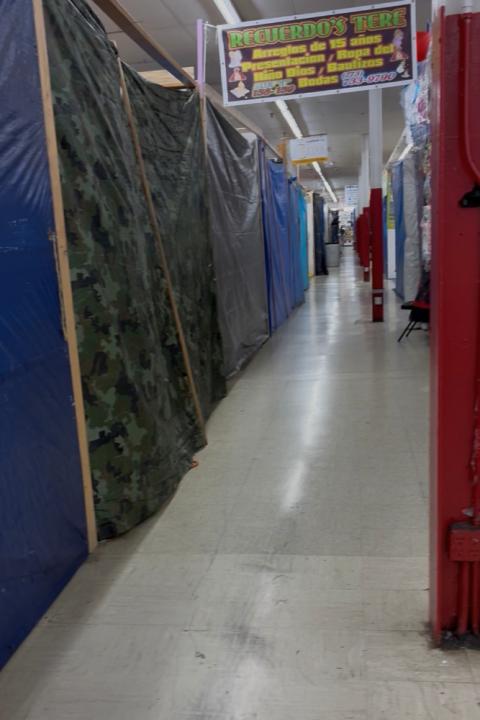
After ICE officers stormed a flea market three miles south of St. Pius V Parish in Chicago to arrest undocumented immigrants on Oct. 16, the empty market is pictured on Oct. 23, 2025. Vendors have stopped renting their spaces and closed their stands, and shoppers have stopped going to the market. (Photo courtesy of anonymous interviewee)
"I heard other immigrants shouting as ICE tried to capture her, 'take me, not her!'"
She falls silent for a moment, then adds, "I lived in fear for the next few days. I stopped renting my space in the market. It's been almost empty since that day." Her gaze drifts toward the street beyond the garden, where the sound of another distant helicopter hums faintly in the sky.
The second woman, 52, listens and nods. When she begins, her words come out in a rush. "I left Mexico 23 years ago in search of a better life," she said. "Where I come from, there was a lot of violence. The poverty was intolerable."
Her journey north was grueling. "It took me about three weeks, and then I was turned away at the border. I almost died crossing the river, but others helped me."
"Cuánto sufrimiento," her friend whispered softly while looking at Curran. "So much suffering."
The woman's eyes filled with tears. "My son was taken away. I was separated from him on the plane from El Paso to Houston and then to Chicago. He was only six months old and had serious health problems. I had to pretend I didn't know him, even though I could hear him crying."
Her husband's family in Chicago paid the smuggler $5,000 to return her baby. "When I tried to regularize my status," she continued, "I was advised by lawyers not to apply, because I had been rejected the first time I tried to cross." She remains undocumented to this day.
At St. Pius V, she found what she calls her "second family." That's where she met Curran. She used to work as a babysitter, she said, until her oldest son's needs made that impossible. He has autism with high support needs and requires constant care.
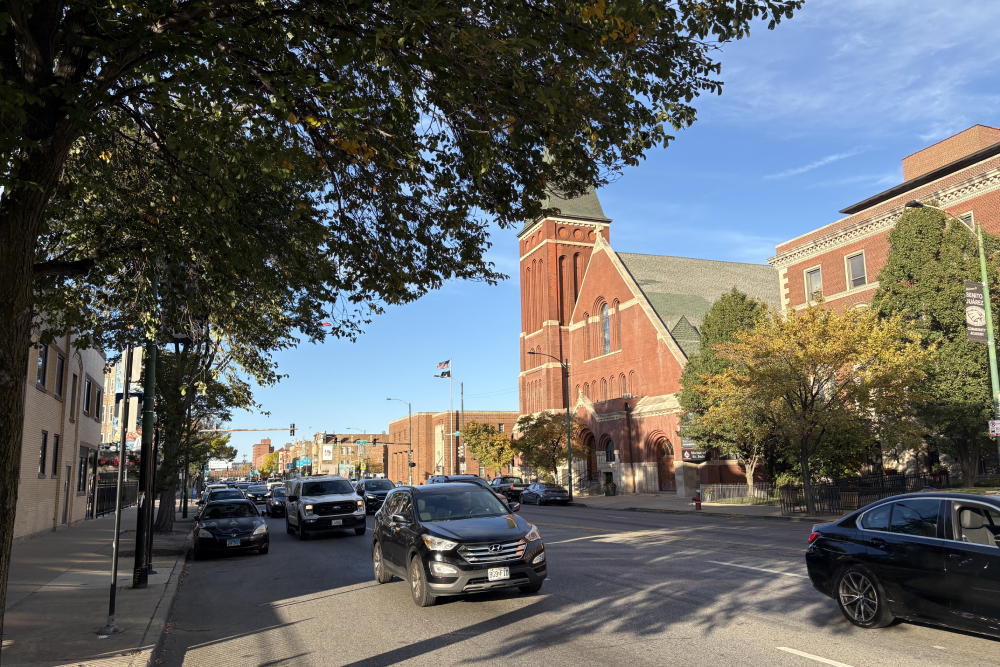
A view of St. Pius V on Ashland Avenue in Pilsen, Chicago, the Mexican neighborhood where Dominican Frs. Brendan Curran and Charles Dahm both serve. (NCR photo/Camillo Barone)
Her other three children were born in Chicago: Two of her daughters are about to finish high school and the third is already working to pay for college. For years, her life revolved around the quiet rhythm of caregiving and community — work, school, church and home.
This year has shattered that fragile routine. "2025 has been the most difficult year since I've been here," she said, her voice breaking. "I live in constant fear of leaving the house. My daughters are terrified of losing me in deportations and beg me every day not to go out."
She has stopped volunteering at a local food pantry and no longer takes her son to the park, once his favorite outing. A few months ago, she heard that immigration agents had taken people there. The panic that followed, she said, only worsened her son's anxiety. "It has aggravated his autism," she added.
The fear now feels inescapable, she explained. Friends whisper about raids in the neighborhood. She knows of families who were torn apart: a father taken from his home in front of his children, another friend who simply never returned from work.
Advertisement
"The father of one of my daughters' school friends was taken in front of his house."
She pauses, her hands folded on the table. Health insurance is gone. Food stamps have stopped. Hope, too, feels distant. "I have no joy or hope at the moment," she admitted. "I only trust in mutual help within our community."
A new sense of fear
Curran, later sitting at his desk in his small office filled with boxes by the walls, Mexican piñatas, Guadalupe paintings and a poster of Pilsen's late Catholic activist Micaela "Miquita" Ibarra, said he remembers how, not long ago, new arrivals from Venezuela and Ecuador came to the city "as kind of a place of refuge, a place where they felt that they had a decent shot at getting connected to family and loved ones."
But things have "radically changed now," he said.
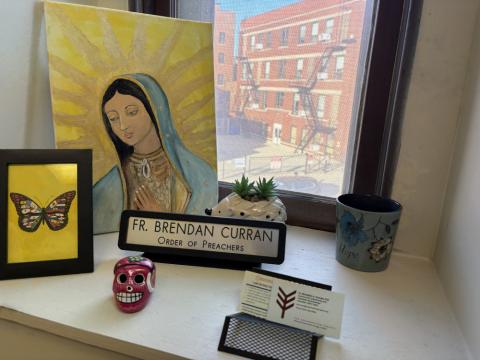
A painting of Our Lady of Guadalupe, a butterfly and a few other decorative trinkets sit at the windowsill of Dominican Fr. Brendan Curran's office at The Resurrection Project in Pilsen, Chicago, Oct. 27, 2025. (NCR photo/Camillo Barone)
"This is more of a situation of protecting the immigrant community where it is — people who are afraid to leave their homes or apartments out of fear that ICE agents would pick them up off the street."
He described U.S. citizens, permanent residents and workers "detained and harassed by immigration agents simply by their skin color, their accent or even by the name of their construction company."
For nearly two decades, Curran has led Friday vigils outside the Broadview Detention Center, the ICE facility nearest to Chicago. But now, even those vigils are shadowed by new dangers. "There have been snipers on the tops of buildings pointed at me doing prayer — a prayer vigil."
"American Catholics need to know that we are witnessing people who have left daily Mass, driving after dropping off their kids to school and they get surrounded by ICE vehicles to demand their legal status," he said.
"I don't know of any U.S. law that calls for that in a public space where no one has you on a list, no warrant, no request for you — and that person is a legal permanent resident," he continued. "Why would we select people simply because of their accent or dark skin?"
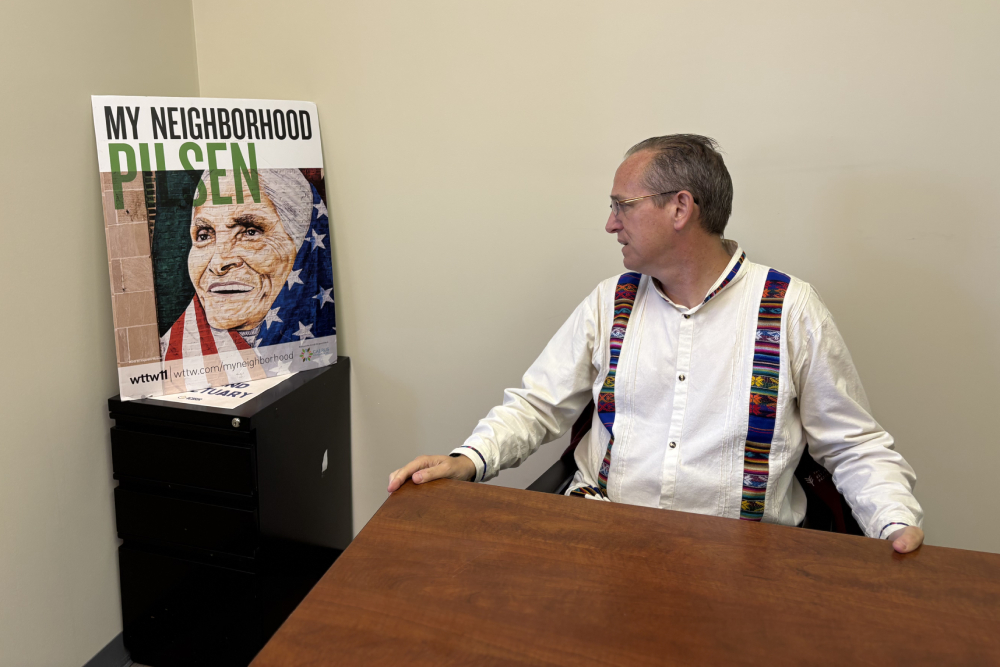
Dominican Fr. Brendan Curran sits at a desk in his office next to a poster of the late Pilsen Catholic activist Micaela “Miquita” Ibarra, Oct. 27, 2025. (NCR photo/Camillo Barone)
"Do we think this is American? Do we think this is the Gospel? When our parishioners are being absolutely terrorized, harassed and under threat, we have to protect them," he said while outside, the sound of yet another helicopter overhead fading away.