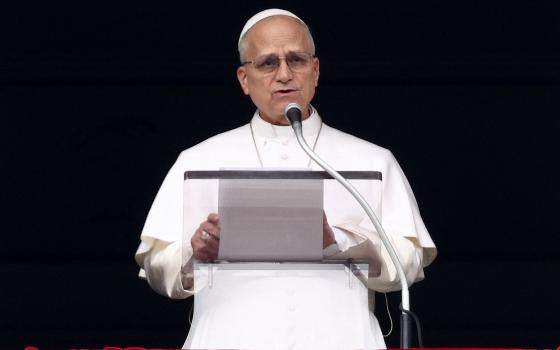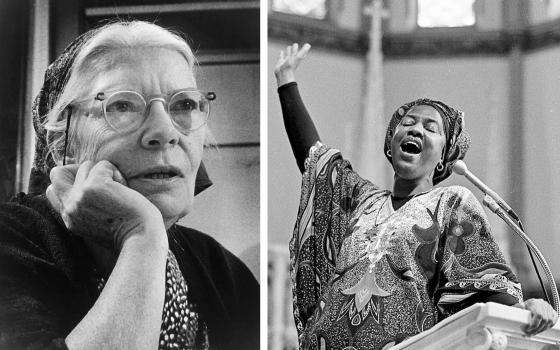
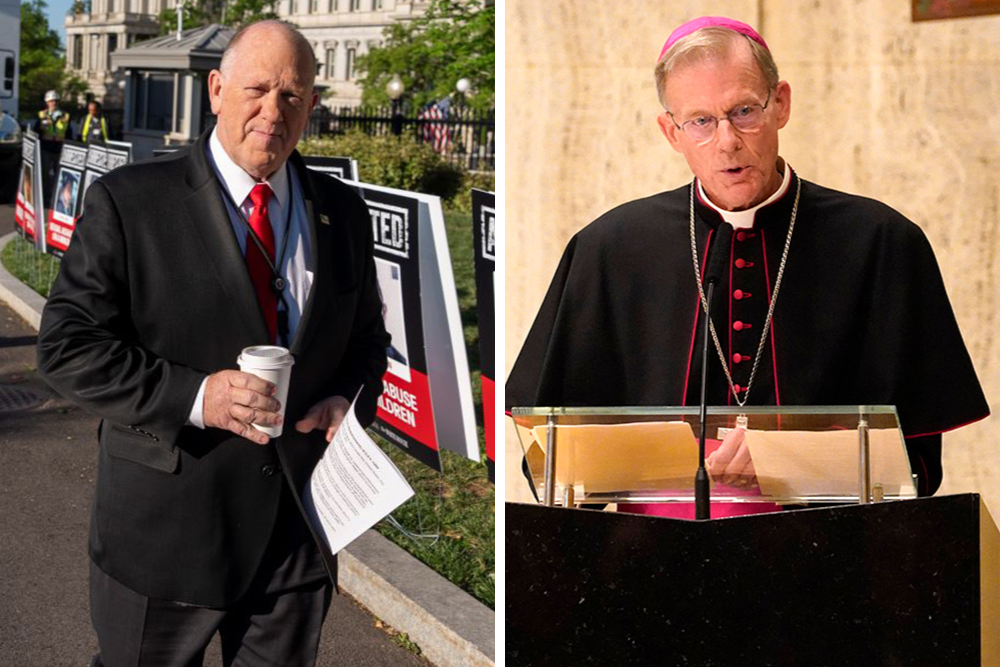
At left, White House border czar Tom Homan walks to do a television interview at the White House April 28, 2025, in Washington. At right, Archbishop John Wester of Santa Fe, New Mexico, offers a reflection on nuclear disarmament during a prayer service for U.N. diplomats at the Church of the Holy Family in New York City Sept. 12, 2022. (AP/Alex Brandon; OSV News/Gregory A. Shemitz)
by Michael J. O'Loughlin
NCR executive editor
Two prominent U.S. Catholics agree that immigration remains a daunting challenge — but each has starkly different viewpoints about what their faith demands of them during this moment.
First there's Archbishop John Wester of Santa Fe, who told me in a recent phone interview that he believes we're living in "a Dietrich Bonhoeffer moment," invoking the 20th-century Lutheran pastor killed for his anti-Nazi activism. Then there's Tom Homan, the lifelong Catholic tapped by President Donald Trump to lead the administration's immigration crackdown.
Wester signed a recent statement along with 17 other bishops, from Arizona to Rhode Island, calling on Congress and the White House to change how federal agents undertake immigration raids. Among the suggestions: restore the right to seek asylum; end raids at sensitive places like churches, hospitals and schools; keep families intact; lose the masks; and only target bona fide criminals, not immigrants who contribute to the common good.
Wester acknowledged that immigration is a "controversial and complicated issue," but said the administration's tactics — mass deportations, presuming people are guilty based on their race and rounding up human beings like cattle — "goes against the Gospel and we need to speak out and call it what it is."
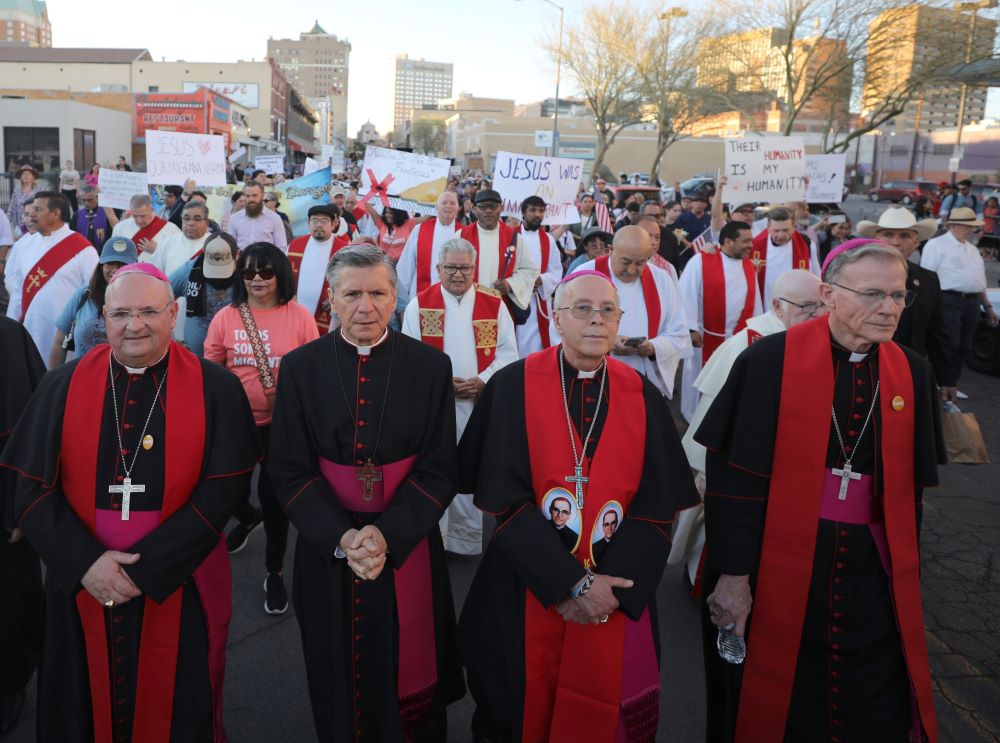
Archbishop John Wester of Santa Fe, N.M., (right) takes part in a demonstration in El Paso, Texas, against mass deportation March 24, 2025. With him are Bishop Peter Baldacchino of Las Cruces, N.M.; Archbishop Gustavo García-Siller of San Antonio and Bishop Mark Seitz of El Paso. (OSV News photo/Bob Roller)
"The important thing is for bishops, priests, deacons, lay leaders to speak the truth," he said.
But speaking the truth can be laden with consequences.
The administration has shown a willingness to target individuals and organizations who call out its mistreatment of migrants and protesters, even groups like Catholic Charities who serve the most marginalized communities.
Consider Homan, who's attacked bishops over their pro-immigration views and this week, he again went after Pope Leo XIV, saying he wanted to school the U.S.-born pope about the dangers facing migrants.
"If we jumped the wall at the Vatican, the penalties for doing that are much harder than the ones here in the United States, entering the country illegally," he told reporters on Feb. 25 — though he offered no evidence that trespassers at the Vatican are mistreated. (For what it's worth, the Vatican implemented new rules last year about illegal entry into the world's smallest sovereign state, including fines up to $29,500 and in instances involving violence, prison sentences up to four years.)
As for the pope, Cardinal Fabio Baggio, undersecretary of the Dicastery for Promoting Integral Human Development, recently told NCR's Vatican correspondent Justin McLellan that Leo XIV shares the "the same pastoral concern" as Pope Francis when it comes to migration. Baggio also noted that the Vatican actually did invite migrants to live in its territory and that the church in Italy is a major contributor to helping resettle migrants and refugees.
Homan said he wants to educate the pope about the extraordinary risks vulnerable people take in order to reach the United States — presumably as justification for the harsh deportation methods the administration employs that they argue have dramatically reduced illegal border crossings.
"I'd be happy to sit down and explain it to him, that illegal immigration is not a victimless crime," Homan said of the pope, pointing out correctly the horrific abuses some migrants face on their journeys to the United States.
("You ought to be fixing the Catholic Church, because they've got their own issues," Homan added, without specifying any particular issues.)
Advertisement
But wouldn't the violence migrants endure prompt Catholics to respond with compassion rather than cruelty?
Wester hopes so.
"These are people who are coming to us for food, shelter and water, and we need to do what we can to help them," Wester said. "Far from that, we're doing the opposite. We're punishing them, we're making their lives miserable."

Archbishop John Wester of Santa Fe, New Mexico, offers a reflection on the urgent need for nuclear disarmament during a prayer service for United Nations diplomats at the Church of the Holy Family Sept. 12, 2022, in New York City. (CNS/Gregory A. Shemitz)
"My hope is that the administration will be contrite," he said. "It's my hope — though perhaps not well founded."
During the president's State of the Union address on Tuesday (Feb. 24), contrition seemed a long way off.
Trump continued to characterize immigrants as "murderers" and "drug lords," and sought to lay economic woes that are partly responsible for helping to sink his approval ratings at the feet of "unrestricted immigration and open borders."
Last month, the White House announced that it would exempt foreign-born clergy and other religious workers from a visa crackdown, a move that won high praise from some U.S. bishops, who rely on foreign-born priests to staff parishes. Might the administration be using that exemption — and the threat of revoking it — to lessen the criticism from Catholic bishops and other Christian leaders about its immigration crackdown?
Wester says Catholics must keep using their voices to defend the rights of migrants.
"We can't throw the immigrants under the bus, we need to speak up for them, come what may," Wester said. "We have to be clear that we will not be blackmailed, we will not be cajoled into compromising our strong beliefs about welcoming human beings, welcoming the strangers in the midst."
With another three years left in the current administration, Wester said Catholics can't give up their prophetic witness.
"We need to keep speaking loudly and strongly," he said. "I think it's going to be a long road."