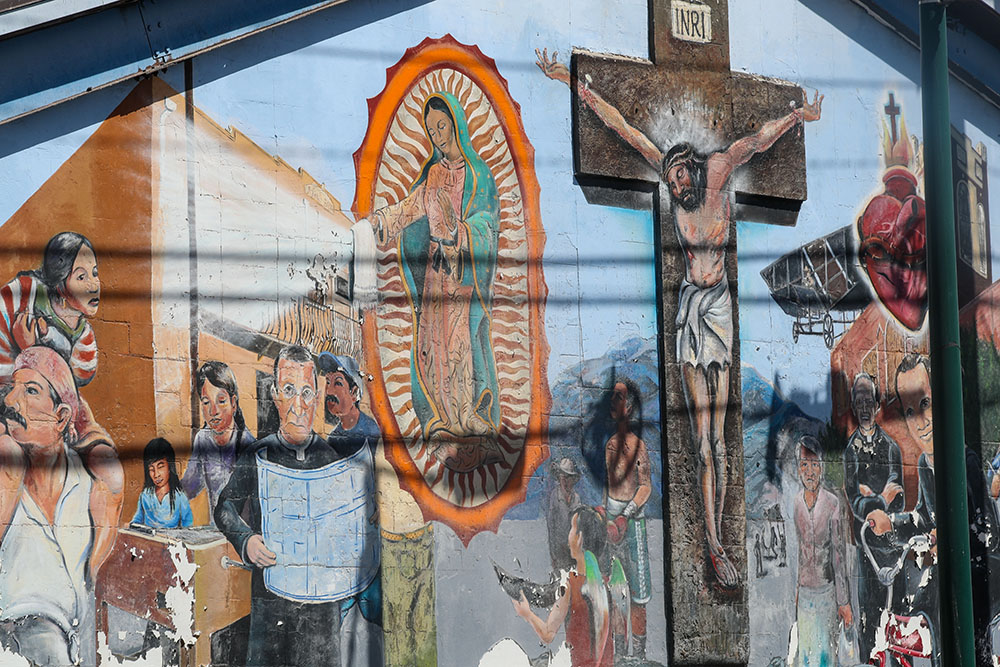
A mural is seen on a building on the grounds of Sacred Heart Catholic Church in El Paso, Texas, March 24, 2025. (OSV News/Bob Roller)

by Brian Fraga
Staff Reporter
"They're following me. I know they're following me."
Brigitte, a young Venezuelan woman, kept looking back over her shoulder. She was nervous and crying.
Scalabrinian Sr. Leticia Gutiérrez Valderrama and another religious sister walked alongside Brigitte near downtown El Paso. Valderrama assured her that no U.S. Immigration and Customs Enforcement agents were following them.
"No, no, we're alone. It's OK," Valderrama said as they walked farther away from the Richard C. White Federal Building, where Brigitte earlier that day in late January had appeared for a hearing in immigration court.
"You're OK," Valderrama said as the women made their way to the parking lot of Sacred Heart Church, a Jesuit parish in El Paso's El Segundo Barrio neighborhood. There, they met Jesuit Fr. Michael Gallagher and a parish volunteer. Together, they waited until a relative arrived to give Brigitte a ride home.
"This is the work of accompaniment, this is what it looks like," Valderrama later told National Catholic Reporter through an interpreter.
Valderrama is among several religious men and women in the borderland region who accompany migrants on a daily basis in the federal courthouses and in immigration detention centers. They seek to provide solace, comfort and support to migrants in challenging situations.
"We're able to show them hope, to keep their faith alive and keep inviting them to recognize that what they're experiencing is not God's will," Valderrama said, adding that she seeks to show migrants that God is with them amid the federal government's mass deportation campaign.
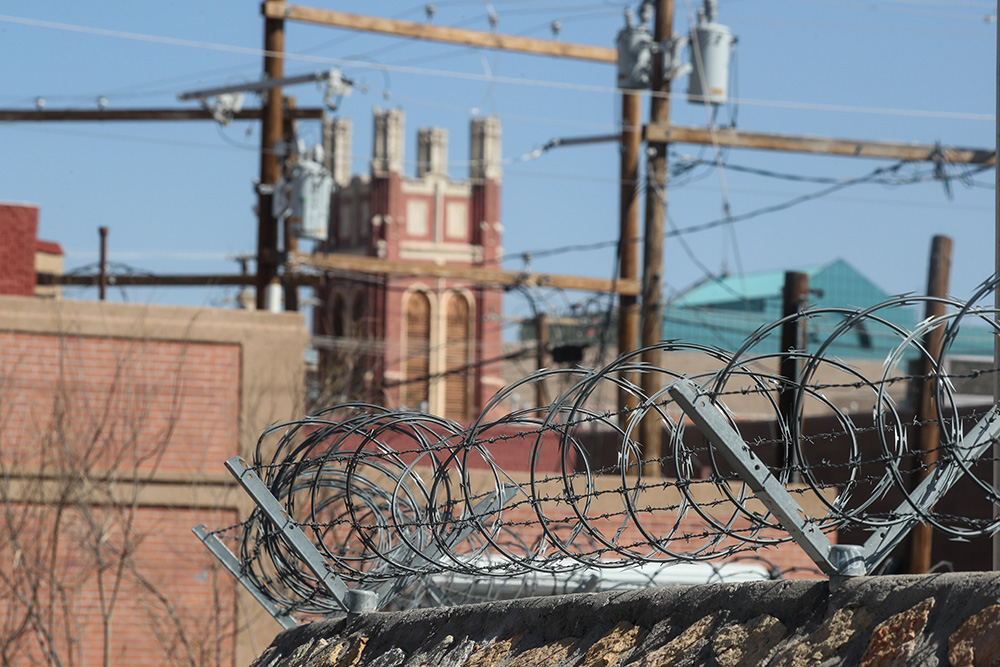
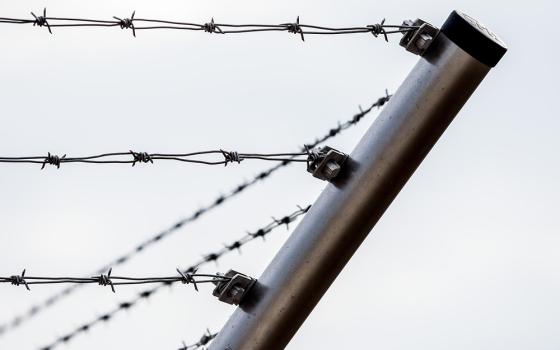
Razor wire is seen at the port of entry in El Paso, Texas, March 24, 2025. Sacred Heart Catholic Church can be seen in the distance. (OSV News/Bob Roller)
"God doesn't want them to suffer in jail and in prison," she said. "This is about what's going on with the politics, with the horrible political situation. They're victims of a system. But it's God who sustains them, and it's God who keeps them alive."
On a late January weekday, Valderrama greeted about half a dozen migrants who had shown up in person for their hearings in immigration court. Among them was a woman from Honduras, who appeared in court with her two children, both of whom were born in Mexico. Valderrama smiled and offered candy to the children. She spoke in Spanish with the woman, who arrived with paperwork organized in a brown accordion file folder.
Gallagher, who helps run the courthouse accompaniment ministry for Jesuit Refugee Services, stood nearby, examining the day's court docket. Twenty-three people were slated to have their immigration hearings that day. They hailed from Honduras, Mexico, Cuba, Venezuela and El Salvador.
Most of the migrants who were seeking legal status in the United States appeared for their hearings remotely with their attorneys. The others took their chances that they would not be arrested by federal immigration agents, who have been known to apprehend migrants when they show up for their court hearings.
"When they get arrested, it just really destroys their lives," Gallagher said as he looked over the docket.
Advertisement
On this day, no ICE officers were seen in the courthouse hallways, though Valderrama said she later saw several federal agents arrest a man outside the building. She said the officers formed a semicircle around the man as he walked out through the front entrance.
"It was the first time I saw something like that. They're usually inside the courthouse," Valderrama said.
In the courtroom, as asylum cases were called, a federal prosecutor filed motions to transfer those cases to Ecuador and Guatemala, which have agreements to adjudicate asylum claims referred to them by the United States. Most of the asylum seekers said they had never been to either of those countries.
"Essentially, the U .S. government is outsourcing its requirements under asylum law," said Imelda Maynard, director of legal services for Estrella del Paso, a ministry of the El Paso Diocese that provides legal services to migrants and refugees.
Known as asylum cooperative agreements, the pacts limit the ability of certain asylum seekers to access critical protections and claim asylum in the United States. In theory, the agreements allow migrants to seek asylum in a safe third country, but Maynard said that is not the reality.
"Essentially, it's a backdoor way to people just being repatriated to countries they fear," she said. "But then the U.S. can sort of wipe its hands and say, 'Well, we didn't send them back to Venezuela. We sent them to Guatemala. What Guatemala does with them is beyond our control.' "

A military aircraft waits for migrants to board from a bus at Fort Bliss in El Paso, Tx., Thursday, Jan. 30, 2025, before deporting them to Guatemala. (AP/Christian Chavez, File)
A woman in the El Paso courtroom held a young child as her partner, a Cuban national, was called. She cried as the prosecutor requested that his asylum case, which had been pending since April 2022, be transferred to Ecuador, a country he had never been to. Immigration advocates said federal prosecutors have been invoking asylum cooperative agreements more often since President Donald Trump took office in January 2025.
"It's really not that unusual now," Maynard said. "Basically the government has figured out a new way to defeat asylum claims, because it's not like these countries have robust asylum systems themselves."
Valderrama said her accompaniment ministry at immigration court began in the spring of 2025 after it became apparent that ICE agents were apprehending people. The ministry has grown to the point where she and the other religious sisters counsel families to have their affairs in order in the event that ICE arrests their loved ones.
At the very least, Valderrama said, the sisters' presence in the immigration court's hallways ensures that ICE officers respect the brief amount of time and space that migrants have to themselves immediately following their hearings.
"As long as ICE is there, we'll be going to the courts," Valderrama said. "If they leave, we'll see. But if they're still there, we're going."