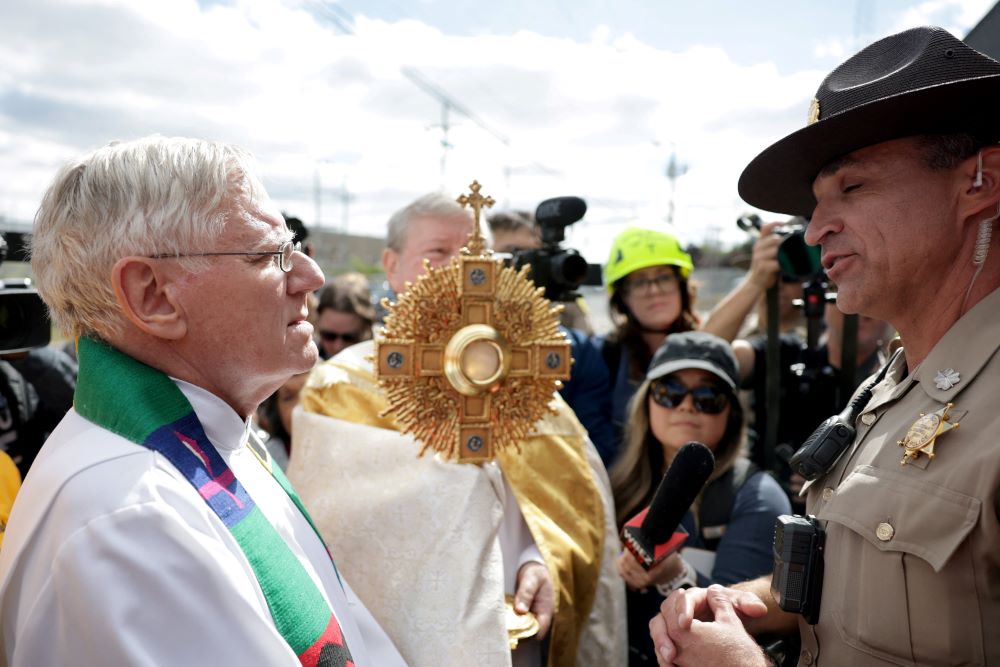
Jesuit Fr. Dan Hartnette speaks with an Illinois State Police officer as members of a Catholic group take part in a procession near the U.S. Immigration and Customs Enforcement Broadview facility in Chicago Oct. 11. The group had hoped to share Communion with detainees at the facility. (OSV News/Jeenah Moon, Reuters)

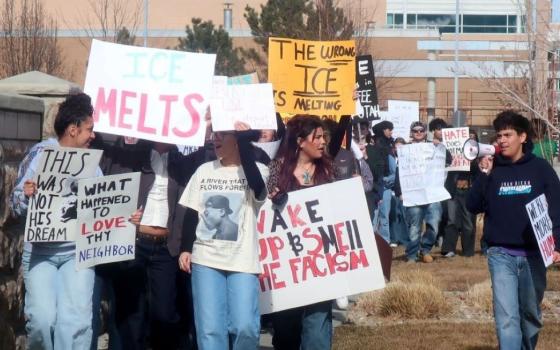
Video footage that went viral on social media earlier this month showed nearly 1,000 Catholics outside the ICE detention center Oct. 11 in Broadview, a suburb west of downtown Chicago, for a eucharistic procession.
Clergy carried Communion toward the gates, hoping to bring it to people held in the detention center. They were turned away. Yet the crowd prayed on — holding signs quoting Scriptures, singing and invoking the church's teaching that every person, regardless of immigration status, deserves dignity and spiritual care.
For Chicago Cardinal Blase Cupich, such moments of grassroots faith reveal something essential about the church's vitality.
"I encourage people at the local level to take initiative," he said in an Oct. 27 interview with the National Catholic Reporter in his office at the Archdiocese of Chicago's pastoral center.
Chicago's Catholics plan to return to the Broadview Nov. 1 for Mass outside the ICE facility, and many are hoping for the cardinal's participation and support. "I can't be everywhere, but I can encourage people," Cupich said. "Those kinds of things should happen on their own. They're spontaneous; they're local, and they're very effective."
Cupich views preventing access to detainees as a serious pastoral and constitutional concern as well as a matter of religious freedom.
"This is an instance of our religious freedom being truncated by the government, because we should be able to minister to people who are in need and offer pastoral concern. It doesn't seem that there is any harm to the government in allowing us to do that," he said.
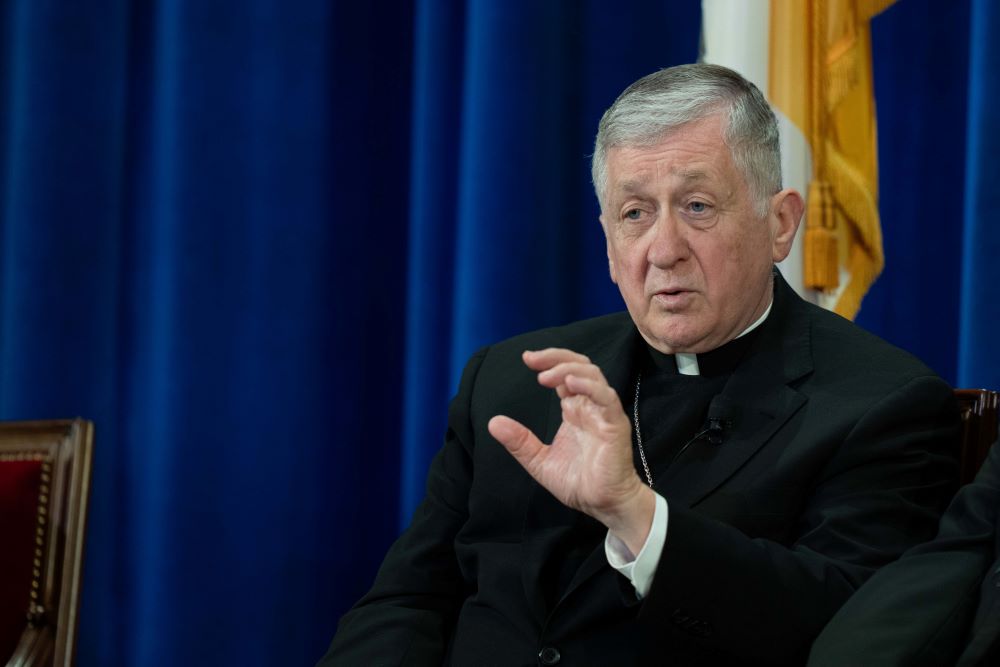
Cardinal Blase Cupich of Chicago speaks at a news conference May 9 at the Pontifical North American College in Rome with other U.S. cardinals who participated in the election of Pope Leo XIV. (CNS photo/Kendall McLaren)
Cupich's critique extends beyond the gates of Broadview to the wider immigration system itself, and he asked that the U.S. bishops' conference take concrete steps to affirm the dignity of immigrants in America.
"We need to speak about the hypocrisy that's going on right now with regard to the way immigration enforcement is happening," he said.
Cupich recalled one case that stayed with him: an undocumented man who built a small business employing a dozen Americans — until he was arrested and deported. "Here you have the collapse of a system by which the common good was promoted, simply because you're targeting individuals without any balance at all," he said.
The interview has been edited for length and clarity.
Your Eminence, Chicago's immigrant communities are facing renewed fear and uncertainty. What do you see as the church's spiritual and civic duty toward working families living under threat of detention or deportation right now?
First of all, I think we have to draw near and be close to them and their needs. That has to do with their physical, material needs. If they need food, we need to reach out to them if they're afraid to go out and shop, but also offer pastoral support to let them know that they're not alone. That's why I did the video as a message to them.
That kind of pastoral humanitarian support is something that we're very aggressive about, and we want to do. But the other piece, it seems to me, is that we have to give them a voice in this moment, because the narrative — that this is a matter of law enforcement for those who have broken the law because they have stayed in this country too long, that is the only issue — has to be challenged, because another part of the story is that these people are here not by invasion, but by invitation.
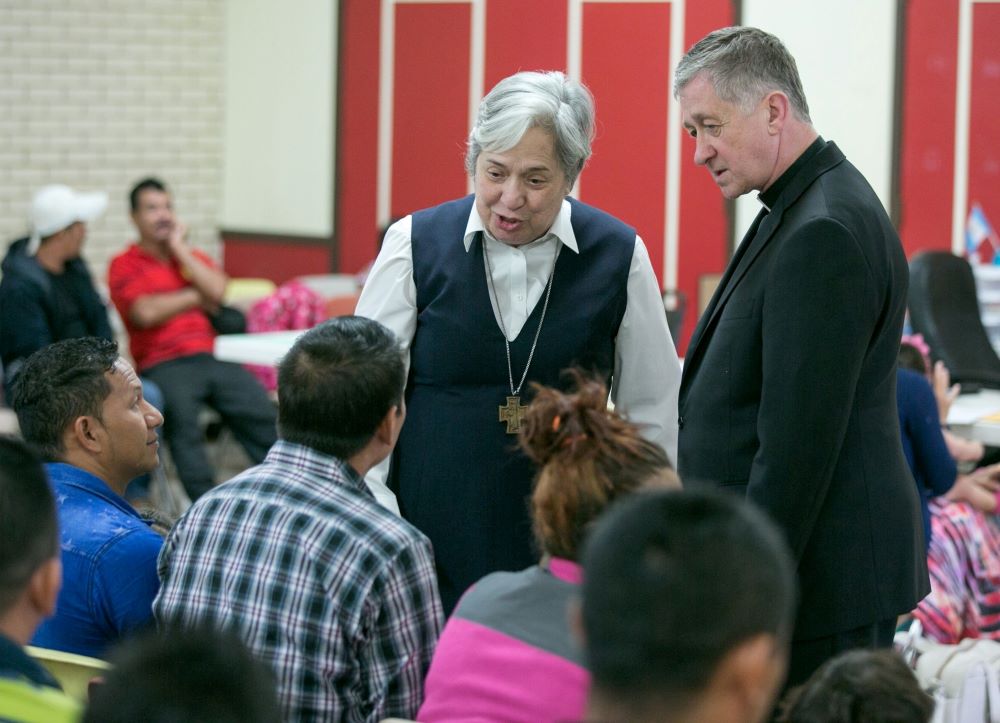
Sr. Norma Pimentel, executive director of Catholic Charities of the Rio Grande Valley, and Cardinal Blase Cupich of Chicago greet asylum-seekers in 2017 at the Humanitarian Respite Center in McAllen, Texas. (OSV News/Courtesy Catholic Extension)
We wanted them here to pick our produce from the land, to landscape our lawns, to care for our elderly and our children, to work in our restaurants, serve our tables, to clean our rooms. We have needed them as a workforce and these people have worked hard. Many of them have contributed to society and to the economy. Also the fact that they have raised families. They have brought children into the world now who are citizens and to see them torn away from their families simply because they don't have documents, ignoring the fact that those families need them for support, is an injustice that needs to be addressed and named.
We also need to address the fact that there's a narrative out there that in some way, people from the Southern Hemisphere are diluting the purity of our country. We have seen this kind of thing before happen in the United States, especially in an attempt to take the crimes of some in the population of immigrants and paint a broad brush that all immigrants are criminals. That kind of thing is part of our history, and we cannot allow that to rise up again at this moment.
You've said ICE immigration tactics can be "unnecessary and intolerable," and also Pope Leo XIV has already spoken forcefully about the moral failure of harsh immigration policies. Looking at the upcoming USCCB general assembly, how do you think the bishops should address the deportation issue? What concrete steps can they take as a united body?
I think that the bishops have to call for comprehensive immigration reform again. There is a bill that's pending called the Dignity Act. It's not perfect, but it would stop the deportation of people who have been here [continuously since Dec. 31, 2020]. We need to press forward and say: "Let's start dealing with the immigration issue legislatively."
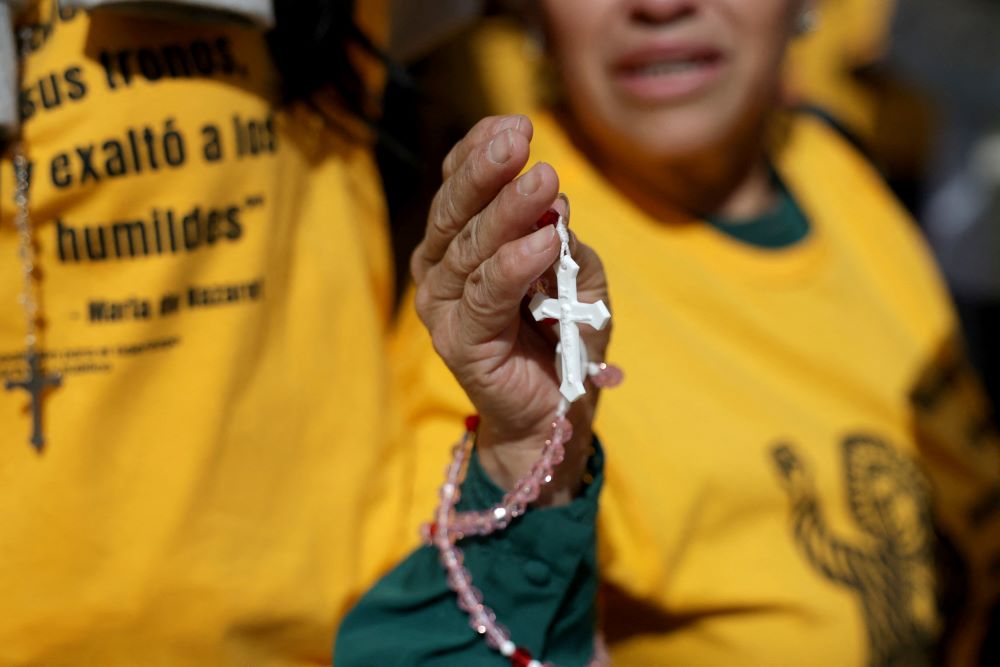
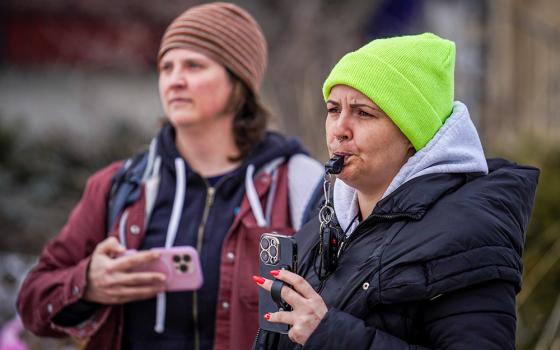
A woman holds a rosary as members of a Catholic group take part in a Eucharistic procession near the U.S. Immigration and Customs Enforcement Broadview facility in Chicago Oct. 11. The group had hoped to share Communion with detainees at the facility. (OSV News/Jeenah Moon, Reuters)
We need to be united in our messaging and we need to follow the lead of the Holy Father. The Holy Father has given us a framework to talk about these issues. We need to seriously consider that and look at what direction that he has given us. And I believe that there is a lot of interest in talking to the bishops right now, in making sure that we say something that is very, very direct and clear to our people. It's important. The whole understanding that the government should only be concerned about breaking a law in terms of coming into our country has to be challenged by the Gospel question of "Who is my neighbor? How am I neighbor to this person?" We have to bring our faith to this, not our politics, but our faith.
What kind of guidance are you giving both pastors and lay parish communities on how to accompany undocumented fellow Catholics who are fearing deportations and forced family separations — both spiritually and in practical solidarity?
I don't need to tell our pastors what to do. They're already doing it. I'm very proud of them. I think that they are picking up the slack. They're looking for ways to be sensitive to people. This weekend at the Mass that I have on television, we're celebrating "the Poor Souls Sunday," the feast of All Souls'. And I make the point that we have a connection to those people who are on the other side of the curtain between time and eternity, because they're poor, and the pope in Dilexi Te has said that if you really want to be holy, you have to be close to the poor. So our prayer for the poor souls is a matter of our holiness, but also our work for the poor who are on this side of the curtain of eternity also should be part of our holiness. We cannot pray for the dead who are poor souls if we don't also work for the poor souls on this side of eternity.
On Oct. 11 about 1,000 Catholics, including clergy, held a eucharistic procession trying to bring Communion to ICE detainees in Broadview, the outskirts of Chicago. They will soon gather there again, on Nov. 1, to celebrate a Mass. Would you consider joining them for future events like these? What do you think is the deep significance of these events?
I encourage people at the local level to take initiative. I have a certain role to play. I can't be everywhere, but I can encourage people and I think that an event like that has its own power without me being there all the time. So I will target where I'm going to be and what I'm going to say when, but I don't want to in any way discourage people from taking initiative just because I can't be there. I think those kinds of things should happen on their own. They're spontaneous; they're local, and they're very effective.
During that Oct. 11 Eucharistic procession, clergy were turned away when they tried to bring Communion to detainees at the Broadview ICE facility. What is your pastoral assessment of denying sacramental access in detention settings and would you use your office to press federal, state or local authorities to guarantee regular access for priests and pastoral ministers to detainees?
We have a very robust way in which we go into penal institutions, prisons, on a regular basis, to minister to people. And that has been a very good system for us. That should also continue at this moment with those who are incarcerated. This is a matter of religious freedom. I think that we do have a committee with regard to religious freedom that needs to look at this issue. And I know that there are several other issues that are happening now. I know that the Military Archdiocese has had some concern about the way that the government is restricting the ability for us to minister to people and I know Archbishop Broglio has talked about that. We should be able to minister to people who are in need and offer pastoral concern. To me, it doesn't seem that there is any harm to the government in allowing us to do that. And of course, it could be a benefit, because we could ease the tensions within those incarceration facilities if we are allowed to go in and minister to people.
Advertisement
With all the Catholic facilities, schools and hospitals that the church has at its disposal, do you think there is anything else practical that the church itself could make available to better serve immigrants who are in need of everything?
We have a very robust legal advisory program and we're working with other agencies to make sure that people have legal representation and that they know their rights. That has been going on for a good part of a year already. We've been preparing for that, so that kind of initiative where people are informed of their rights but also have access to legal representation, is something that we have invested in.
Immigration so often gets discussed in political or economic terms, but at its heart it's also a story of exile, hope and the search for home — themes that run throughout Scripture. How do you think the church is being called right now to rediscover the spiritual meaning of 'welcoming the stranger?' Do you ever fear that a significant portion of American Catholics are ignoring this teaching?
We always have to preach the Gospel. I would just point out that in the Holy Father's apostolic exhortation, he makes a very powerful statement. We cannot claim that we are pursuing holiness in life if we do not join in God's preferential option for the poor. I think that that is at the heart of the message that we have to have to our people. You cannot claim to be pursuing a life of holiness if you do not have a preferential option for the poor, the weak, the vulnerable, the people who are left out, who are discarded. And that's the challenge that we have to give to our people. Don't claim to be holy if you ignore the poor, if you see them as inconsequential, as unimportant to your life. That I think is a very powerful message. The point is that God has always had a preferential option for the poor. That's what Dilexi Te is all about. If you want to be holy, examine yourself in this regard.