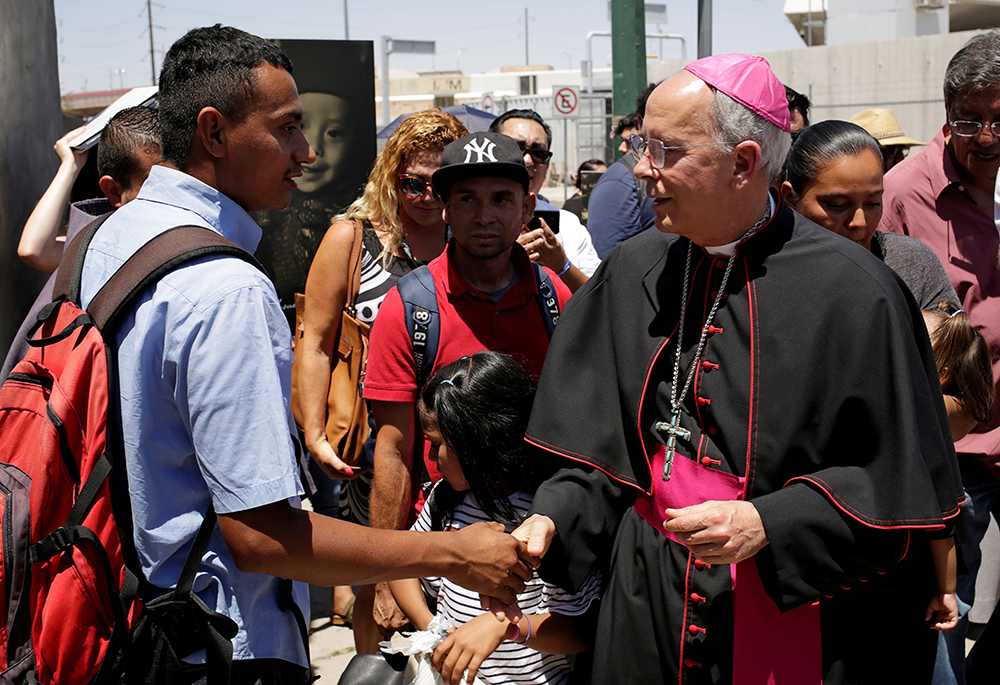
Bishop Mark J. Seitz of El Paso, Texas, greets a Salvadoran migrant in Ciudad Juarez, Mexico, June 27, 2019, who was deported after crossing the Paso del Norte international border from El Paso. (OSV News/Reuters/Jose Luis Gonzalez)

by Brian Fraga
Staff Reporter
In this city that sits along the U.S. southern border with Mexico, immigrant families are being torn apart by the Trump administration's mass deportation campaign, said El Paso Bishop Mark Seitz.
"People are suffering, and the effects of that suffering will have an impact on our country too, for many years to come," Seitz told the National Catholic Reporter during a Jan. 21 interview at his office in El Paso.
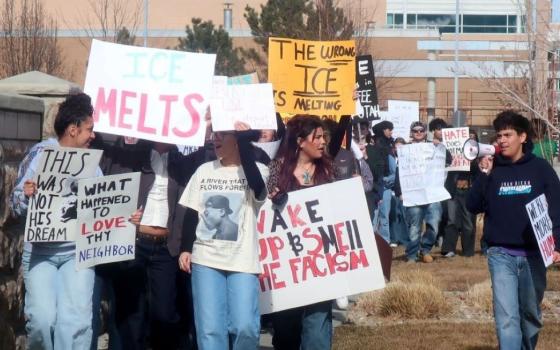
Seitz, 72, addressed the federal government's ongoing immigration crackdown, which in recent weeks has prompted widespread protests across the country, especially in Minneapolis, where federal immigration agents have shot and killed two people in the last three weeks.
"I'm horrified by what I see" in Minneapolis, said Seitz, who was appointed bishop of El Paso in 2013 and has been an outspoken advocate for immigrants and a vocal proponent of the Catholic Church's teachings on migration.
During his interview, Seitz commented on the Trump administration's hardline immigration policies and their effects on the border community in El Paso. He described his local church's efforts to accompany migrants during difficult times, shared his thoughts on the recent immigration statement from the U.S. bishops' conference and offered a solution for overcoming "a fear of the person we don't know."
The interview has been edited for purposes of length and clarity.
NCR: Has it surprised you to see the ferocity and relentlessness of the federal government's crackdown on immigration over the past year?
Seitz: Oh, it totally surprised me. Shocked me. I didn't think that the government would even be allowed to go as far as it's gone with all of this. I really thought that the limits on governmental power would prevent this kind of response. And it's very, very concerning. Sometimes it's hard for me to recognize my country.
What has bothered you the most about this crackdown?
It's hard to pick one thing. But, in a general sense, it's the total disregard for fundamental human rights. You know, when we talk about human rights, we're not just talking about the position of some activist. We're talking about something that's very fundamental to the teaching of the church, to the belief of not only the Catholic Church, but Christianity in general, and to people of faith even well beyond Christianity, and that is that human beings have a particular dignity because they are created by God.
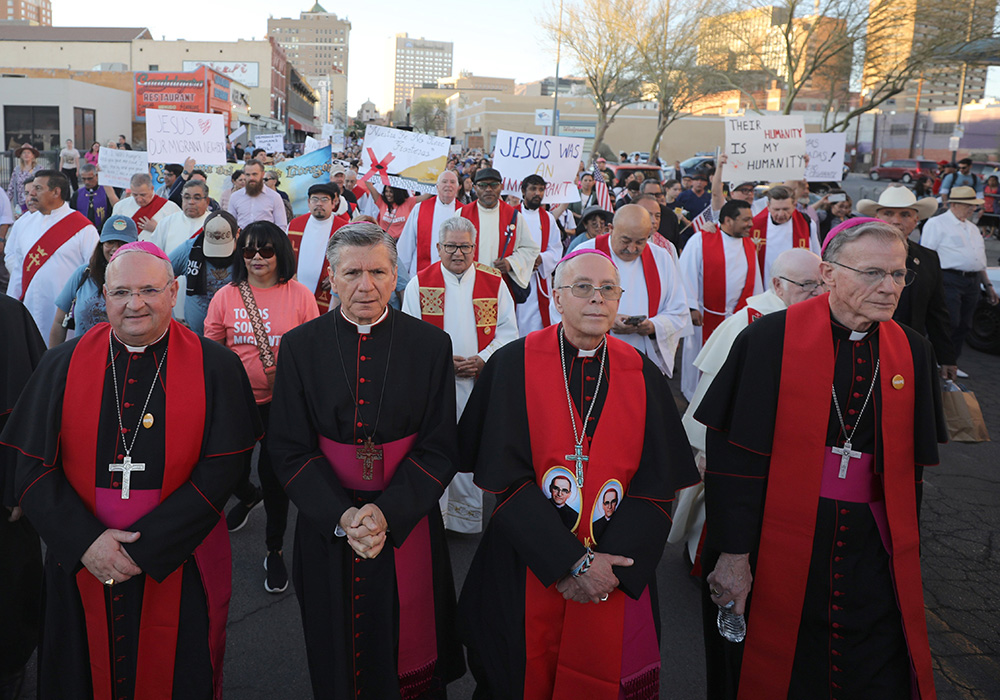
Bishop Peter Baldacchino of Las Cruces, New Mexico; Archbishop Gustavo García-Siller of San Antonio; Bishop Mark J. Seitz of El Paso, Texas; and Archbishop John C. Wester of Santa Fe, New Mexico, lead a march in El Paso March 24, 2025, against mass deportations by the U.S. government. (OSV News/Bob Roller)
What do you think of the recent violence that we've seen in Minneapolis related to the deployment of federal immigration agents there?
I'm horrified by what I see there. You know, it could well be that the reaction of people to [the federal government's] violent entrance into the community has also been over the top in some respects. We, as a church, certainly believe that people have a right to protest. You know, they have a right to express their concerns. But we don't believe that they have a right to violently impede officers of the law. The church would not turn a blind eye to those overreactions on the part of people.
But at the same time, we have to say what we're witnessing there is not in accord with what our Constitution calls for, and certainly not in accord with what the fundamental teaching of Christ and his church would be.
What have been the impacts of the administration's immigration policies on the El Paso border community that you shepherd?
People are traumatized here. And it's not only people who are working to regularize their [immigration] status. Even people who have their passports are fearful when they're out in this community, because we've seen examples of people being violently pulled from their cars before they were even asked the question about whether they were here illegally. The simple fact that they could be stopped, because they may be an immigrant, ought to be a great concern to all of us. The Constitution and its Bill of Rights, and our courts, through the years, have clarified that law enforcement cannot stop a person simply because of the color of their skin or the language that they speak. And those court decisions have been reaffirmed over and over again. But that appears to be what's happening. And so people aren't afraid for no reason. They are terribly afraid, and as I say, traumatized is not too strong a word, and their children are as well. When they go to school in the morning, they are left wondering, "Will Mom or Dad be there when I come home?"
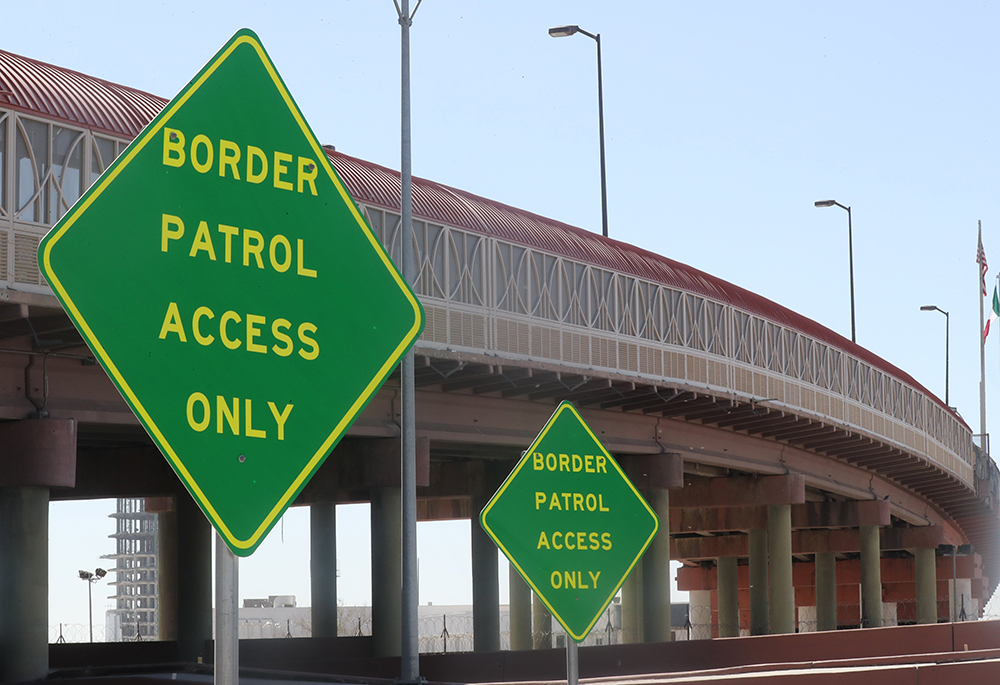
Signs are seen near the port of entry bridge in El Paso, Texas, to cross into Ciudad Juarez, Mexico, March 24, 2025, the day of a protest and vigil led by El Paso Bishop Mark J. Seitz against mass deportations by the U.S. government. (OSV News/Bob Roller)
What can the Catholic Church do to respond to the situation beyond issuing carefully prepared public statements?
Well here in El Paso, we're trying to do quite a bit. We have teams going out to neighborhoods and parishes to ask people how they're doing, especially trying to identify those families who lost breadwinners and to see if we can help them. That's kind of in its initial stages, but it's happening in a couple of parishes, at least.
We are visiting the detention centers. I'm celebrating Mass in Camp East Montana, which is the largest detention facility in the country. It has over 3,000 people now and it's growing. We celebrate Mass there every Sunday and I'm going most weekends when my schedule allows. And we're also sending out a team of priests to hear confessions there during the week.
We've also been trying to inform people in our parishes about their rights and what they should do if immigration authorities come to their door or stop them on the street, what they need to cooperate with, and what they don't need to say. All of those rights apply to people who are immigrants here. You know, it goes against the grain for a Latino to say, "We shouldn't answer the door unless there is a legal document like a search warrant." But they have to know that that's their right.
Advertisement
What can the church do to best advocate for and accompany migrants?
I certainly hope that Catholics will be leaders in the response to these violations to basic human rights and dignity. In order to do that, we in the church, obviously, have to do a better job of teaching our people about what the church has to say about this. It's so clearly laid out in Scripture, and in the long history of the teaching of the church, and certainly by all of our recent popes, going back to certainly Leo XIII, not to mention Leo XIV.
We hope that by being reminded of these fundamental teachings, that Catholics will be active in calling our nation to a return to that respect for human life and dignity that's laid out in the first document that created this country, the Declaration of Independence. So let's live it. Let's practice it now. The church will never tire of reminding the government of that, and we would hope that the citizens of this country would also do the same.
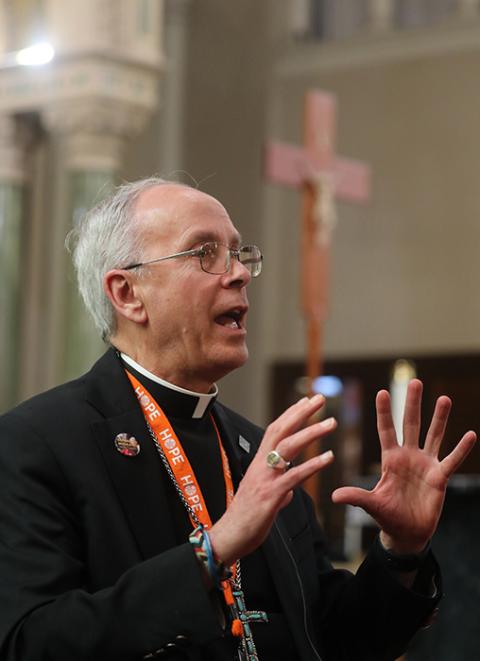
Bishop Mark J. Seitz of El Paso, Texas, gestures during an interview with an OSV News at St. Patrick's Cathedral in El Paso March 24, 2025, before leading a rally and vigil in El Paso in solidarity with migrants. (OSV News/Bob Roller)
This past November, the U.S. Conference of Catholic Bishops released a special message on immigration. What did you think of the statement?
I was thrilled with it. We were limited in the length of it. It couldn't say everything. But we worked so hard on it, to find something that all the bishops could come together on. You know, everybody has their own way of saying things or they may differ in their willingness to say things that would be considered confrontational. All of us have a different take on how outspoken perhaps we should be on these issues, but I have not met a single bishop in the conference who would say that this is not a serious concern, of what's happening in this country right now.
How did you come to be so outspoken on issues pertaining to immigration?
Well, first of all, I guess we can say I'm a passionate person. God has called me to be a pastor. And that implies that I care about people deeply. I care about their lives and their experiences, their well-being, especially on a spiritual level. You know, we are not a people who have one life of faith, and then another life in the world. The Incarnation means clearly that these two realities are joined. I care about people, and what they're experiencing, just like, I believe, my master did. When Jesus finished preaching and saw people who were hungry, he fed them. And he told the disciples to feed them. So, yeah, thank God he gave me this passion. And all of my life and ministry, I've tried to live that.
If you had known me when I was in Dallas, you would have known that I was very active in the pro-life movement, and I continue to be, although it's kind of overshadowed in what people see right now in the area of immigration. I'm going to speak at a pro-life conference in L.A. this weekend [Jan. 24], and I'm going to talk about immigration, because the church has this beautiful, totally consistent teaching about the dignity of the human person from conception to natural death.
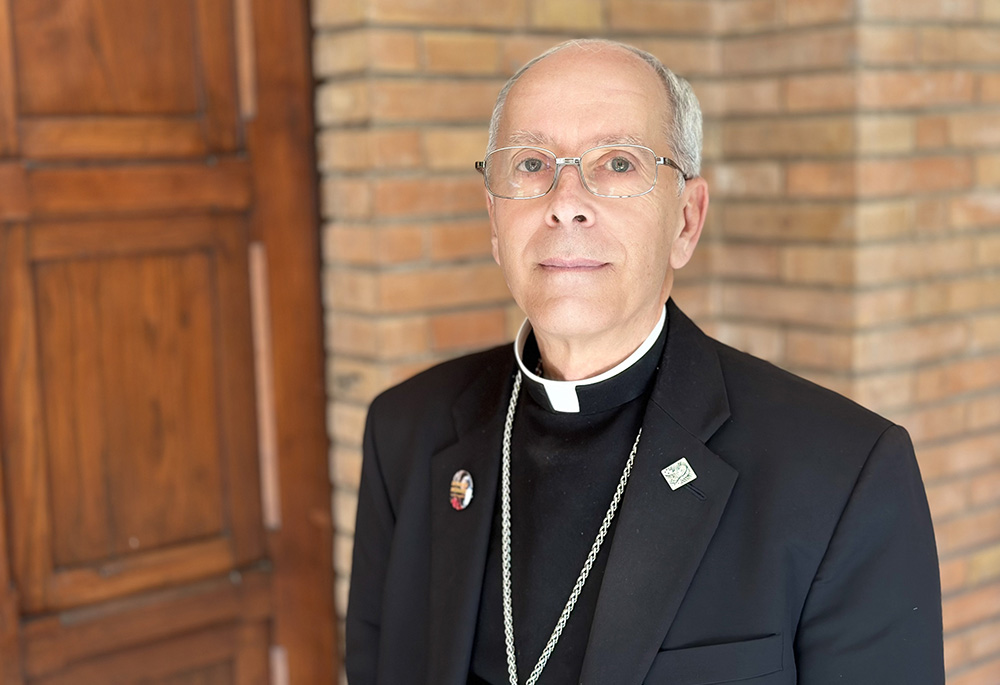
Bishop Mark J. Seitz of El Paso, Texas (CNS/Robert Duncan)
Can immigration be seen as a pro-life issue?
Sure. Every issue has its own unique aspects. I think abortion still has a particularly serious character to it, because it is the violent killing of a totally innocent human life. Somehow, we don't seem to grasp that.
Immigration, in a certain sense, should impact us in another way that is extremely serious. We need to come to grips with the fact that a child who is an immigrant, or an adult, or an elderly person who is an immigrant, is facing, at the very least, indirect threats to their very life. And the way that we're aggressively assaulting them in the process of arrest very often, in the way that we're treating them when they are in detention, and certainly, in the places that we're sending them back to, warrant some serious reflection.
In the majority of cases, they fled their country because they could not live there. In many cases, their lives had been threatened, or they couldn't support their family. They were starving. So now we're sending them back into circumstances even worse than when they left, because in order to escape that situation, they sold everything. And sometimes, when we're sending them back, they're being seen as traitors to their country and threatened to be thrown into prisons that are known to torture people. I know that for a fact.
Do you see anyone in our government today, expressing even the slightest concern for the well-being of those that we are treating that way? Not the least. It's incomprehensible.
Despite the church's teachings and recent statements from popes and bishops, various polls indicate that Catholics in the United States are deeply divided on immigration policy. Why do you think that is and is there a way out of the toxic polarization that we see on this issue?
Immigration does raise deep emotions. We have built into ourselves, probably from ages immemorial, a fear of the person we don't know. And sadly, I believe, politicians have, without conscience, tapped into that primordial fear. And they have been willing to characterize a whole broad group of people as violent criminals, rapists, and so on, when, in fact, that is a huge mischaracterization, to put it nicely.
Yes, people have come here who have not behaved well. But if you take the group as a whole, immigrants in general, and put them alongside people born in this country, study after study has shown that immigrant communities commit fewer crimes than nonimmigrant communities. So to characterize the whole group in that way, is absolutely a house built on cards, it's absolutely false.
That fear that we have, which is so strong, can be overcome rather easily because it's so false. And the way to do it, I believe, is to provide opportunities simply for people to meet the people they fear, to know them, to know their story. It doesn't take any rocket science. It doesn't take all kinds of complicated statistics. Just meet an immigrant in your community. Listen to their story and see if you think the same.