
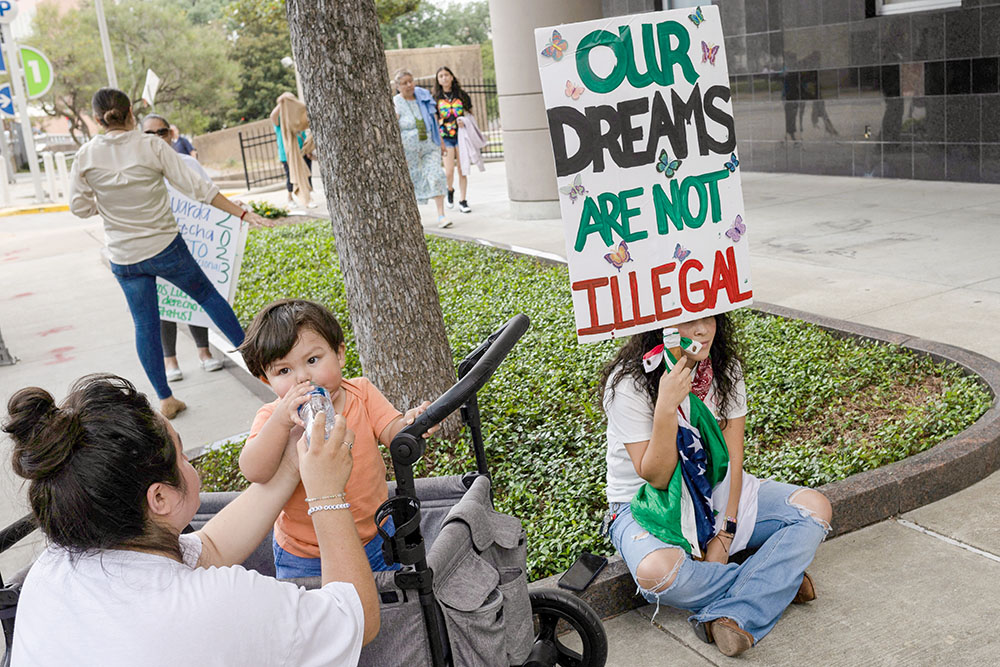
Brendaletzy Lopez, 30, a recipient of the Deferred Action for Childhood Arrivals policy, holds a placard that reads, "Our dreams are not illegal," ahead of a hearing on the DACA program, outside the federal courthouse in Houston June 1, 2023. Texas Catholic bishops say a federal court is poised to change the lawful presence of an estimated 90,000 DACA recipients in Texas to unlawful. (OSV News/Reuters/Adrees Latif)

by Brian Fraga
Staff Reporter
Texas is the only state that Corina Gonzalez has called home since she was brought to the United States as a 9-year-old girl from Mexico.
But Gonzalez, 31, and her husband may soon have to move to another state. Because they live in Texas, an upcoming court ruling is expected to strip them of the work permits they have through the federal government's Deferred Action for Childhood Arrivals (DACA) program.
"In the worst case scenario, if that becomes the case, then we'll have to move," Gonzalez told National Catholic Reporter in a recent interview. A nurse practitioner with a daughter in high school, Gonzalez described feeling "stressed out" at the prospect of relocating her family.
"At this point, we're just putting everything in God's hands," she said.
On Nov. 24, final briefings were due in the U.S. District Court for the Southern District of Texas, where Judge Andrew Hanen is set to rule on competing proposals for DACA, which has been the subject of federal litigation for almost a decade.
One of those proposals, submitted by the Trump administration, would make DACA recipients in Texas ineligible for the work permits offered by the Obama-era program. If Hanen approves that plan, DACA recipients in Texas will lose their income and career opportunities.
DACA recipients who move to Texas from other states could also see their work permits revoked.
"You're probably looking at a two-tiered DACA program where individuals in 49 states and the District of Columbia would benefit from work permits and protections from removal, except that the work permits would not be issued in Texas," said Pedro Alemán, a policy advocate at Catholic Legal Immigration Network Inc., known as CLINIC.
Alemán, who works on DACA-related issues for CLINIC's advocacy team, told NCR that the judge's ruling has the potential to trigger an "exodus" of DACA recipients from Texas that he said would cause major statewide disruptions in workplaces and communities.
"It will upend people's lives," Alemán said.
Advertisement
The Texas Catholic Conference of Bishops added that Hanen's ruling has the potential to "impact virtually every community in Texas" by removing the lawful presence of the nearly 90,000 DACA recipients who live in the state.
"We, the Catholic bishops of Texas, firmly resolve to respond with compassion and a call for justice for those who, through no fault of their own, are now being forced to abandon their homes, their livelihood and their communities," the bishops said in a prepared statement.
The difficult situation facing DACA recipients in Texas is the result of a legal back-and-forth saga that began in 2018, when Texas Attorney General Ken Paxton joined six other states to sue the federal government in an effort to end DACA. The plaintiffs argued that the program was illegal and financially harmed states because they provided social services such as driver's licenses to DACA recipients.
In January, the 5th Circuit Court of Appeals reviewed an earlier ruling that Hanen had issued where he found that DACA was unlawful. While largely affirming that decision, the 5th Circuit narrowed the ruling to apply only to Texas, saying that the state proved it was harmed by the policy.
Alemán said it was "an egregious mistake" for Texas to argue that DACA recipients are a financial burden to the state, noting that they work and pay taxes. Gonzalez, who lives in Dallas with her husband and daughter, added that undocumented immigrants are not eligible for public benefits such as Medicaid or the Supplemental Nutrition Assistance Program.
"I'm actually here paying taxes. I own a home, I'm paying taxes on that as well. I have my own insurance through my husband's job. We're here to contribute," she said.
In its January order, the 5th Circuit separated the issues of protection from deportation and work authorization and returned the case to the lower court to implement its order. Alemán said the judge's ruling will have to abide by the parameters of the 5th Circuit's instructions.
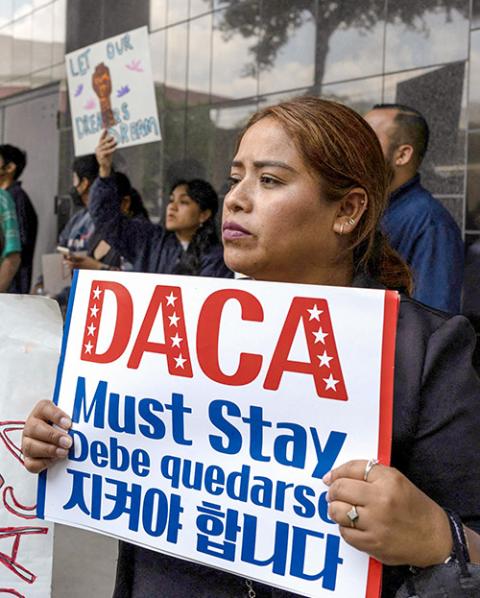
Beatrice Cruz of Arizona holds a sign in support of the Deferred Action for Childhood Arrivals policy after a hearing on the DACA program, outside the federal courthouse in Houston June 1, 2023. (OSV News/Reuters/Adrees Latif)
The judge "can either come out with a summary decision where he's going to decide this is how DACA is going to be implemented throughout the country and in Texas," Alemán said, "or he can just issue a notice to bring the parties together and then issue a ruling then. We don't know when that will happen but it will probably be soon after those briefs are submitted."
According to an Oct. 30 memo from the U.S. Conference of Catholic Bishops, the 5th Circuit's January order, in theory, still allows protection from deportation to be available nationwide for current and new DACA recipients. The order also opens the possibility for current and new DACA recipients, with the exception of those living in Texas, to request work authorization under the program.
On Sept. 29, the Trump administration submitted a proposal on how to implement the 5th Circuit's order. According to the filing, the administration said U.S. Citizenship and Immigration Services had developed plans to reopen DACA to new applicants in all states, except Texas. Because of litigation, DACA has been closed to new applications since 2021.
The administration's proposal also calls for the revocation of DACA work permits in Texas, though DACA recipients in the state would receive "forbearance from removal," meaning that the federal government would not pursue deportation proceedings against them. However, DACA recipients in Texas would not be considered lawfully present in the country.
That sort of legal limbo that Texas' estimated 90,000 DACA recipients stand to find themselves in prompted the state's Catholic bishops in their Nov. 4 statement to express their solidarity.
"It is contrary to the facts to claim that our state is harmed by DACA recipients lawfully working here," the Texas bishops said. "Instead, this kind of unprecedented and disruptive action by our government will harm our communities by fomenting fear, severing relationships, disrupting business and removing some of the most upstanding individuals from our community."
A DACA recipient for 10 years, Gonzalez was a young single mother who worked her way through nursing school to become a registered nurse. Now a married homeowner, Gonzalez said she and her husband, who is also a DACA recipient and works as an electrician, are facing a difficult choice.
"We'll probably have to establish residence in another state, where I don't know anything about, and that I didn't grow up in," she said. "But I'm pretty sure they would be happy to have people like us who want to have good careers and who want to contribute to the community."