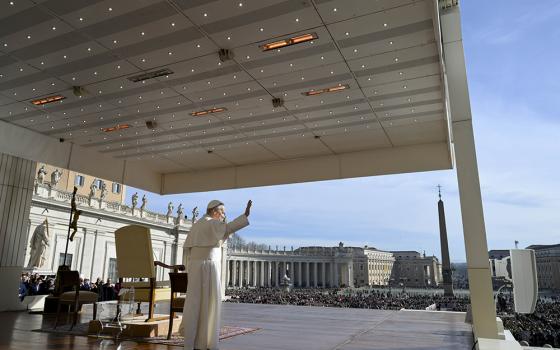
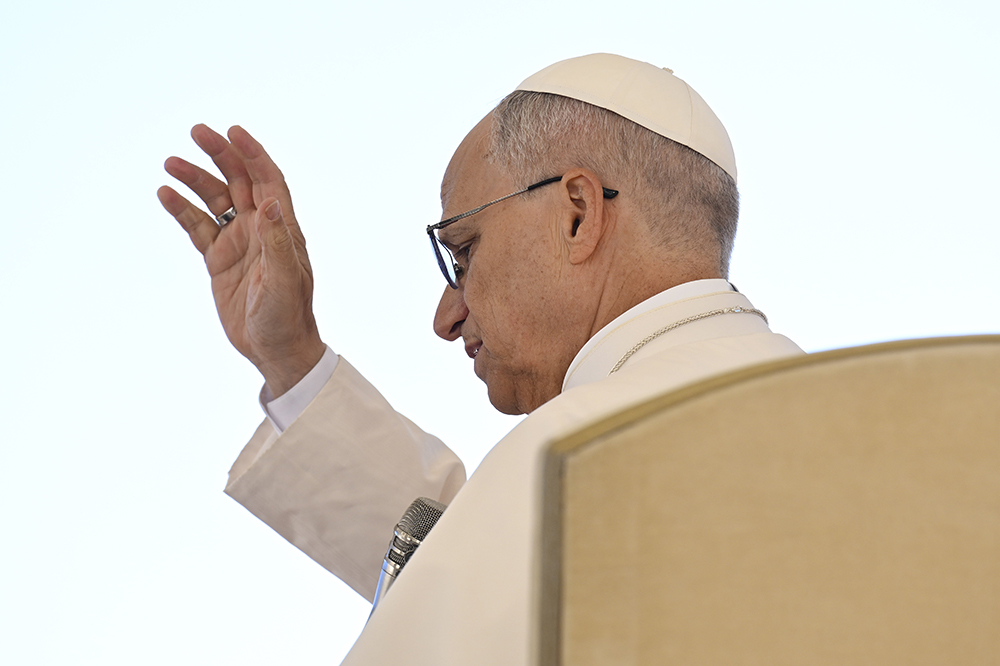
Pope Leo XIV gives his blessing at the end of an audience for the Jubilee of Migrants and the Jubilee of the Missions Oct. 4, 2025, in St. Peter's Square at the Vatican. (CNS/Vatican Media)

by Gustavo Arellano
While the world was celebrating the election of Pope Leo XIV back on May 8, I was enjoying a different type of billowing white smoke that day: fragrant plumes coming from the gigantic offset smokers at Heritage Barbecue in San Juan Capistrano, California.
The restaurant offers some of the best grilled meat you'll find in the United States specifically because it's not hidebound to tradition like too many pitmasters who think they're replicating a wooden shack in the Texas Hill Country but can't even reach the level of Arby's.
Chef-owner Danny Castillo is of Mexican American and white heritage. His No. 2 chef is Filipino. Castillo lets his multicultural staff incorporate their backgrounds — Mexican, Chinese, working-class white and so many more — into dishes so delicious and innovative that Castillo was a finalist in the California category of the James Beard Awards, the Oscars of the American restaurant industry.
Heritage stands across the street from Mission San Juan Capistrano, most famous nationally for the swallows that return every spring. It was established by Junípero Serra, the Spanish Franciscan who is officially a saint but one I don't recognize. His vision of Catholicism for California was antithetical to the one I was brought up in and the Gospel that Heritage practices. Serra and his underlings forced Indigenous converts into their Eurocentric world and sought to suppress their language, customs and traditions — a Puritanism that led to the deaths of tens of thousands of Indigenous people in what's now California and beyond.
There's no way to avoid the church when I eat at Heritage, so I appreciated God's humor that Leo's election happened on a day I met a friend for lunch. If I still didn't get the message that God really wanted me to reflect on my religion over my brisket, he saved the best joke for last: On the way back to my car, I saw a luxury tour bus parked outside the mission. The brand of its manufacturer was etched on its chromed bumper: Prevost, the surname Leo was born with.
Advertisement
News of the first pope from the United States brought me joy that escalated seemingly every hour as more details emerged about Leo. He offered comments in fluent Spanish at St. Peter's Square during his first speech because he had long ministered in Peru — that made him an honorary Latino in my book. He was a native of Chicago, the City of the Broad Shoulders — people from there always know how to grind through the difficulty of life and overachieve, which is what we Catholics need in a modern-day pontiff. His Holiness was a White Sox fan — which definitely made him a voice for the downtrodden!
But it was maybe a few days later when my happiness about Leo turned into exultation when news emerged about his family background. His paternal grandparents were immigrants from Italy and France. His maternal grandparents were of Creole heritage who were listed as "mulatto" in the 1900 U.S. Census when they lived in New Orleans but switched to "white" upon moving to Chicago in the 1920s.
Here was a truly American pope, and not a moment too soon. Across the world, strongmen like Donald Trump speak darkly about immigrants "poisoning the blood" of their countries. They push myths about a purity of national character as rationale for xenophobic campaigns against newcomers that tap into this country's darkest times. Since the summer, Trump has sicced a toxic alphabet soup of federal agencies — ICE, ERO, CPB, DHS and too many others — on Latino communities across the country under the lie that they're invaders.
It's a dystopian worldview that's the opposite of the America I grew up in and that I'm a part of — my late mom was fairer than most so-called whites, while my formerly undocumented dad bears the dark skin of Indigenous ancestors we know next to little about. Yet in the eyes of too many Americans, we're nothing more than Mexicans.
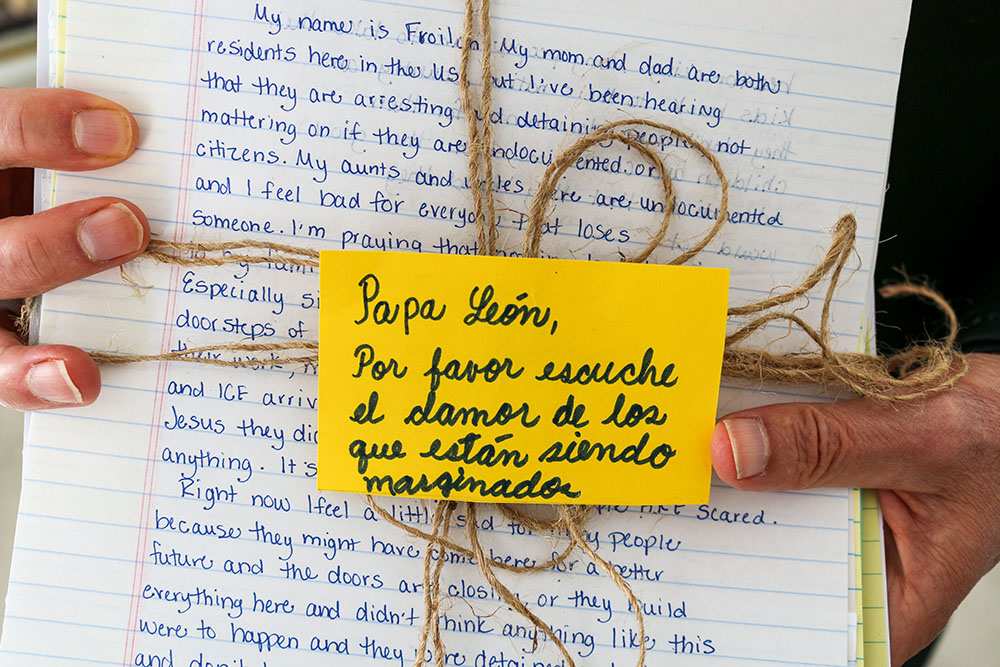
Bishop Mark Seitz of El Paso, Texas, holds a bundle of letters to Pope Leo XIV from migrants in the United States before presenting them to the pope Oct. 8, 2025, during an audience at the Vatican. The note, in Spanish, says, "Pope Leo, please listen to the cry of those who are being marginalized." (CNS/Courtesy of Hope Border Institute)
My America is that of what Catholicism became in the United States after the sins of Serra: a faith founded on immigrants whom church fathers largely encouraged to hold on to their own national devotions and customs because all our parallel roads led to the glorious roundabout that is Mother Church. Yet too many Catholics have forgotten this past or just don't care for it anymore — 55% of us voted for Trump, according to the Pew Research Center, although certainly not me or my family.
Leo has forcefully pushed back against the Trump administration's narrative. In October, he told a delegation of immigration advocates — including Bishop Mark Seitz of El Paso, Texas — that the church cannot remain silent on deportations. In a separate speech, Leo said that abuse of migrants was "not the legitimate exercise of national sovereignty, but rather grave crimes committed or tolerated by the state."
But there's one key issue that Leo still hasn't spoken much about: his own family's story. I hope he does, because it represents the church at its best and one the faithful and outsiders need to hear more than ever — it's one that many of us have lived or are living in a country that increasingly doesn't want to hear it.
His ancestors moved from Louisiana to Chicago at a time where people of Black heritage were fleeing the terror that was Jim Crow — refugees, in other words. At some point, they "passed" as white to let their children have an easier chance at the American dream. Leo and his brothers were able to live in a multicultural city that sadly remains too segregated — maybe that's why he joined the Augustinian order, one that preaches service to others.
His paternal grandparents were immigrants from Italy and France. His maternal grandparents were of Creole heritage. Here was a truly American pope, and not a moment too soon.
The young Robert Prevost went to Peru, a country that has sent hundreds of thousands of people to the United States. He had a street-level view of those who leave everything for another land. They are not criminals; they are not leeches. They are the people of which Jesus said in Matthew's Gospel, "Truly I say to you, as you did it to one of the least of my brethren you did it to me."
To Leo, strangers and sojourners are "privileged witnesses of hope" who can "revitalize ecclesial communities that have become rigid and weighed down," as he proclaimed during a speech this summer for the World Day of Migrants and Refugees. Those remarks were characteristic of the pontiff's style so far: kind, aspirational and grounded in the idea that everyone can have a stake in the Word.
I pray that Leo gets a bit more of his predecessor and lash out at the racist tyrants of today across the globe, but I'm not holding my proverbial breath. It doesn't seem to be his countenance, and that's fine — every pope should be their own pontiff.
But at the very least, I hope he practices the journalistic adage of showing, not telling. By highlighting his heritage, Leo can show that people of "impure" racial backgrounds are just as worthy of love and respect as anyone else, that humans more often than not leave their homelands to better life for themselves and their new neighbors.
"Let us invoke the Spirit of love and peace," Leo concluded in his Pentecost homily, "that he may open borders, break down walls, dispel hatred and help us to live as children of our one Father who is in heaven."
Help us get closer to that ideal, Pope Leo, by invoking the story of you.