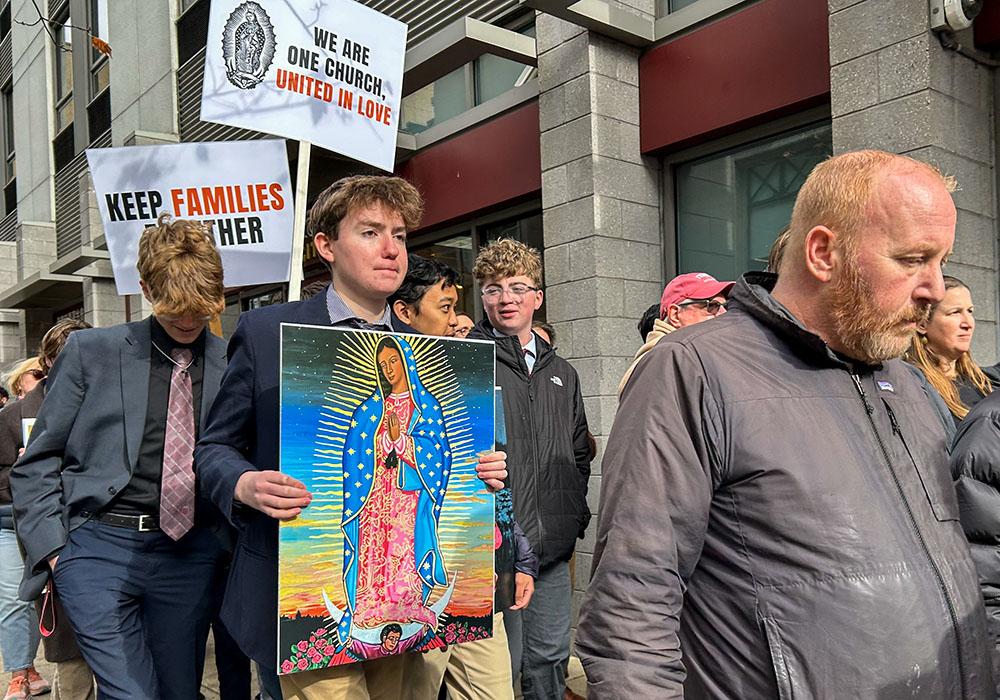
A student holds an image of Our Lady of Guadalupe during a Nov. 13, 2025, prayer vigil and eucharistic procession for immigrants outside of the Immigration and Customs Enforcement Office in Philadelphia. The vigil was one of several held across the nation that day as part of the "One Church, One Family" initiative, a grassroots effort launched by several Catholic entities. (OSV News/Gina Christian)

by Rigoberto Caloca Rivas
As an immigrant who has spent nearly five decades working alongside immigrant families in the United States, I've seen how migration reshapes lives, communities and entire regions. I've witnessed the resilience of people rebuilding their futures, the quiet contributions they make to local economies and the daily challenges they face navigating systems never designed with them in mind. These experiences have taught me that migration is far more than a headline or a talking point. It is a human story, an economic force and a global reality that deserves a deeper, more thoughtful conversation.
María's story brings this reality into focus.
She migrated so her children could stay alive. Her story is not an exception — it is the human reality behind today's immigration headlines. She fled Guatemala after drought, hunger and economic collapse made survival impossible. Leaving her children behind was the most painful decision of her life but migration was the only way to keep them alive.
After a dangerous journey north, she found steady work cleaning houses and began sending money home. Her remittances stabilized her family's food supply, paid for medicine and kept her children in school. Over time, they repaired their home, bought a small refrigerator and watched their oldest daughter pursue nursing.
As María rebuilt her life, she found more than a job — she found a community. A local Catholic parish welcomed her, helped her navigate legal resources and offered the sense of belonging she had lost. She began volunteering at parish events and soon became a quiet leader among immigrant women facing similar struggles. What began as an act of desperation became an engine of renewal for her family, her hometown and the immigrant community she joined.
Advertisement
Immigration has shaped the United States from its earliest beginnings. The same dreams of freedom and opportunity that drew people across oceans centuries ago continue to draw newcomers today. Their labor built railroads, harvested crops, staffed factories, launched businesses, and fueled scientific and cultural innovation. Immigration has never been a side story — it has been a driving force behind America's economic dynamism and demographic renewal.
One part of this history is often overlooked — the quiet, faithful presence of the Catholic Church walking alongside immigrant communities. Long before our current debates around immigration, the church was present in the neighborhoods, fields, shelters and border towns where newcomers first arrived. For generations, Catholic parishes, religious orders and lay leaders have offered what governments could not — community, language support, spiritual grounding and a sense of dignity during moments of profound uncertainty. From the Irish and Italian immigrants of the 19th century to today's Latino, Asian, African and Middle Eastern families, the Church has been a place where newcomers could breathe, belong and begin again.
Welcoming the stranger is central to who we are as Catholics and who we must be as a nation. At a time when fear speaks loudly in politics, workplaces and neighborhoods, the church's prophetic voice must rise above the noise.
The U.S. bishops' 2025 special pastoral message on immigration speaks directly to this moment. Their words echo what many of us witness daily: families bracing for uncertainty, children afraid to go to school, and communities shaken by enforcement actions. Their message is clear and urgent: "We oppose the indiscriminate mass deportation of people." They call for an end to "dehumanizing rhetoric and violence, whether directed at immigrants or at law enforcement."
The Gospel calls us to something far more demanding: to recognize Christ in the migrant and to act accordingly, even when it is inconvenient, unpopular or politically costly.
In moments like these, the church's mission becomes even more essential. Governments issue visas and deportation orders, but they cannot determine a person's worth. The church insists that dignity is already established by the Creator.
As this story unfolds, the deeper question is not whether immigration will continue to shape our nation — it always has and always will — but whether we will allow fear to shape our response. Fear narrows the heart. It blinds us to the image of God in our neighbor. It tempts us to trade compassion for control and to mistake cruelty for strength. The Gospel calls us to something far more demanding: to recognize Christ in the migrant and to act accordingly, even when it is inconvenient, unpopular or politically costly.
This moment will test the moral imagination of our country and our church. The choices we make now, in our parishes, our communities and our public life, will reveal whether we truly believe what we proclaim.
If we say every person is made in the image of God, then we cannot remain silent when that dignity is denied. If we say families are sacred, then we cannot look away when they are torn apart. If we say the Gospel still speaks to our world, then we must allow it to speak through us.