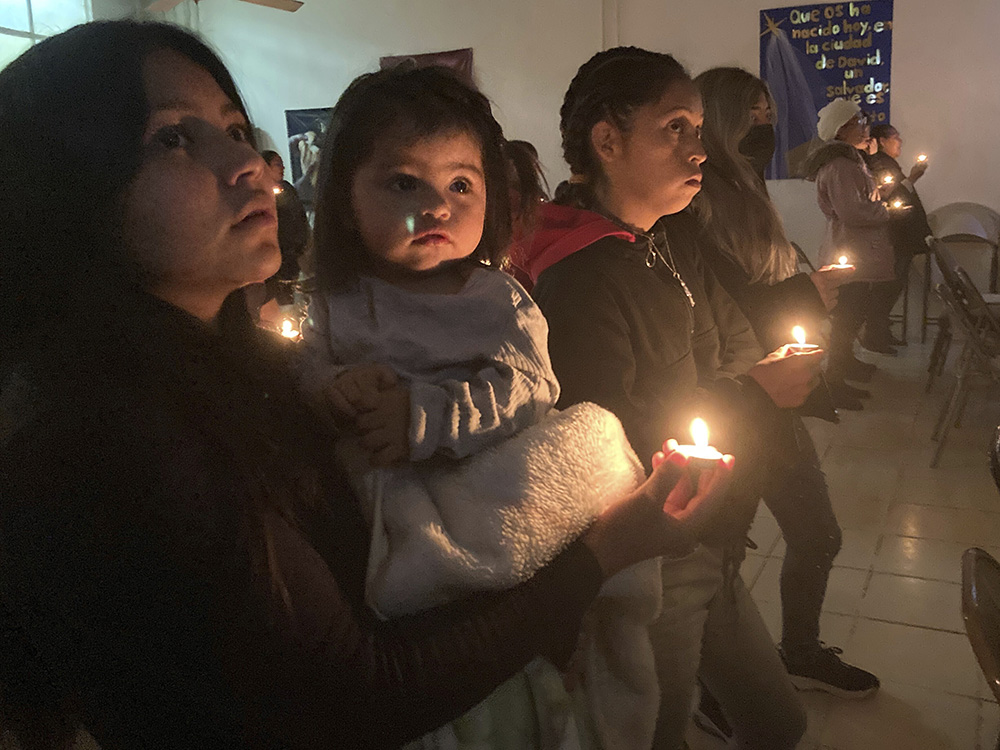
Guests at the Buen Samaritano shelter for migrants participate in a candle lighting ceremony in anticipation of Christmas in Ciudad Juárez, Mexico, across from El Paso, Texas, Dec. 22, 2022. (AP/Morgan Lee)

by Yolanda Chávez
For migrants, returning to the story of Jesus' birth is not just a devotional gesture, but an act of memory. Christmas, read through the experience of human displacement, reveals a truth we often prefer to soften: Jesus was not born at home.
He was born in transit, out of place, without belonging to any secure space. Mary and Joseph were not traveling by choice, nor driven by the romantic notion of a spiritual journey. A decree set them in motion. A political decision forced them to leave, far from their support networks, their history and the minimal protection that familiarity provides.
The road was not pilgrimage; it was imposition. And the birth took place in exposure.
The lack of lodging is not a pious detail of the story. It is not a romantic anecdote nor a pastoral backdrop. It is structural exclusion. "There was no place for them" does not mean they arrived too late; it means they did not count. They were not a priority. There was no space for their bodies, for their exhaustion, for the vulnerability of a woman about to give birth.
God does not correct this precarity from the outside; God agrees to be born there.
The mystery of the Incarnation does not unfold at the center, but at the margins; not under a roof, but exposed; not protected, but vulnerable. God chooses to enter history without guarantees, entrusting his body to displaced parents and his first breath to exposure to the elements.
That is why Jesus does not merely resemble today's migrants and displaced people; Jesus is with them. He shares their uprootedness, their fear, their lack of place. His body is born already marked by transit, by borders, by the absence of refuge. From his very first day, the life of the incarnate God is bound to those who have nowhere to stay.
Advertisement
Christmas, read from the migrant experience, is not the celebration of an idealized birth but the revelation of a God who inhabits human exposure and turns it into a place of encounter. A God who does not wait for adequate conditions to become present. A God who does not settle into safety, but accompanies from within fragility.
And the image remains with us: a child born outside a home, wrapped in the fragility of those who do not count, breathing for the first time on foreign ground.
There, in exposure, God speaks: "Here I am." Not in palaces, not in full houses, not in the security of those who count.
"Here I am" in the tired body of a displaced woman, in the trembling hands of a homeless father, in the open night where no one promises anything.
"Here I am," where there are no papers that protect, no walls that shelter, no doors that open.
"Here I am" in every child born in transit, in every life that finds no place, in every border where fear learns how to breathe hope.
Since then, God has not abandoned exposure; God inhabits it. God accompanies it. And God names it home.