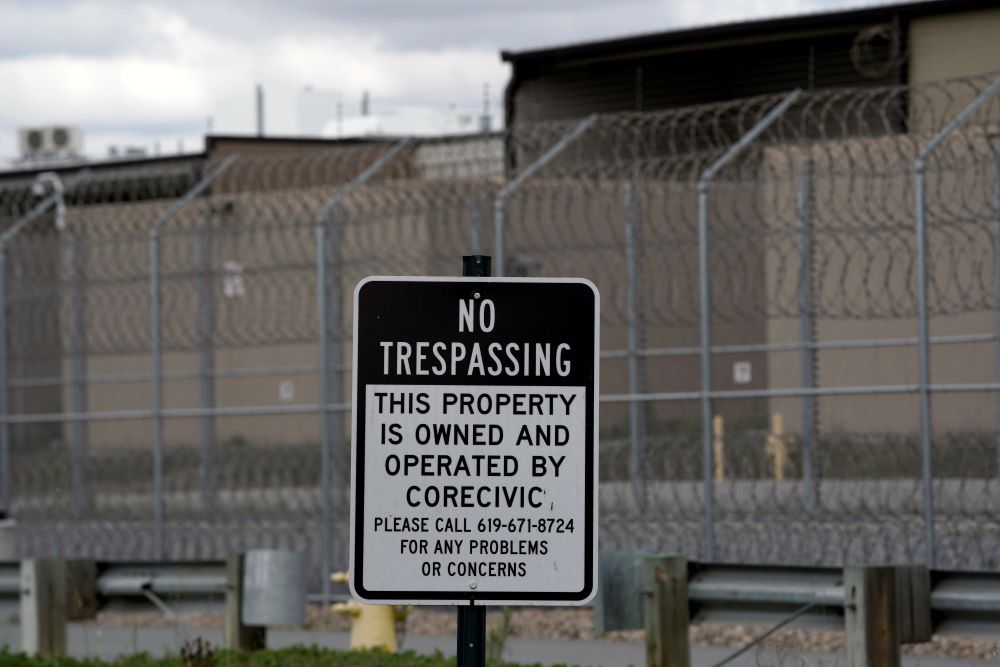
The Otay Mesa Detention Center, an Immigration and Customs Enforcement federal detention center in San Diego, Calif., is pictured April 11, 2020. (CNS/Reuters/Bing Guan)

by Steve Miller
Editor's note: The development company owned by brothers Terry and Ryan Anderson, Platform Ventures, has announced that it is not currently considering any offers on the Kansas City, Missouri, facility thought to be under sale for use as an immigrant detention center.
In a column the National Catholic Reporter published online on Feb. 4, Melinda Henneberger criticizes a proposed immigrant detention facility planned for Kansas City, Missouri, describing it as morally indefensible and contrary to Catholic social teaching. She highlights the involvement of a company owned by parishioners of Visitation Parish in Kansas City and places the parish at what she calls the "uncomfortable center" of the controversy, urging moral pressure on the parish community as a form of accountability. "And, we know who does shame better than anyone, don't we?" writes the author.
I share the author's outrage at the suffering inflicted on migrants — and I would go further. What is unfolding through current immigration enforcement, and through the proposed detention facility, is an organized indifference to human dignity that should trouble every conscience. Nothing in what follows should be read as a defense of ICE, the facility or the corrosive moral logic that normalizes cages, contracts and profit as routine business.
My concern is narrower, but important. The column's framing risks assigning moral responsibility to a parish for actions it neither initiated nor controls, and it does so by inviting the parish into a posture of public shaming. That move misunderstands both how parishes function and how moral accountability is most faithfully pursued within the Catholic tradition.
I write with two relevant affiliations that require transparency. I am chair of the board of the National Catholic Reporter, and I am a 60-year member of Visitation Parish. I strongly support NCR's editorial independence, and I would not want it otherwise. I had no knowledge of this column prior to publication. The board sets the mission and hires the CEO/publisher, who in turn hires the executive editor, who makes editorial decisions. We do not preview, direct or interfere with editorial decisions. That separation is essential to NCR's credibility and its ability to pursue hard truths without fear or favor.
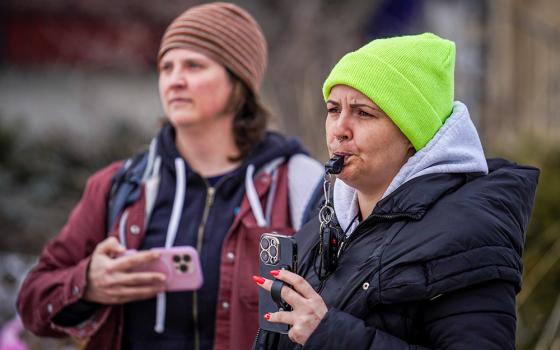
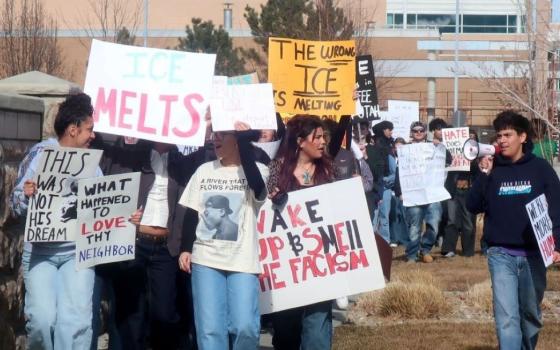
My issue: The column's framing landed not only on individuals but on an entire worshiping community. Parishioners arriving for Mass encountered an off-duty police officer engaged because protests had been threatened. Outside, I spoke with two protesters — thoughtful, committed Catholics and longtime NCR readers — who came because of the column. Our conversation was respectful and grounded in a shared moral concern for migrants and the vulnerable.
That context matters. Visitation Parish has a long record of concrete social engagement: a multi-decade partnership with a parish in El Salvador; an active Racial Justice Committee shaped by Pope Francis' teaching and the U.S. bishops' 2018 pastoral "Open Wide Our Hearts"; ongoing formation in Catholic social teaching; and collaboration with Kansas City's oldest historically Black Catholic parish through KC Catholics Addressing Racism. These are not reactive gestures but sustained practices that advance the very values — welcome, dignity and solidarity — at the heart of this debate.
What concerns me is the suggestion that Visitation Parish should therefore stand at the "uncomfortable center" of this controversy and act as an agent of public pressure against individual parishioners. That suggestion raises two problems.
First, it blurs the distinction between personal accountability and institutional complicity. Parishes are moral communities. They form consciences through preaching, education, prayer and service. They do not exercise authority over their members' private business decisions, including those of major donors. To suggest otherwise assigns a kind of collective responsibility that may feel morally satisfying but is neither accurate nor ultimately effective.
Second, it misunderstands the pastoral vocation of a parish. Visitation, like most parishes, is a diverse community — politically, culturally and economically. People of influence worship alongside people who are struggling. Catholics across the spectrum come to the same Eucharistic table. In that setting, a parish must proclaim the demands of the Gospel clearly, especially for the stranger and the marginalized. But a parish that becomes an instrument of public humiliation ceases to be a school of discipleship and becomes something else entirely.
Advertisement
This is not a call to soften moral critique. Individuals with power should be challenged when their actions contradict Catholic social teaching. Institutions should be held accountable when they enable injustice. The question is one of accuracy and framing: When does affiliation illuminate a story, and when does it collapse individual responsibility into collective blame?
There is also a practical concern. If parishes are expected to publicly police the private conduct of members, where does that expectation end? Do pastors adjudicate employers, investments, political choices or business relationships as conditions of belonging? That road does not lead to conversion. It leads to fear, faction and a community held together by pressure rather than by the slow, demanding work of moral formation.
If conversations with individuals are needed, the Gospel offers a path that begins with direct, personal engagement and aims at repentance and repair — not spectacle. And if civic action is required, there are appropriate democratic channels: organizing public comment, zoning and permitting processes, elected leadership, journalism and sustained advocacy. Many Catholics, alongside neighbors of other faiths and none, are rightly working in those arenas now.
I offer these reflections with respect for NCR and for the author's moral urgency. My hope is simply that, as we pursue accountability, we do so with care — distinguishing between person and institution, between moral clarity and collective blame, and between prophetic witness and the temptation to use shame as a tool.
Kansas City needs the best of our Catholic tradition right now: courageous solidarity with migrants, unwavering insistence on human dignity and communities that form consciences for the long work of justice. That is work our parishes, our civic institutions and our Catholic journalism can and must each do — clearly, faithfully and in their proper roles.