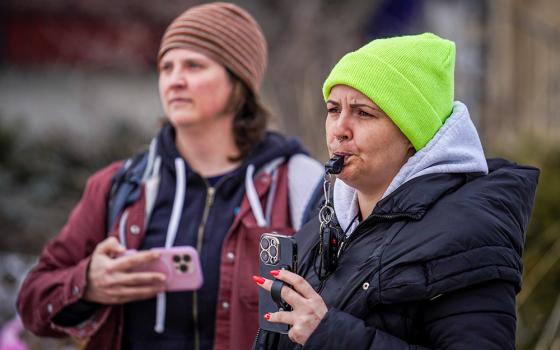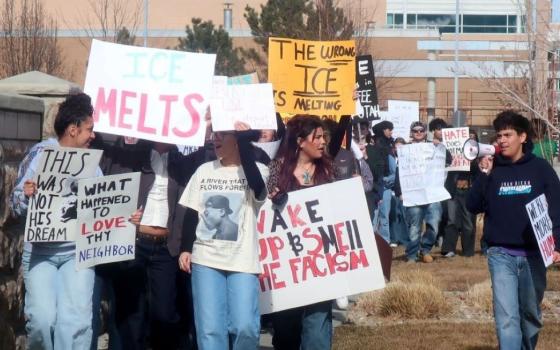
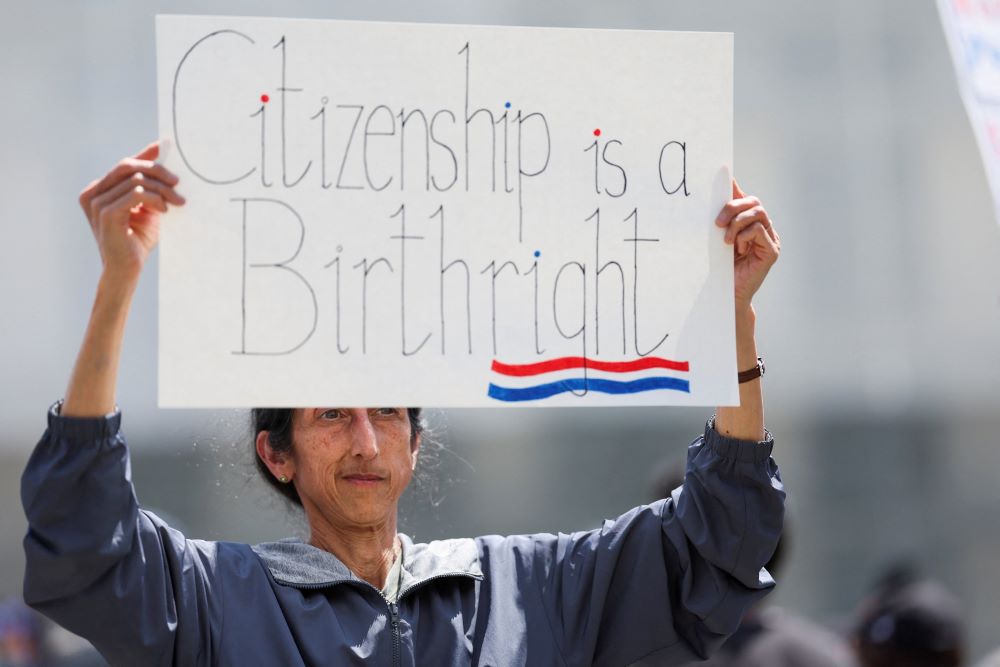
A demonstrator holds a sign as people protest on the day Supreme Court justices hear oral arguments over U.S. President Donald Trump's bid to broadly enforce his executive order to restrict automatic birthright citizenship, outside the U.S. Supreme Court in Washington May 15, 2025. (OSV News/Reuters/Leah Millis)

by Tom Faletti
The Supreme Court has agreed to hear oral arguments this spring on President Trump's executive order ending birthright citizenship, with a decision expected by June or early July.
Some people think this debate is all about immigrants. They are mistaken. If Trump succeeds in eliminating birthright citizenship, anyone's citizenship might be challenged.
"But I'm a natural-born citizen," some might respond — using words straight out of the Constitution. "I was a citizen when I was born. Birthright citizenship is about women trying to sneak across the border to have a baby here. It's not about me."
While the president does try to justify his executive order abolishing birthright citizenship by referring to babies born to recently arrived mothers, his executive order goes further.
The order takes citizenship away from children born here even if their mothers have lived here for decades. It also takes citizenship away from children whose mothers were here lawfully when the baby was born, if the mother was here on a temporary stay. This violates the 14th Amendment, which clearly states that anyone born in the United States and subject to the jurisdiction of the United States is a citizen.
If the president can choose who has a right to birthright citizenship and who doesn't, then it's not a right anymore. In fact, the executive order does not even acknowledge citizenship as a right. Instead, it refers to citizenship as a "gift" and a "privilege." Who gets to give this "gift" or withhold this "privilege"?
If the president can choose who has a right to birthright citizenship and who doesn't, then it's not a right anymore.
According to the executive order, the government gets to decide whether a person has the "privilege" of being a citizen. That means that Trump or any future president could add to the categories of people who don't have the "privilege" of being a citizen.
The U.S. Catholic bishops have issued a position statement taking a clear stand in favor of birthright citizenship: "The Church opposes the repeal of birthright citizenship because it would render innocent children stateless, depriving them of the ability to thrive in their communities and reach their full potential." In a letter to Congress in 2024, the bishops supported legislation that would expand the protection of stateless people, not expand the rolls of the stateless.
But this debate is not just about isolated children in unusual circumstances. It affects all Americans.
If the president can decide who has the "privilege" to be a citizen and who does not, then even natural-born citizens do not have a right to citizenship, and everyone is at risk. Trump has already said that he is considering taking away the comedian Rosie O'Donnell's citizenship, so this is not an abstract idea. There is no telling how far a current or future president might go beyond the current executive order.
That's why this is about far more than mothers sneaking across the border. Future presidents could use this new power to try to shut down anyone who opposes them. For example, if you criticized the president, the government could retaliate against you by demanding that you provide proof of your citizenship or face incarceration and deportation.
Your driver's license is not proof that you are a citizen. Without birthright citizenship, even your birth certificate would no longer be proof. The government could demand that you provide evidence that your parents fit in the privileged categories so that you had the privilege of being considered a citizen when you were born. Could you provide that evidence?
Advertisement
The point is this: Without birthright citizenship, a birth certificate is no longer the end of the story. The burden of proof falls on you to demonstrate that you have the "privilege" of being a citizen according to criteria chosen by the president.
You might end up in court, trying to prove your citizenship. Some American citizens have already been arrested and detained by the current administration. You might eventually prevail in court, but the process could totally disrupt your life.
Letting the president usurp this power could chill free speech because people might hesitate to question the government if they knew they could become a target of retaliation. The executive order may not affect you now, but it could be expanded and used to threaten the citizenship of any "natural-born citizen" the government wishes to silence.
Members of Congress should be equally concerned. The end of birthright citizenship would give any president of any party a new tool to silence legislators or force them to bow to the president's will. Our leaders in Congress need to speak out against the idea that birthright citizenship is a "privilege" and work to protect everyone's right to birthright citizenship, because if this moves forward, everyone's citizenship is at risk. Even theirs.