
U.S. House Speaker Mike Johnson, R-La., speaks with reporters as the House votes to end the partial government shutdown on Capitol Hill in Washington Feb. 3, 2026. (OSV News/Reuters/Kylie Cooper)

by Mathew N. Schmalz
At a press conference on Tuesday, Feb. 3, House Speaker Mike Johnson was asked about Pope Leo XIV's criticism of the Trump administration's immigration policies. Johnson responded with Bible verses justifying respect for a nation's borders and laws, which he elaborated in a lengthy Facebook posting.
Johnson is Southern Baptist and I'm Roman Catholic. I recognize him as my brother in Christ. And I recognize the kind of Christianity he's talking about.
It's the Christianity of the Roman Empire. It's the Christianity of the state. It's Christian nationalism.
And I see the threat that must be resisted now, as always. To understand this shift, it's important to consider Christianity as Speaker Johnson sees it.
Johnson argues that the "Left" has exploited the command of Leviticus 19:34 to love the stranger. In his view, the biblical admonition to be hospitable applies only to individuals, not to government. The government, as he sees it, is a separate entity that exists to protect human beings in a dangerous world.
Johnson's position clearly draws on a Christian theological pedigree. Its emphasis on individual moral responsibility is distinctly Protestant and distinctly American.
But if he really wants to build his argument on Scripture, Johnson must contend with more challenging passages from the Hebrew Bible. Take, for example, the story from the Book of Judges in which a host offers his own daughter to ruffians in order to safeguard his guest.
Hospitality as described means putting ourselves and others at risk.
Beyond the rhetoric, what strikes me are the gaps and contradictions in Johnson's defense of deportation.
Advertisement
Johnson does not clarify how the government should wield the "sword" he attributes to civil powers based on a passage from St. Paul's Letter to the Romans. I would be interested to hear what his Christian beliefs say about warrantless entry, the use of children to lure their parents into the arms of ICE agents, the detention of American citizens and the use of violence — including lethal force — against Americans who, in the view of many observers, were exercising their constitutional rights.
The "sword" can protect the defenseless; it can also harm them. Similarly, power isn't inherently good or evil. And so, I believe that if the end goal is biblical, the way we pursue the end goal should be biblical as well.
Johnson also faults America's immigrants for not following the biblically sanctioned obligation to assimilate and follow their host country's laws. But depending on your Christian perspective, America is either "too woke" or "not woke enough." Take whatever position you want as a Christian — right or left — but there are many reasons not to assimilate into mainstream American culture. And what about Christians in other countries hostile to Christianity? Should they assimilate and submit or should they stand firm and resist?
The speaker leaves many questions unanswered. And that's where the Christian nationalism comes in.
Johnson continues to criticize the Biden administration and the "progressive Left" for allowing illegal immigration. This rebuke is designed to support a political agenda, with specific beneficiaries and targets. Christian obligation is individualized; the state's coercive power is maximized. In fact, the dynamics of power favor the state's ability to place religion at its service.
Johnson is performing a real sleight of hand, a sorcerer's trick.
He's drawing boundaries, building walls and promoting a false narrative in the name of protecting America as a homogenous Christian nation.
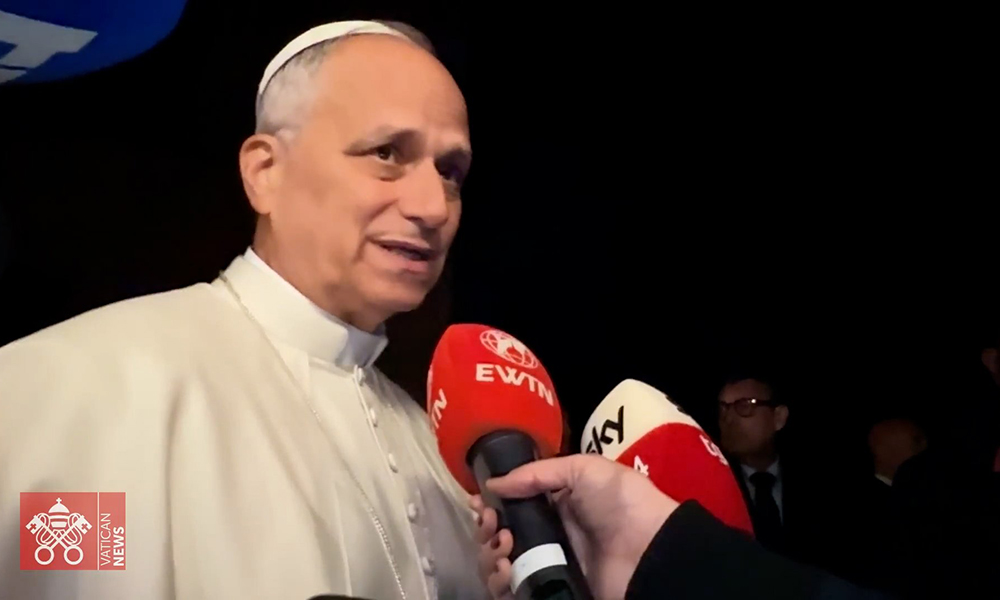
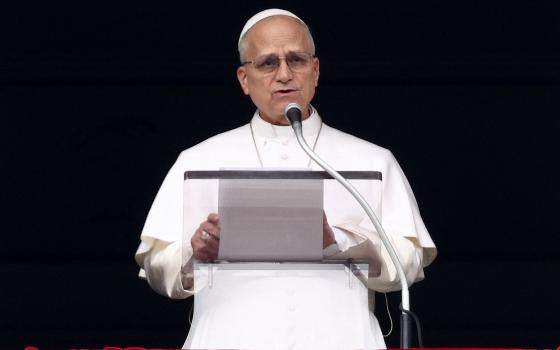
Pope Leo XIV is seen speaking to journalists outside the Palazzo Barberini in Castel Gandolfo, Italy, in a screen shot from a video taken Nov. 4, 2025. (CNS screen grab/Vatican Media)
Despite his best efforts, Johnson is missing the big picture, the commitment at the heart of the Christian message. And this is where I return to Pope Leo.
In contrast, Leo emphasizes that we will be judged on how we treat "the least of these" among us. From a Catholic perspective, governments exist to promote the "common good." In this instance, the use of the word "common" reinforces the belief that we are all in this together.
But in essence, Leo is talking about the kingdom of God: the time when Jesus will return in glory and ask us to account for our lives.
St. Paul writes: "There is neither Jew nor Greek, there is neither slave nor free, there is no male and female, for you are all one in Christ Jesus."
In the kingdom of God, there is no inside or outside.
And the kingdom of God is not just some future event. Christians aren't encouraged to hunker down and have the state use the "sword" to protect them. According to Scripture, the kingdom of God is a mustard seed that grows within us. Christians should bear witness to the kingdom of God through acts of love and mercy in the here and now.
Johnson is comfortable using the power of the state to protect Americans from outsiders. He contends that we must be protected because these outsiders are not "us." But we will all be outsiders sometime, and that includes Christians like me who believe the current administration's policies and methods are unchristian.
Johnson is comfortable using the power of the state to protect Americans from outsiders. He contends that we must be protected because these outsiders are not "us." But we will all be outsiders sometime, and that includes Christians like me who believe the current administration's policies and methods are unchristian.
Johnson presents a biblical proof text in support of a government that draws upon a much-debated Christian view on what individual Christians and government should and should not do.
Christianity in the service of the state — or the state in the service of a particular form of Christianity — represents a mistake that Christians continually repeat. And Johnson is making that same mistake in his Christian defense of deportation.
That danger must be resisted now, as always.