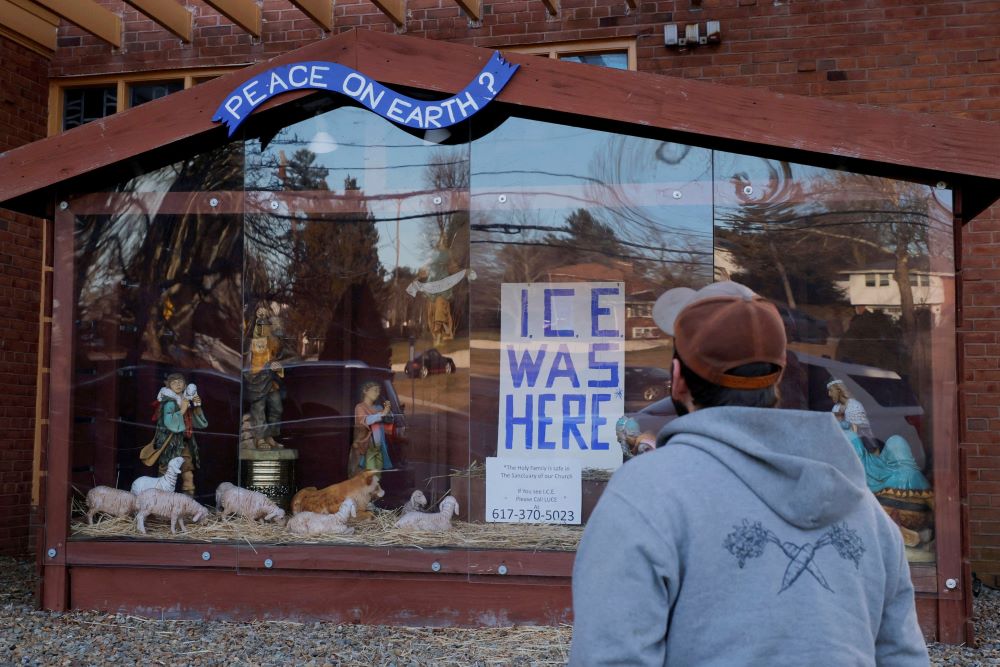
A sign reading "ICE Was Here" stands in the outdoor Nativity at St. Susanna Catholic Church in Dedham, Mass., Dec. 8, 2025. The Archdiocese of Boston has asked that the sign be removed. (OSV News/Reuters/Brian Snyder)

The parishioners of St. Susanna Parish Church near Boston have presented their archbishop, Richard Henning, with an extraordinary opportunity.
St. Susanna's pastor, Fr. Stephen Josoma, and the archbishop have been at odds over the "ICE was here" nativity scene that the parish's Pax Christi group erected at the beginning of Advent last month.
The archdiocese criticized the scene, which includes a sign saying the Holy Family is "safe in the sanctuary of our church," as "divisive political messaging." The statement added: "The display should be removed and the manger restored to its proper sacred purpose."
Josoma says the scene is meant to depict "Incarnation, 2025," adding: "It reflects the context that Jesus would be coming into if he were born today."
After the archdiocese issued its statement Dec. 5, Josoma said the display would remain as-is until he has a conversation with the archbishop. Josoma said in a telephone interview Dec. 16 that he hoped that would happen in the next couple of days.
He said there's "no animosity" between him and Henning and that he looks forward to the conversation.
Terrence Donilon, the spokesman for the archdiocese, said on Dec. 19 that he had "no update" on the situation.
What's the truth of Christ's birth that we need to focus on today?
Just over a year after succeeding Cardinal Sean O'Malley, Henning has the chance to surprise his flock with an inspiring move: He could show up at St. Susanna's on Sunday, admit he was wrong to issue such a dismissive criticism, and learn more about what prompted the display in the first place.
A long shot? Probably. But maybe Henning is more inclined to listen than people give him credit for.
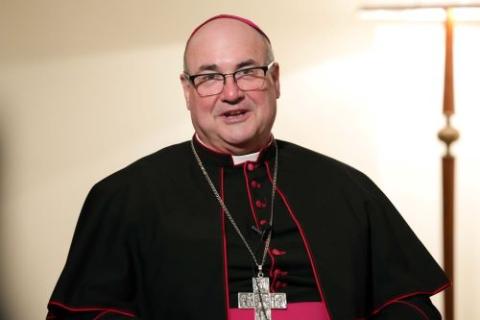
Archbishop Richard Henning of Boston (CNS/Lola Gomez)
When he arrived at the Cathedral of the Holy Cross for his installation as archbishop of Boston last year, he was approached by survivors of clergy sexual abuse. They asked him if he would talk with them.
He approached them and said: "I'm very sorry, I have to learn. I have to listen."
His dustup with St. Susanna's presents Henning with a chance to do some of both. And there's nothing like an apology to serve as a gateway to getting at the truth.
That truth — of what this church's nativity scene is really about — brings us to a core principle of Catholic social teaching: subsidiarity.
Subsidiarity is the principle that decisions and actions should happen at the lowest, most local, competent level possible, with higher authorities only stepping in to offer support. That is especially relevant to a parish's work on behalf of immigrants in its midst along with the nativity scene it builds in front of its church.
Both the archdiocese and the parish have done considerable work on behalf of immigrants, with the archdiocese's Catholic Charities operation focused on issues of resettlement, housing and legal defense and the parish focused on support for individual immigrant families.
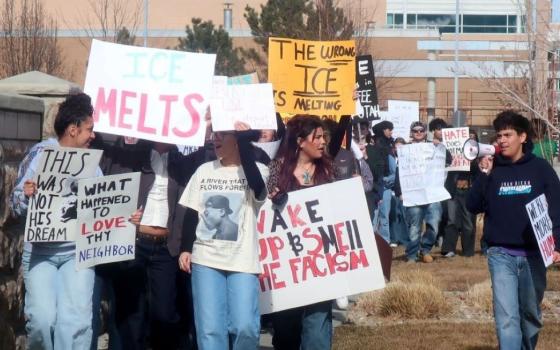
The parish also supports the Immigrant Justice Network of Massachusetts known as LUCE, which helps warn undocumented people of possible raids by ICE.
A sign beneath the empty crib in the parish nativity sign reads: "If you see ICE please call LUCE at 617-370-5023."
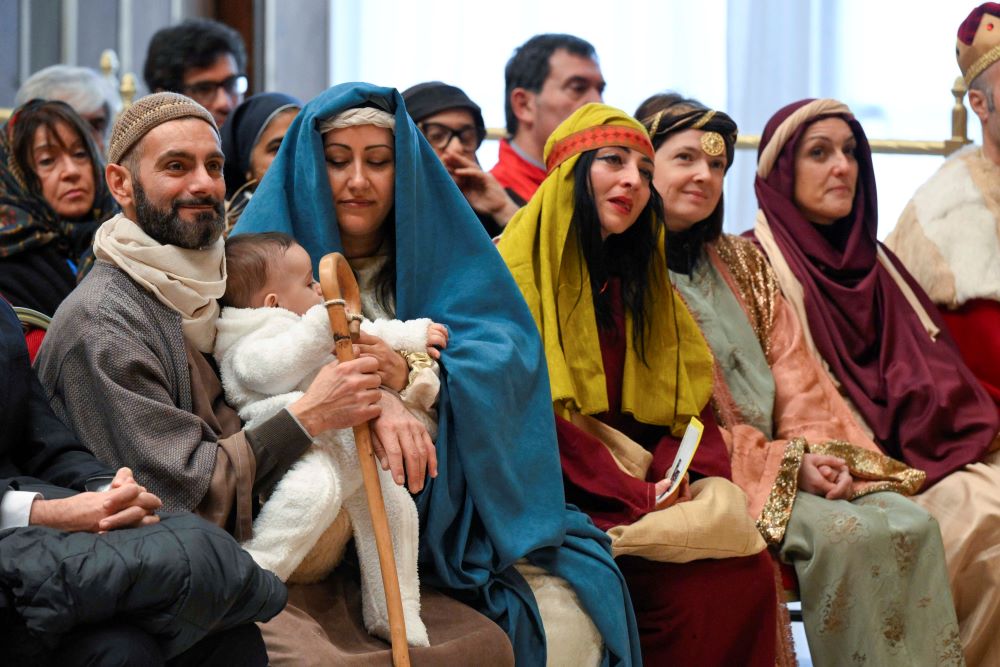
Actors take part in a live Nativity scene at Rome's Basilica of St. Mary Major Dec. 13. (CNS/Vatican Media)
The idea of a nativity scene is to help believers imagine as much of the truth of Christ's birth as possible.
Historians trace the first nativity scene to 1223, when St. Francis is said to have set one up in Italy. As Slate reported in 2012:
… The only historical account we have of Francis' nativity scene comes from The Life of St. Francis of Assisi by St. Bonaventure, a Franciscan monk who was born five years before Francis' death.
According to Bonaventure's biography, St. Francis got permission from Pope Honorious III to set up a manger with hay and two live animals — an ox and an ass — in a cave in the Italian village of Grecio. He then invited the villagers to come gaze upon the scene while he preached about "the babe of Bethlehem."
The Gospels of Luke and Matthew provide limited accounts of Christ's birth, but each provides some basis for St. Susanna's embellishments. Luke reports that, with no room in the inn, the family was turned away. Matthew casts the Holy Family as refugees, hoping to escape the scourge of King Herod.
Those two Gospels were written 80 to 90 years after Christ's birth, of course, so it's best to look to them more for symbolic truths as opposed to historical fact.
Advertisement
St. Susanna's has explored those truths in various ways in recent years, creating nativity scenes highlighting the climate crisis (Jesus floating in water filled with plastic bottles), family separation (Jesus in a cage) and gun violence (a list of mass shootings).
All of which sets the stage for a discussion Henning could have with the parishioners of St. Susanna's: What's the truth of Christ's birth that we need to focus on today?
What have parishioners heard from people who may be undocumented and fear being picked up by ICE? What are some of the ways parishioners are working with immigrants? How might the archdiocese be more helpful to those efforts?
Earlier this month, Henning visited four parishes in the archdiocese as part of a novena to Our Lady of Guadalupe, often regarded as the spiritual guardian of migrants. Why not pay a visit to St. Susanna's with that same inspiration in mind?
Henning chaired the committee that drafted the statement about ICE enforcement that the U.S. Conference of Catholic Bishops issued Nov. 12 at their meeting in Baltimore. He's the lead voice in a video montage of bishops speaking up on behalf of immigrants:
As pastors, we the bishops of the United States are bound to our people by ties of communion and compassion in our Lord Jesus Christ. And we are disturbed when we see among our people a climate of fear and anxiety around questions of profiling and immigration enforcement.
In its editorial following the bishops' statement last month, NCR asked: "What about real action?"
The parishioners of St. Susanna's have been taking real action. Their bishop should go learn from them.