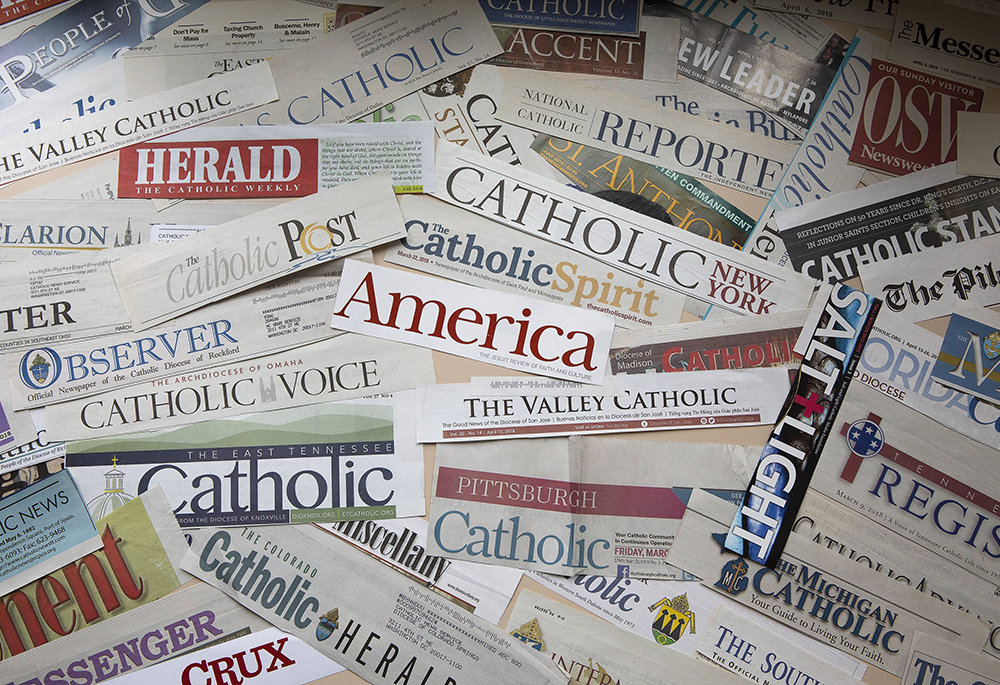
The mastheads of numerous Catholic newspapers are seen in this photo illustration. (CNS/Tyler Orsburn)

by Carol Zimmermann
February, which is quickly wrapping up, is most notably Black History Month, but it is also National Cancer Prevention Month, American Heart Month and a lesser-known celebration — Catholic Press Month.
This monthlong event promoting Catholic journalism comes on the heels of the Jan. 24 feast day of St. Francis de Sales, patron saint of journalists. The French saint and doctor of the church who died in 1622 was known for his prolific and persuasive writings, often in the form of leaflets promoting the Catholic faith.
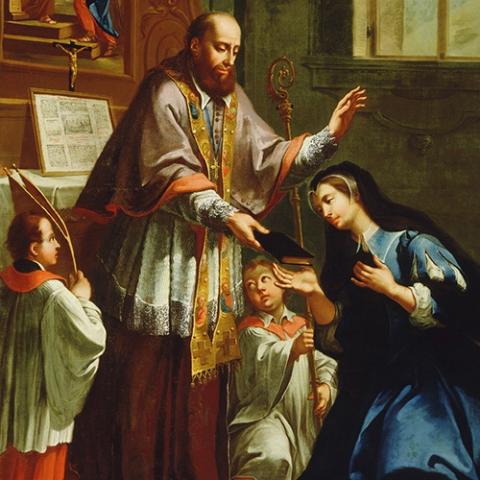
St. Francis de Sales is the patron saint of journalists. His feast day is Jan 24. (CNS)
In the U.S., the first Catholic newspaper was founded in 1822 by Bishop John England in the Diocese of Charleston, South Carolina. The paper, the United States Catholic Miscellany, was essentially an outreach to the immigrant Catholics in the diocese as a way to unite and inform them with news that related to their shared Catholic faith.
And now, more than 200 years later, we at the National Catholic Reporter are also involved in an outreach to immigrants — but in a whole different way. Today it's not so much about letting immigrants know what's going on as it is about communicating how the church is standing with them at a time of polarization and distrust and when deportation threats from our federal government have caused so many to live in fear.
In recent weeks and months we have particularly focused — in news coverage, editorials and commentaries — on the Catholic response of support, companionship and recognition of the God-given dignity of all, but in particular those here in this country from other lands, amid the U.S. government's current immigration crackdown.
Our work has not gone unnoticed, with one particular column urging Catholics to decide if they serve President Donald Trump or the Gospel getting mentioned by other news outlets and quoted on "The Last Word with Lawrence O'Donnell," on MS NOW.
Massimo Faggioli, theologian and professor at the Loyola Institute at Trinity College, Dublin, recently gave a shoutout to NCR and two other Catholic publications in a post on X for "doing courageous work of reporting and raising awareness on the spiral of violence and authoritarianism into which the country is falling."
Comments to that post did not seem to be from our faithful readers but instead from many questioning if our publication is even Catholic.
But as our readers know, we certainly are a Catholic publication, founded in 1964 during the time of the Second Vatican Council, when a group of Catholics in Kansas City, Missouri, decided that laypeople should be doing independent church journalism. That's what we still believe, although most of us now work remotely and not in the original brick-and-mortar office.
Advertisement
In a column at the start of our 60th anniversary celebration, our publisher Joe Ferullo said: "We remain an organization made up of lay Catholics who believe the people in the pews should have a voice, the people in power should be held to account, and honest, truthful journalism — especially in this day and age — is something to treasure."
And we do treasure our work, especially in these precarious times and in an occupation that is not guaranteed to survive. Across the country, several Catholic diocesan newspapers and also national Catholic magazines have closed in recent years, which I know personally from the 2022 closure of Catholic News Service where I worked for three decades.
But even more broadly, hometown newspapers are closing across the country at the rate of two a week and even major newspapers are feeling the crunch. The Pittsburgh Post-Gazette is closing this May, and the long-revered Washington Post recently announced cuts to a third of its staff and that it will be eliminating entire sections from its pages.
These closures and cutbacks create what has been described as news deserts leaving so many stories untold and creating gaps where readers do not know what community leaders or officials are doing, let alone their local sports team, or chancery.
We certainly don't take our work for granted and will continue in this fraught moment to tell the stories of those supporting and accompanying immigrants from Minnesota to the U.S.-Mexican border. This month, and year-round really, we will strive to follow the example of our patron saint who was described by Pope Francis in a 2022 letter as someone whose writings were not theories "concocted behind a desk, far from the concerns of ordinary people."