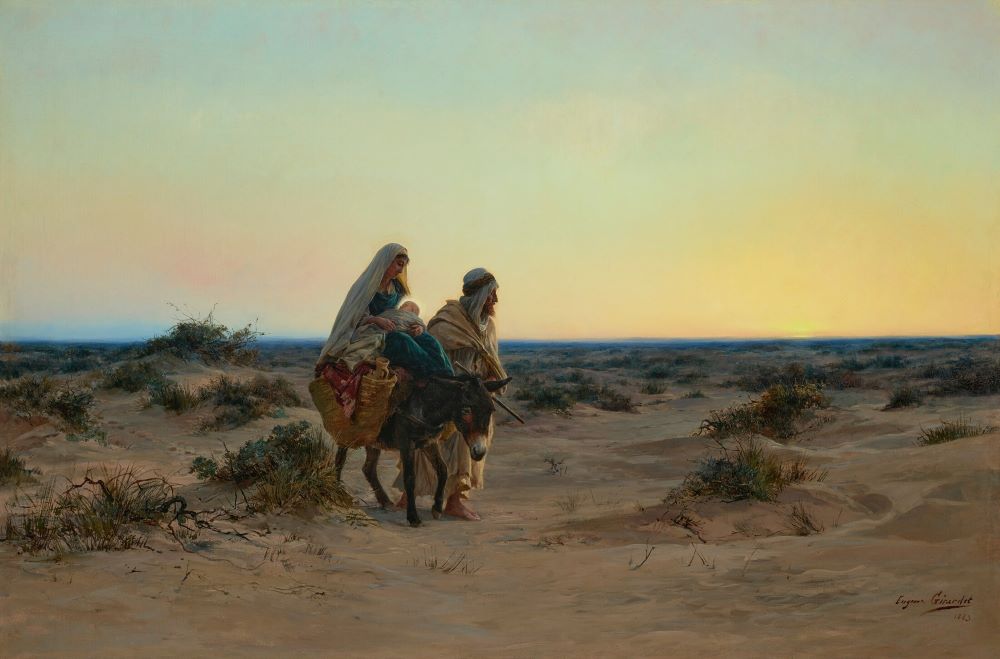
"The flight into Egypt" (1883) by Eugene Alexis Girardet (Artvee)

by Yolanda Chávez
The feast of Epiphany has already passed on the liturgical calendar. The decorations have come down; the Gospel has moved on. And yet the question Epiphany raises does not disappear with the date. It lingers, unresolved: What happens after we have seen God?
Matthew's Gospel ends the Epiphany story with a brief, almost understated sentence: "And having been warned in a dream not to return to Herod, they departed for their own country by another way" (Matthew 2:12). The Magi have seen the child, offered their gifts and completed the expected religious gesture. The story could have ended there. But it does not. It ends with a change of route.
This detail is not narrative decoration; it is a theological consequence. Seeing God does not leave the path intact. The Magi do not return by another way because they received a moral instruction or a spiritual technique. They return because the encounter has disrupted their map. Having seen God, they can no longer walk the same roads without betraying what they now know.
What they have seen is unsettling. God is not in the palace. God is not aligned with political power, security or control. God is not where the system says God should be. God is found in fragility — in a modest home, without guarantees, exposed and vulnerable: a child who cannot protect himself.
After that encounter, Herod's road is no longer an option. The change of route is not sentimental or mystical; it is ethical. "They returned by another way" means they broke a circuit. They refused to complete the loop between revelation and power. They did not go back to report. They did not collaborate. They did not offer religious legitimacy to a system that would soon demand victims in order to preserve order.
What is urgently needed is not instruction, but accompaniment, a pastoral imagination capable of walking with people who are discerning return without rushing their decisions or judging their outcomes.
We often speak of Epiphany as light — as clarity, understanding, reassurance. But the biblical text suggests something more disturbing. Epiphany does not illuminate the world so that we can continue walking it as it is. It illuminates in order to interrupt. The light of God does not confirm existing routes; it exposes their cost.
Once revealed, Herod's road shows what it requires: fear, silence and the sacrifice of the vulnerable. It is a logic that secures stability by managing lives deemed expendable. After Epiphany, this road can no longer be traveled in innocence.
The Magi do not become heroes. They simply lose the ability to pretend they do not know. They have seen too much. And once God has been encountered in the open, unprotected places of the world, returning to business as usual becomes impossible without self-betrayal.
For many migrants today, "returning by another way" is no longer a metaphor. It is a lived discernment.
In my own experience of migration and forced return, I am asked questions that sound practical but are deeply spiritual: What did you do with your belongings? How do you close a life built over many years? How do you survive the return? Beneath these questions lies a quieter, more decisive one: Can I keep walking this road?
For many, the road of migration has become a space of exhaustion rather than hope, a life lived on hold, marked by constant fear and precarity without horizon. A system that demands endurance as proof of worthiness. And within faith communities, silence — or worse, spiritual pressure to persevere at any cost.
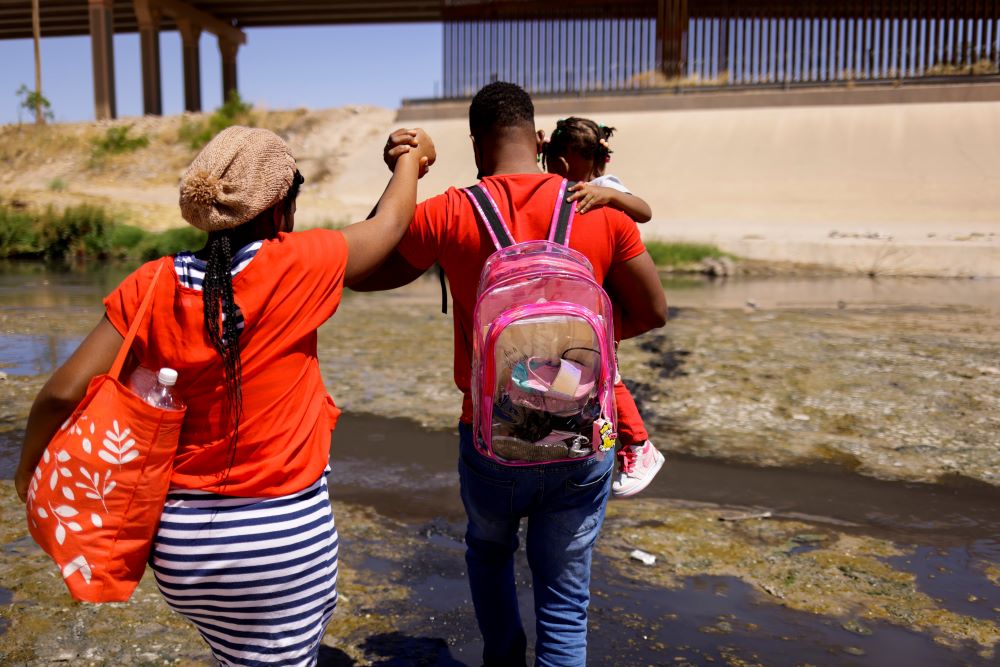
An asylum-seeking migrant family from Haiti cross the Rio Bravo to turn themselves in to U.S Border Patrol agents to request asylum in El Paso, Texas, as seen from Ciudad Juarez, Mexico, April 22, 2022. (OSV News/Reuters/Jose Luis Gonzalez)
It is important to say clearly what this reflection is not suggesting. This is not about romanticizing return. It is not about promoting self-deportation. It is not about spiritualizing unjust immigration systems or placing responsibility on individuals to resolve structural violence. Changing routes does not necessarily mean changing countries.
Discernment here does not mean choosing departure over staying, but refusing to sacralize any path that destroys life.
Sometimes it means refusing to keep blessing systems that require sacrifice in order to survive. Sometimes it means naming that perseverance has become a form of harm. Sometimes it means recognizing that staying, leaving or returning are all decisions shaped by unequal power — even when they are made "freely" — and that none of them should be moralized from the pulpit.
What is urgently needed is not instruction, but accompaniment, a pastoral imagination capable of walking with people who are discerning return without rushing their decisions or judging their outcomes.
To accompany in this moment requires listening without correction. It requires resisting the temptation to spiritualize endurance. It requires naming the grief of return, because returning is not going back home but entering another form of displacement. It requires honoring courage without turning it into virtue or failure. Above all, it requires reimagining God.
Many migrants have been formed in a theology that promises protection in exchange for faithfulness. Lived experience often dismantles that promise. What remains is not the absence of God, but a different presence: God not as guarantee, but as companion; a God who does not ensure safety, but refuses abandonment.
Advertisement
This is the God revealed at Epiphany — not aligned with power but found in exposure; not securing outcomes, but walking alongside.
"They returned by another way" does not mean that the Magi knew where that new road would lead. The Gospel does not tell us that they had clarity, certainty or a plan. It only tells us that, after what they had seen, there were roads they could no longer walk. Encounter had changed the limits of what was possible in good conscience.
Perhaps the most honest faith today is not the one that can explain its decisions with confidence, but the one that refuses to keep moving along paths that demand victims in order to function; a faith willing to live with uncertainty rather than complicity, a faith that recognizes when a road has become morally uninhabitable.
Epiphany does not end with vision. It begins with the responsibility that comes when we can no longer claim innocence.