
(Unsplash/Elle Hughes)

by Mary M. McGlone
My favorite toy of late is a teleidoscope, a kaleidoscope that reflects your surroundings. It helps me see things in a beautifully different light and that's precisely what we need when we listen to Jesus. Jesus taught in koans, traditional anecdotes or riddles that unveil the inadequacy of logical reasoning when it comes to the most important matters in life.
In today's Gospel, Jesus tells his disciples that they are the salt of the earth. Scholars go round and round analyzing what makes salt insipid, but Jesus wasn't focusing on salt, but on mission. Scripture scholar Douglas Hare explains that the salt metaphor would have sounded as strange to Jesus' disciples as it does to us. Hare suggests that we'd get the message better if we said something like: "Get to it, you can be the hot peppers of the earth!"
Now that's one to ponder.
Jesus' statement, "You are the light of the world," brazenly refocused a common description of God and applied it to the disciples. Of course, God is the true light, but God needs flesh and blood disciples to be the windows through which the light shines or the mirrors reflecting it into new places.
Jesus' teaching was hardly new. Isaiah taught the same thing. According to Isaiah, being a light for the nations has nothing to do with attending church, listening to homilies or interpreting Scripture. The light Isaiah talks about shines in the faces of givers and receivers, people who share bread, shelter the oppressed and homeless, and clothe the naked. Eating or living together creates greater community. When someone receives the clothes of another, they're bound together in a new way. They mirror each other such that they can no longer ignore one another.
Right now in the United States, people who identify with others' needs might feel like lonely hot peppers in big pots of bland beans. Such people are all around us. Remember Judge Hannah Dugan who made authorities burn with anger when she whisked Eduardo Flores-Ruiz out a side door of a Milwaukee courtroom to avoid ICE agents? Of course, the FBI arrested her.
She exemplifies the reality of the cross: Those who act in the name of God will share the fate of the poor.
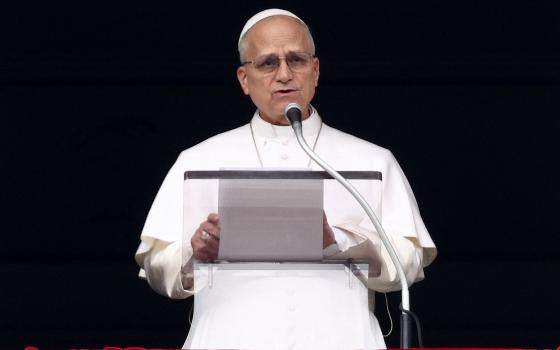
What does this have to do with us? Pope Leo XIV delivered a message for the World Day of Migrants and Refugees in October. Rather than simply defend them, he spotlighted them, calling them evangelizers who risk everything to find a better life.
Leo said, "In a world darkened by war and injustice, even when all seems lost, migrants and refugees stand as messengers of hope. Their courage and tenacity bear heroic testimony to a faith that sees beyond what our eyes can see and gives them the strength to defy death."
In this message, Leo warned that "sedentarization," poses a serious danger to the church today. The word may sound peculiar; unfortunately, the reality is not. Common parlance might call it couch-potatoism. Sedentarists watch the news, observing and maybe feeling bad about what happens to "them," then they change the channel, forgetting that they are us and we are them and all of us are God's.
Advertisement
In November, the U.S. bishops issued a statement decrying the U.S. government's treatment of migrants. They talked about how saddened they are by the state of contemporary debate in the U.S., the vilification of immigrants, conditions in detention, and by seeing parents afraid to take children to school.
How are we called to be hot peppers in society? Surely, we don't lack for situations begging for the spice of the Gospel. Our bishops lamented ways in which U.S. laws are destroying communion among us and thwarting the exercise of the compassion of Jesus. They exhort us to "advocate for a meaningful reform of our nation's immigration laws and procedures."
Today, we witness wars, nations invading less powerful neighbors, leaders of nations with excess food allowing starvation in poorer countries. Common rhetoric villainizes the vulnerable while media makes it all seem ordinary. We're advancing rapidly in our spiritual sedentarization. Meanwhile, subtle but powerful forces are dosing us with spiritual Novocain. This is how evil works, slow cooking the church into pots of bland beans.
The remedy? We need to let our vision get mixed up so that we see differently. In his apostolic exhortation Dilexi Te, Leo tells us that hearing the cry of the poor is the way into the heart of God. Listening primarily to our friends and peers reinforces our blind spots and reinforces lifeless visions of our Christian mission.
People familiar with the suffering that comes from injustice can be our teleidoscopes, scrambling our placid viewpoints and adding hot peppers to a church in mission. Isn't it time to let the Gospel spice up our lives?