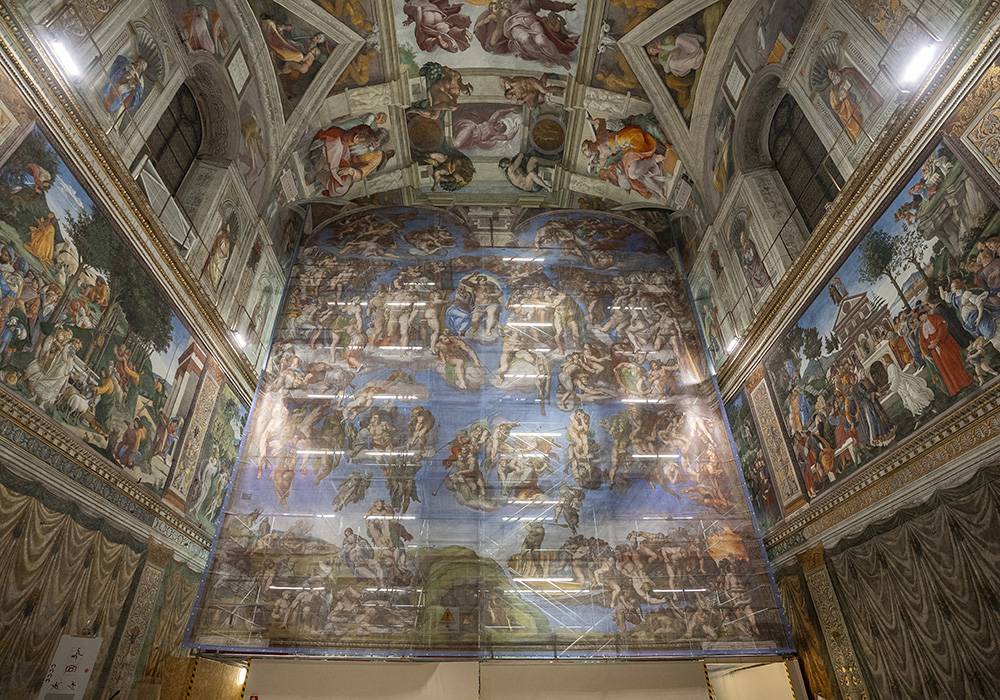
Scaffolding covers Michelangelo's "The Last Judgment" during extraordinary maintenance work undertaken by the Vatican Museums. (Courtesy of the Governorate of Vatican City State)

As the world's cardinals gathered beneath the gaze of Michelangelo's "The Last Judgment" to elect Pope Leo XIV last May, the iconic 16th-century fresco watching over them appeared slightly muted.
That's because, beyond the 133 cardinal electors who spent two days in the Sistine Chapel for the conclave, the Renaissance masterpiece typically sees some 20,000 visitors each day. Those visitors breathe and, as Rome experiences consistently warmer temperatures, sweat.
In recent years, that perspiration has subtly dulled the brilliant colors that convey Michelangelo's harrowing vision of the end of time, prompting its first intensive cleaning in more than three decades.
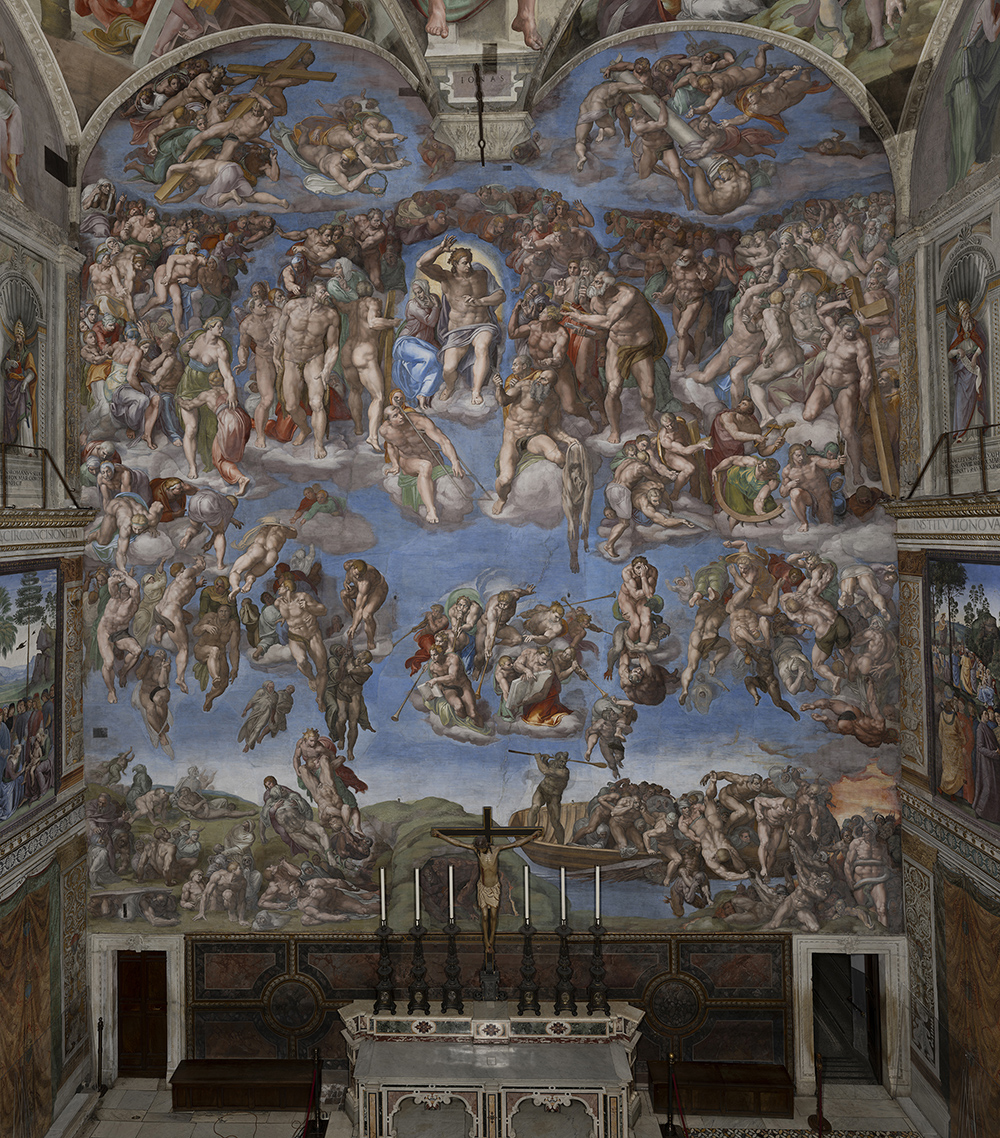
Michelangelo's "The Last Judgment" in the Sistine Chapel, prior to extraordinary maintenance by the Vatican Museums (Courtesy of the Governorate of Vatican City State)
"The lactic acid produced through perspiration binds very easily with the calcium present on the surface of the fresco," Fabio Morresi, head of the Vatican Museums' scientific research laboratory, told the National Catholic Reporter during a press visit to the Sistine Chapel Feb. 28. "That reaction forms a salt, calcium lactate, which creates a thin whitish layer on the surface. Over time, that layer mutes the colors and softens the contrasts of 'The Last Judgment.' "
The fading was accelerated in recent years by the scale of tourism passing through the chapel. Prior to its last restoration in 1994, annual visitors numbered about 1.5 million. Today, more than 6 million people pass through each year.
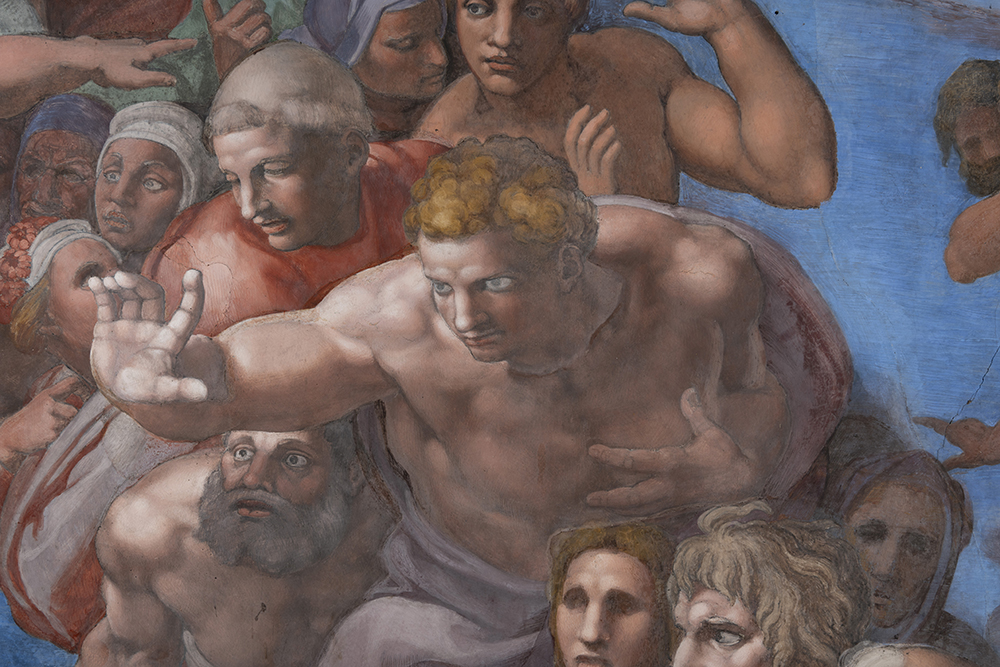
A detail from Michelangelo's "The Last Judgment" shows the surface before and after the Vatican Museums' extraordinary maintenance on the fresco, which removed a thin layer of calcium lactate buildup. (Courtesy of the Governorate of Vatican City State)
Visitors often reach the Sistine Chapel overheated after walking through non-air-conditioned galleries. Combined with rising temperatures those conditions have led to more sweat in the sacred space.
"This increase is almost certainly linked to changes in the climate," Morresi said. "Greater heat means greater perspiration and more lactic acid."
The average temperature in Rome in 2024 is estimated to have risen some 4.5 degrees Fahrenheit compared to the 1991-2020 average.
Over roughly three months, 10 to 15 restorers are performing what officials describe as "extraordinary maintenance," the first such intervention since a 14-year restoration of the entire Sistine Chapel concluded in 1994. The project is expected to conclude before Holy Week.
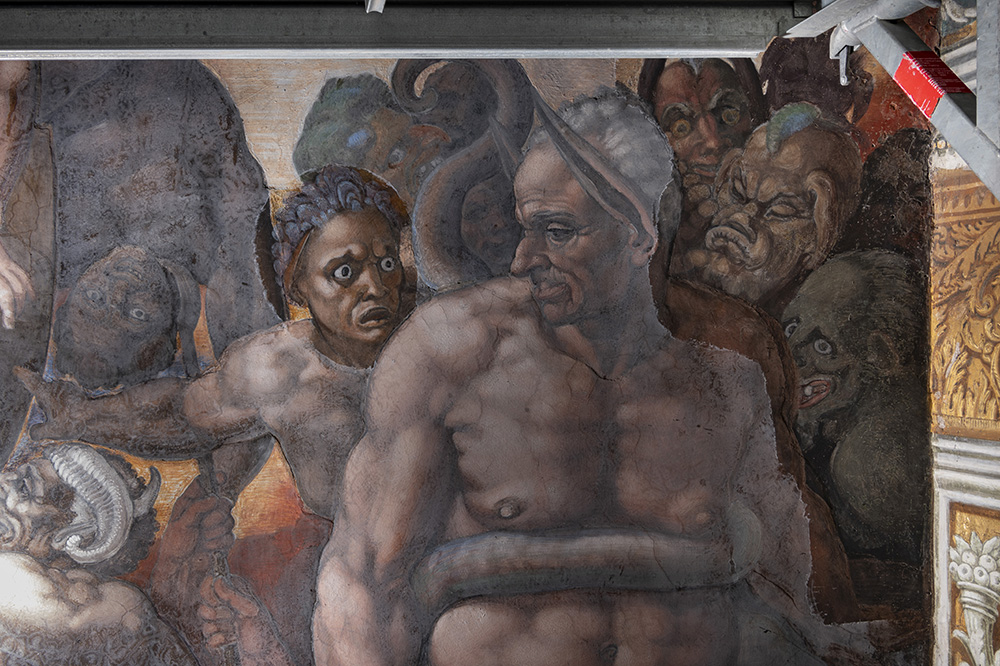
A detail of the group around Minos in Michelangelo's "The Last Judgment" shows areas where conservators removed a thin layer of calcium lactate buildup. (Courtesy of the Governorate of Vatican City State)
The extraordinary cleaning, which required specially designed scaffolding to fit around the chapel's altar, is financed by the Florida chapter of the Patrons of the Arts in the Vatican Museums, a longstanding association of benefactors that supports conservation efforts across the Vatican.
Unlike the sweeping restoration of the 1990s in which conservators removed centuries of soot, glue-based coatings and accumulated grime that had darkened the altar wall, the current cleaning process is focusing on removing a thin surface deposit that can be safely lifted without disturbing the underlying paint. Using purified water applied through layers of specialized Japanese tissue paper, restorers dissolve and remove the water-soluble salt while leaving Michelangelo's original pigments intact.
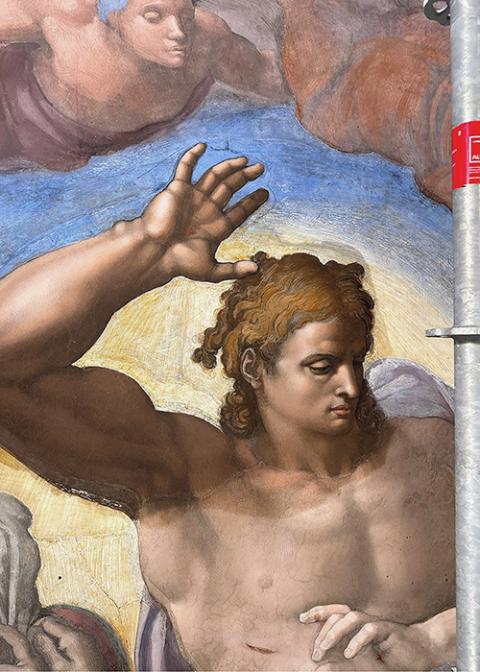
A detail of Christ in Michelangelo's "The Last Judgment" is seen during the Vatican Museums' extraordinary maintenance to remove a thin layer of calcium lactate buildup. (Courtesy of the Governorate of Vatican City State)
Although the last restoration was completed more than 30 years ago, Vatican officials said the buildup of calcium lactate has accelerated particularly over the past decade, despite a climate control and lighting system installed in 2014 to stabilize the chapel's environment.
Marco Maggi, head of the Vatican Museums' conservator's office, said the temperature in the Sistine Chapel is maintained between 71-75 degrees Fahrenheit, with relative humidity between 55-60%. Carbon dioxide levels are kept lower than those typically found in crowded office spaces, even though as many as 700 to 800 people may occupy the chapel at any given time.
Commissioned in 1533 and completed in 1541, "The Last Judgment" covers the entire altar wall of the Sistine Chapel in a sweeping depiction of Christ's second coming. In most churches, scenes of the Last Judgment appear above the entrance, confronting worshippers as they depart. In the Sistine Chapel, Michelangelo's vision stands directly behind the altar, facing the congregation and, in modern times, the cardinals gathered in a conclave.
Advertisement
The fresco's muscular nudes scandalized some contemporaries. After Michelangelo's death, drapery was added to many figures whose nudity was deemed indecorous. Those alterations remained until the 1994 restoration removed much of the later overpainting.
Whereas that restoration reversed some of the censorship imposed during the Counter-Reformation, today's intervention reflects a different challenge: safeguarding the fresco in an era of climate change and mass tourism.
"The goal of preventive conservation," Maggi said, "is to guarantee the best conditions for today's visitors, and to pass on that right, unchanged, to future generations."
The National Catholic Reporter's Rome Bureau is made possible in part by the generosity of Joan and Bob McGrath.