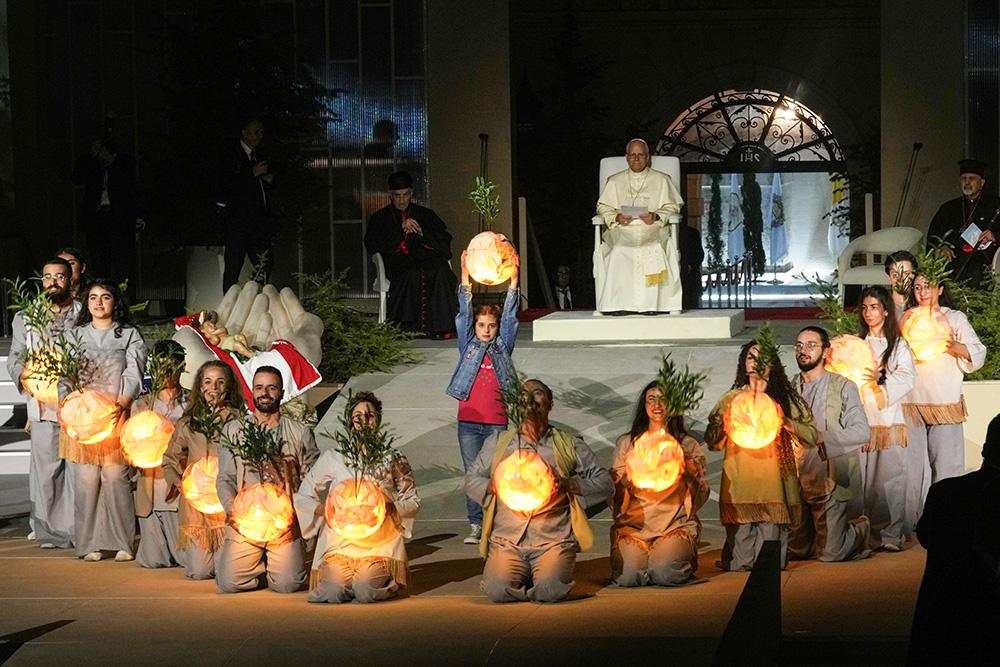
Pope Leo XIV watches a performance by youths holding illuminated globes during an event in Bkerki, the seat of the Maronite Church, in Lebanon Dec. 1, 2025. (AP/Domenico Stinellis)

Pope Leo XIV called on young people who have inherited a world "torn apart by wars and disfigured by social injustice" to realize their vocation as the generation that can rebuild a country battered by unrelenting crises.
"There is hope within you, a gift that we adults seem to have lost," Leo told some 15,000 young people in Lebanon Dec. 1 in one of the most charged moments of his pontificate so far, addressing the future generations of a nation scarred by conflict, economic collapse and mass emigration.
"You have time! You have more time to dream, to plan and to do good," the pope said, pausing to accommodate cheers from the crowd. "You are the present, and the future is already taking shape in your hands! You have the enthusiasm to change the course of history!"
After a rather muted three days in Turkey, where Leo's agenda for his first trip abroad as pope was marked by private meetings and intimate prayer encounters, the pope's event with young people in Bkerki, Lebanon, delivered the first burst of enthusiasm typically associated with papal trips.
Though Leo's voice often boomed through the square, he clutched his written remarks with both hands for most of its delivery, keeping his head down while intently reading. Cheers from the crowd that were provoked by mentions of Lebanese saints and calls for peacemaking often prompted him to look upward.
The biggest cheers the pope solicited were after his speech, when, before blessing the crowd, he asked: "Young people of Lebanon, are you ready to be artisans of peace?"
Leo's only full day in Lebanon was packed end-to-end, pushing the 70-year-old pontiff to make the most of a highly anticipated visit lasting less than 48 hours.
Advertisement
The day's itinerary included a series of encounters with Lebanon's diverse religious communities — Maronite Catholics, other Christian denominations and interreligious groups — before culminating in the youth event that reinforced the message of hope at the heart of his visit to Lebanon.
Throughout the morning, the pope delivered his remarks in French, a semiofficial language in Lebanon dating from its period under French occupation between 1920 and 1946, though he spoke in English to the young people. Although fluent in Spanish and Italian, Leo is not conversational in French, but has occasionally chosen to read speeches in the language.
Bolstering young people
In the hours before the pope's arrival in Bkerki, the square in front of the offices of the Maronite patriarchate, the seat of the Catholic rite that comprises some 80% of Lebanon's Christians, was transformed into a one-night-only World Youth Day celebration. Young people sang, danced and chanted relentlessly ahead of the pope's arrival. Attendees who spoke to National Catholic Reporter expressed hope that the pope would deliver a message of peace amid their nation's crises that affect them personally.
Margaritta Hayek, 30, was among those singing in full force ahead of the pope's arrival. She traveled to Beirut from Mardoush in southern Lebanon, where she said the house next to her family's had been destroyed by an Israeli air strike and where air raid sirens still ring out daily.
"I hope [Leo] will remind everyone about the importance of peace, and that we are all humans, not to kill each other but to build connections," she told NCR.
Rebecca Lichaa, 23, from Deir al-Ahmar along the Lebanon-Syria border, said more Syrians now live in her village than Lebanese due to the migration caused by the Syrian civil war, which at times has led to local conflicts.
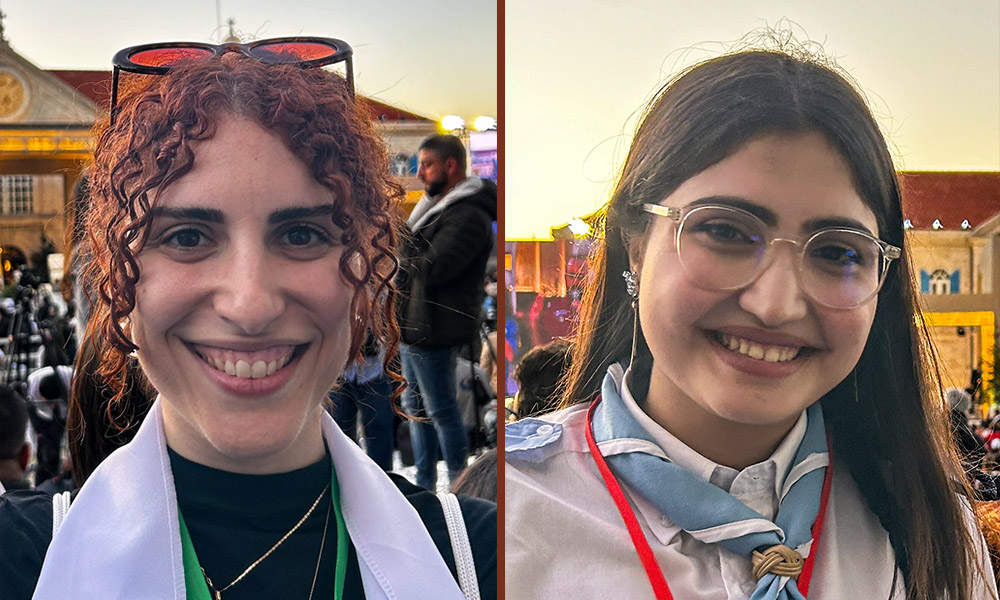
Margaritta Hayek, left, and Rebecca Lichaa at the papal event in Bkerki, Lebanon, Dec. 1, 2025 (NCR photos/Justin McLellan)
Lichaa, too, wanted Leo to "say something about peace, because we truly need peace."
"As a young Lebanese, I don't want to leave my country; that's why I hope to hear something that can be of hope to young people, above all to the young Christians because we need that," she told NCR.
The Christian population in Lebanon is estimated to have declined from 60% in 1970 down to around 30% today, due to mass emigration fueled by a series of political, economic and bellicose crises.
The foundation for peace, Leo told the attentive crowd, "cannot be just an idea, contract or moral principle," but must be drawn from the example of Jesus' mercy.
"Peace is not authentic if it is the product of partisan interests," he said. "It is only genuinely sincere when I do to others what I would like them to do to me."
The pope assured the crowd that Lebanon "will flourish once again," and encouraged Lebanon's future generations to "draw from the good roots of those dedicated to serving society without using it for their own interests."
"With a generous commitment to justice, plan together for a future of peace and development," he said. "Be the source of hope that the country is waiting for!"
Unity in the Middle East
Before arriving for his meeting with young people, Leo met with the leaders of Lebanon's various religious communities, including the Sunni and Shiite Muslim communities, which each make up approximately one-third of Lebanon's population.
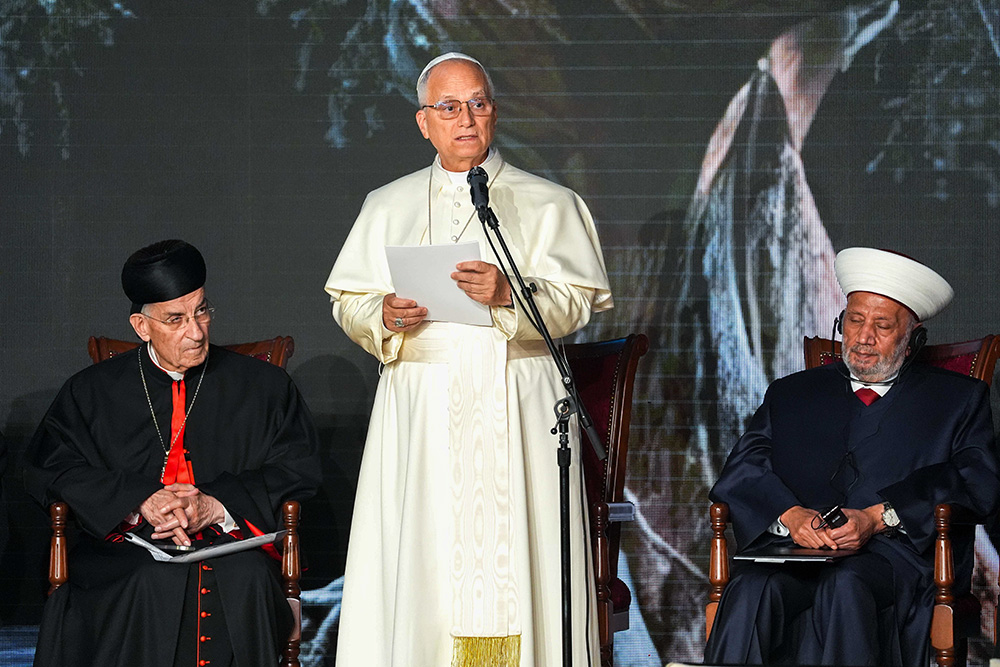
Pope Leo XIV delivers a reflection during an ecumenical and interreligious meeting in Martyrs' Square in Beirut Dec. 1, 2025. Seated behind him are Cardinal Bechara Rai, patriarch of the Maronite Catholic Church, left, and Sheikh Abdul Latif Derian, the grand mufti of Lebanon. (CNS/Lola Gomez)
Despite the "trepidation and disheartenment" with which people look toward the Middle East, "a sense of hopefulness and encouragement can be found when we focus on what unites us: our common humanity, and our belief in a God of love and mercy."
"In an age when coexistence can seem like a distant dream, the people of Lebanon, while embracing different religions, stand as a powerful reminder that fear, distrust and prejudice do not have the final word, and that unity, reconciliation, and peace are possible," he said.
Recalling that 2025 marks 60 years since the publication of Nostra Aetate, the landmark document issued by the Second Vatican Council that opened up the church's relationship with other faiths, Leo said that "true dialogue and collaboration is rooted in love."
The document's call to dialogue, he said, "should embrace all people of goodwill, reject prejudice, discrimination and persecution, and affirm the equal dignity of every human being."
Leo with Lebanon's Catholic community
In the morning, Leo urged Lebanon's bishops, priests, members of religious communities and other churchworkers to "take a stand to ensure that no one else will have to flee from his or her country due to senseless and cruel conflicts."
The pope traveled to the hilltop Shrine of Our Lady of Lebanon in Harissa, just outside Beirut, with people withstanding the rain to line his route there and catch a glimpse of his motorcade passing by. Along the winding path that leads to the church, a large banner commemorated previous papal visits to the shrine by Popes John Paul II, Benedict XVI and now Leo.
When Leo entered the church he was met with great fanfare from the approximately 2,000 people there, cheering and breaking out in chants of "Long live the pope!"
Many Maronite bishops who were present tend to the Maronite community abroad, populated by the large Lebanese expatriate diaspora; Leo's visit to Lebanon gave them a reason to make the pilgrimage back to their homeland.
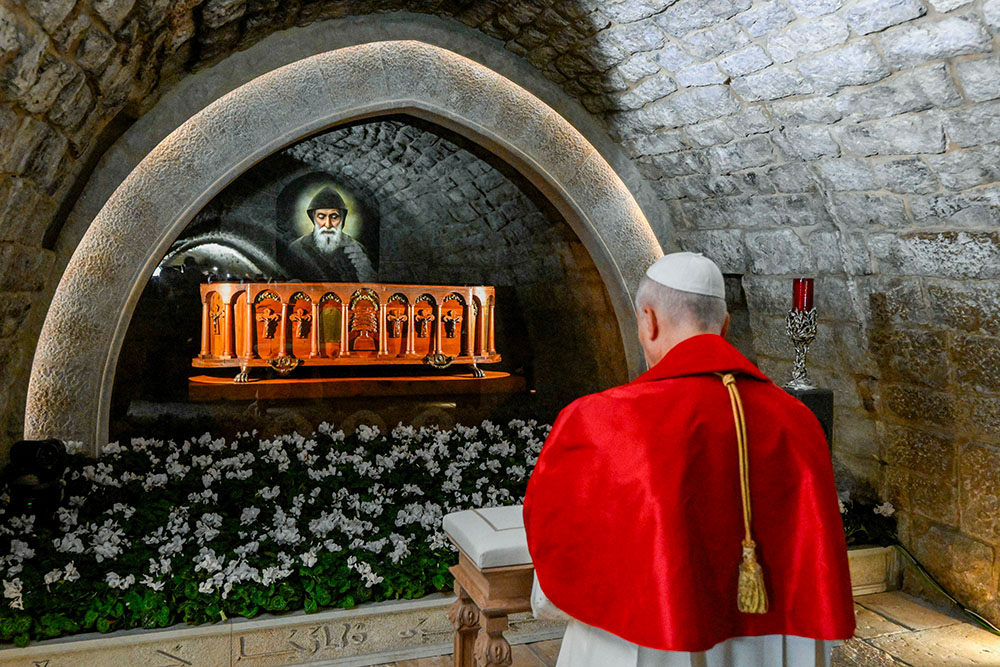
Pope Leo XIV prays in silence before the tomb of St. Charbel at the Monastery of St. Maron in Annaya, Lebanon, Dec. 1, 2025. (CNS/Vatican Media)
Before the church leaders, Leo praised Lebanon as a model where, "even when faced with extreme need and threatened by bombardment, Christians and Muslims, Lebanese and refugees from other lands, live together peacefully and help their neighbors."
Only through the "unifying power of love even in the moments of trial" can "we free ourselves of injustice and oppression," he said, even when "we are betrayed by people and organizations that ruthlessly exploit the desperation of those who have no alternative."
At the shrine, Leo continued to drive home his message of uplifting young people, a major theme of his visit to Lebanon.
"It is important to foster their presence, even in ecclesial structures, appreciating their fresh contributions and providing them with opportunities," he said.
At tomb of Lebanese icon, a papal first
The pope began the day by making history. He became the first pope to visit the tomb of St. Charbel Makhlouf, a towering religious figure known as the "miracle monk of Lebanon," who was canonized in 1977.
The 19th-century saint, a Maronite monk and priest, lived as a hermit for 23 years and despite not writing or preaching publicly gained worldwide fame through the numerous miracles attributed to him.
Standing aside his tomb at St. Maron's monastery, Leo asked for the intercession of St. Charbel to deliver communion and unity for the church and peace for the world.
"But we know well, and the saints remind us, that there is no peace without conversion of hearts," the pope said. "May St. Charbel, therefore, help us to turn to God and ask for the gift of conversion for all of us."
The National Catholic Reporter's Rome Bureau is made possible in part by the generosity of Joan and Bob McGrath.