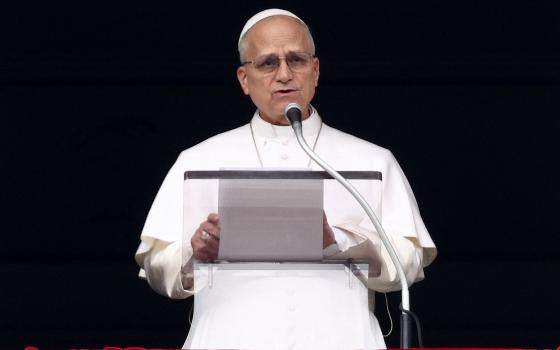
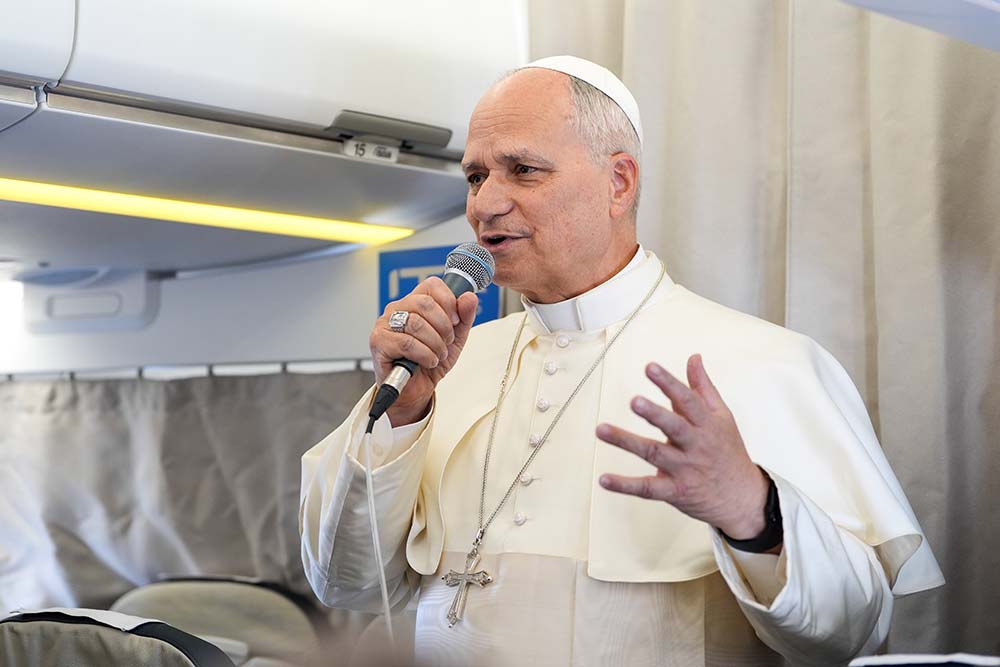
Pope Leo XIV speaks to journalists during a news conference aboard his flight from Turkey to Lebanon, Nov. 30, 2025. (CNS/Lola Gomez)

The Vatican continues to advocate for a two-state solution between Israel and Palestine and, despite resistance, will continue to seek mediation between Israel and Palestine, Pope Leo XIV said in an impromptu airborne press conference.
"We all know that at this moment Israel does not accept that solution, but we see it as the only solution," Leo told the 81 journalists accompanying him on his flight from Istanbul to Beirut Nov. 30.
But, he added, "we are also friends of Israel," and the Vatican will continue to act as a "mediating voice that can help bring us closer to a solution with justice for all."
The Holy See formally recognized the state of Palestine in 2015 and Leo has previously reiterated its long-standing position in support of a two-state solution. But his remarks on the plane were his most pointed appeal yet for Palestinian statehood in the context of the war in Gaza.
The pope surprised reporters by fielding two questions about his trip to Turkey on the two-and-a-half hour flight. Pope Francis, known for his openness to the media, would reserve his airborne press conferences for his flight back to Rome, signalling a surprise from his more reserved successor.
Speaking in Italian, Leo said he and Turkish President Recep Tayyip Erdogan discussed both the conflicts in Gaza and Ukraine during their meeting in Ankara Nov. 27.
The Turkish president is "certainly in agreement" with a two-state solution between Israel and Palestine, the pope added, and Turkey "has an important role that it could play in this."
Advertisement
Turkey's role in Ukraine
Regarding negotiations between Russia and Ukraine, the Turkish president "helped very much to convoke the two parties," the pope said.
"Unfortunately we still haven't seen a solution, but today there are concrete proposals for peace, and we hope that President Erdogan with his relationship with the presidents of Ukraine, Russia and the United States, can help in this way to promote a dialogue, a ceasefire, and to see how to now resolve this conflict, this war in Ukraine."
Erdogan has signaled that Turkey, where Russian and Ukrainian delegations have already met three times to little result in 2025, could be the venue for definitive peace talks between the warring sides.
Christian meeting in Jerusalem proposed for 2033
Leo also confirmed that he had proposed a trip to Jerusalem in 2033 with other Christian leaders during a meeting in Istanbul to mark 2,000 years since Jesus' passion, death and resurrection.
"There are still years to prepare, but it was a very beautiful encounter because Christians of different traditions were present and they also wanted to participate in this way," he said about his meeting with other Christian leaders Nov. 29.
Leo leaves Turkey, arrives in Lebanon
After concluding his visit to Turkey, the pope praised it as a nation where, despite an overwhelming Muslim majority, "different religions are able to live in peace."
Erdogan and his government have been criticized for their systematic marginalization of Christians, but Leo did not issue any attacks on the Turkish government during his three days there. Instead, he assured government officials in Ankara that "Christians desire to contribute positively to the unity of your country."
The pope arrived in Beirut Sunday evening to begin a quick trip to Lebanon Nov. 30-Dec. 2 that includes only one full day in the country.
How Leo will address Israel's military action in the region, which has included regular strikes in Lebanon, will be highly scrutinized. From the Vatican he has advocated for peace in Gaza, calling for "an immediate halt to the barbarity" in the Gaza Strip, but has shied away from invoking Israel by name.
The National Catholic Reporter's Rome Bureau is made possible in part by the generosity of Joan and Bob McGrath.