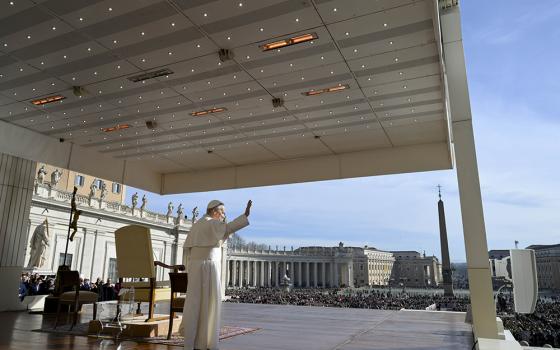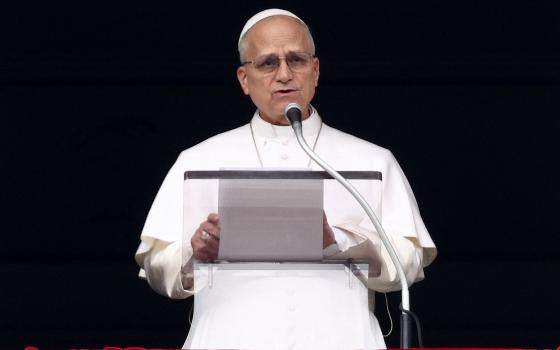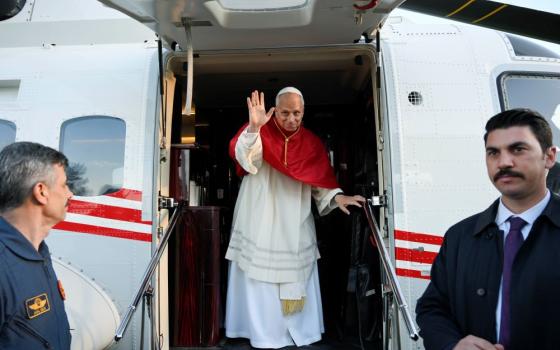
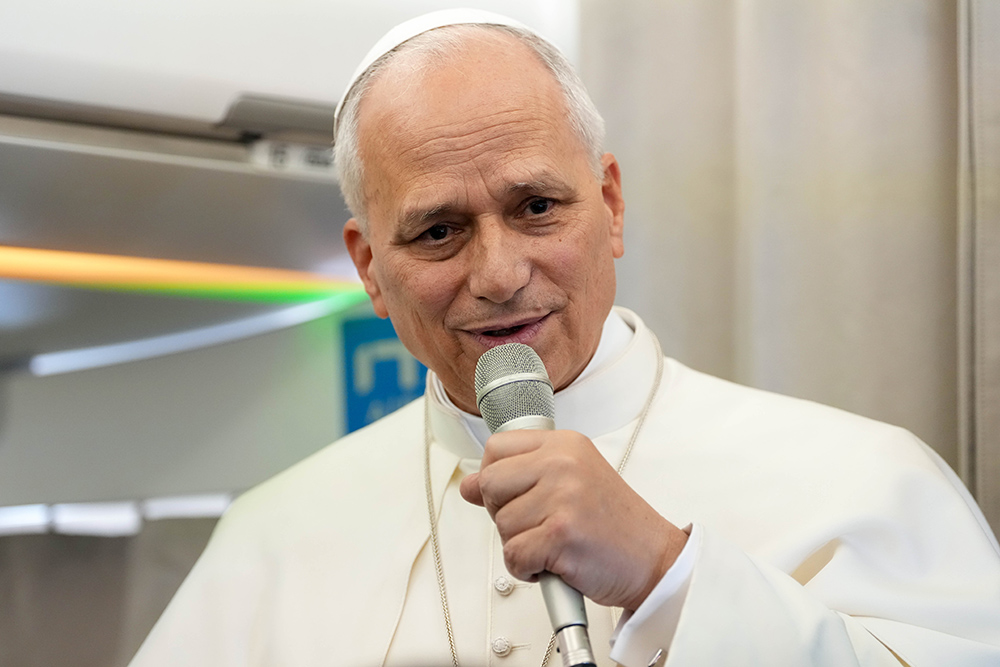
Pope Leo XIV answers a question from a journalist aboard his flight back to Rome from Lebanon, Dec. 2, 2025. (CNS/Lola Gomez)
The United States still has "another way" to exert influence in Venezuela short of attacks within its territory, Pope Leo XIV said in his first major press conference as pope. The press conference also touched on Ukraine and immigration, and revealed new insights into where he might travel next.
Responding to President Donald Trump's threat to strike alleged drug-trafficking networks inside Venezuela, Leo said that "it is better to look for ways of dialogue, maybe pressure, including economic pressure," rather than military intervention.
On the day Leo departed for his six-day tour in the Middle East, Trump said the United States would attack alleged drug-trafficking networks on Venezuelan territory.
"The voices that come from the United States change, sometimes with some frequency," Leo said. Meanwhile, Venezuela's bishops are "looking for ways to calm the situation" and pursue "the good of the people, because so often who suffers in these situations is the people, not the authorities."
Leo took six questions from journalists in the 26-minute press conference, answering them in English, Spanish and Italian. Two days prior, he had surprised journalists by fielding two questions from Turkish media on his flight from Istanbul to Beirut; in the past, papal press conferences have been exclusively reserved for the pope's return flight to Rome.
Immigration
After Leo's six-day tour through two Muslim-majority countries, he was asked about Catholics in the West who see Islam as a threat to Christianity.
The pope responded that North America and Europe need to be "less fearful" toward migrants and added that a fear of Muslims is "generated by people who are against immigration and trying to keep out people who may be from another country, another religion, another race."
His trip to Lebanon, he said, sought "precisely to raise the world's attention to the possibility that dialogue and friendship between Christians and Muslims is possible."
Next papal trips
In the press conference, the pope was rather transparent in discussing plans for future papal trips: "I hope to realize a trip in Africa," he said, specifically Algeria.
"Personally, I hope to go to Algeria, to visit the locations of St. Augustine's life, but also to continue the message of dialogue and the construction of bridges between the Christian world and the Muslim world," Leo said.
Advertisement
The pope also expressed his interest in traveling to Latin America, namely Argentina and Uruguay, neither of which Francis visited during his trips to the continent. Peru, where Leo spent more than two decades as a missionary, "would also receive me," he said with a laugh. And "there are many countries close by."
Vatican on peacemaking
On Ukraine, Leo said Europe's deeper involvement in peace negotiations "is important," noting that the original U.S.-proposed peace plan, which did not initially include European participation, had since been modified. Italy, he added, could play a credible mediating role between Ukraine, Russia and the United States, and the Holy See supports such efforts aimed at a "just peace."
Asked whether he plans to work with Trump or Israeli Prime Minister Benjamin Netanyahu on Middle East peace, Leo said he has already "begun a few conversations with some," but declined to name them.
The Vatican, he noted, maintains diplomatic relations "with most of the countries through the region," and hopes "to continue to raise that call to peace."
Synodality
Leo also was pressed to address the German synodal way, a far-reaching effort to expand lay participation in church governance that critics have accused of undermining episcopal authority or even risking schism.
Just because synodality is "lived differently" in different places, he said, "does not mean that there is rupture or a fracture."
Yet, he said, many Catholics in Germany feel that their country's synodal way does "not represent their own hope for the church or their own way of living the church."
"There is a need for further dialogue and listening within Germany itself so that no one's voice is excluded," he said. "So the voice of those who are more powerful do not silence or stifle the voice of those who might also be very numerous but don't have a place to speak up."
Understanding the new pope
Leo, almost seven months into his pontificate, told journalists that if there were one book to help people understand who he is, not written by St. Augustine, it would be The Practice of the Presence of God by Brother Lawrence, a 17th-century Carmelite friar.
In it, the author describes "a type of prayer and spirituality where one simply gives his life to the Lord and allows the Lord to lead."
"If you want to know something about me, that's been my spirituality for many years. In the midst of great challenges, living in Peru during years of terrorism, being called to service in places I never thought I would be called to serve to, I trust in God and that message is something that I share with all people," he said.
Asked about his reaction to his election to the papacy, Leo answered directly in that vein: "I resigned myself to the fact when I saw how things were going that it could be a reality. I took a deep breath. I said, 'Here we go Lord you're in charge, you lead the way.' "
The National Catholic Reporter's Rome Bureau is made possible in part by the generosity of Joan and Bob McGrath.