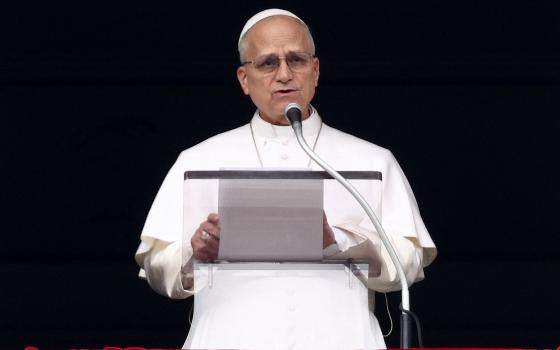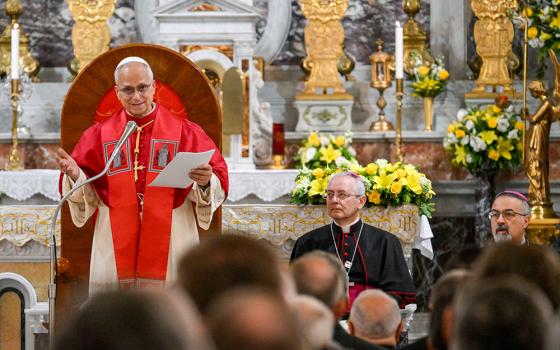
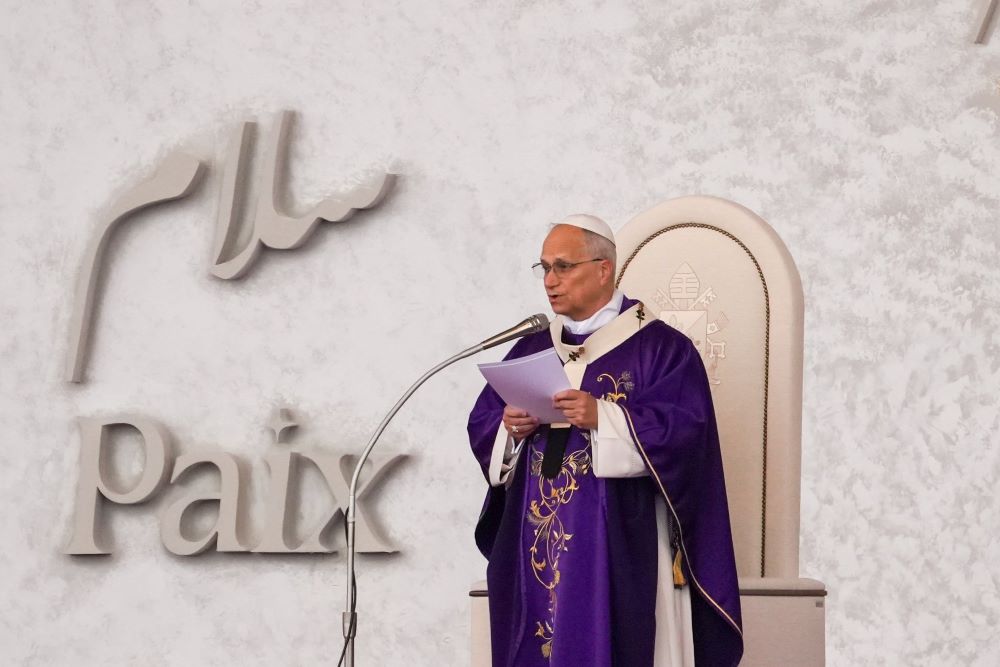
Pope Leo XIV gives his homily during Mass in Beirut, Lebanon, on the final day of his first apostolic journey Dec. 2. At the end of Mass, he said: "Listen to the cry of your peoples who are calling for peace!" (CNS/Lola Gomez)
In a country still reeling from conflict, economic collapse and its 2020 devastating port explosion, Pope Leo XIV urged the Lebanese people to resist disillusionment and cultivate hope during the final moments of his visit to the Middle East.
Before some 150,000 people along Beirut's waterfront Dec. 2, the pope said the people of Lebanon are called "to not be discouraged, to not give in to the logic of violence and the idolatry of money, and to not resign ourselves in the face of the spreading evil."
At the end of Mass, Leo issued an appeal to political and social leaders in all countries marked by war: "Listen to the cry of your peoples who are calling for peace!"
The Mass overlooking the Mediterranean Sea was the culminating event of Leo's short trip to Lebanon, which lasted less than 48 hours.
'The Middle East needs new approaches to reject the mindset of revenge and violence, to overcome political, social and religious divisions, and to open new chapters in the name of reconciliation and peace.'
—Pope Leo XIV
Earlier in the day, the pope visited a hospital for people with mental disabilities, and immediately before the Mass he prayed at the site of the 2020 chemical explosion that killed more than 218 people, injured 7,000 and displaced 300,000. He also met with about 60 family members of those who died.
Last Mass in the Middle East
Leo's Mass in Beirut was only the second papal Mass celebrated in Lebanon. While Popes John Paul II and Benedict XVI both visited the Arab nation, only Benedict presided over a public Mass.
Preaching just beyond the inoperative cranes and half-collapsed silos still looming over the port, Leo said Lebanon's return to stability depends on a shared commitment to the common good.
To rebuild Lebanon, which touts a rare religious diversity for the Middle East, "we must unite our efforts," Leo said.
"Disarming our hearts is the only way to do this," he said in his homily, delivered in French. "Let us cast off the armor of our ethnic and political divisions, open our religious confessions to mutual encounter and reawaken in our hearts the dream of a united Lebanon."
Advertisement
Speaking to the region at large in his appeal after Mass, the pope said that "the Middle East needs new approaches in order to reject the mindset of revenge and violence, to overcome political, social and religious divisions, and to open new chapters in the name of reconciliation and peace."
"The path of mutual hostility and destruction, and the horror with the deplorable results that are before everyone's eyes. We need to change course, we need to educate our hearts for peace," he continued.
With Lebanese President Joseph Aoun, a Maronite Catholic, seated in the front row, Leo called in his homily for "a Lebanon where peace and justice reign."
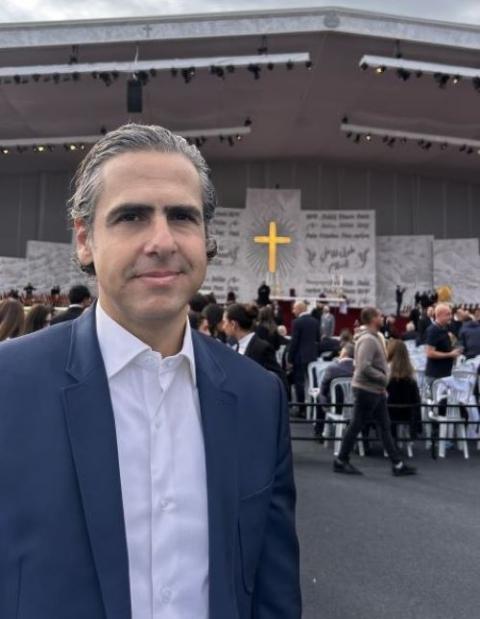
Louis Abou Charaf, a lawyer from the region around Mt. Lebanon, attended the pope's Dec. 2 Mass in Beirut with his wife and child. (NCR photo/Justin McLellan)
Louis Abou Charaf, a lawyer from the region around Mt. Lebanon, attended the Mass with his wife and child. He said his country — which has overcome a civil war, regional conflicts and recurring political instability — "is like a phoenix."
"It dies and lives again; this is the story of Lebanon," he told the National Catholic Reporter.
Charaf said he hoped that the pope’s visit would encourage Lebanon "to be part of the peace process in the region" and send a message to the neighboring countries who become entangled in conflict to "leave Lebanon alone."
In his homily, the pope appealed to Lebanon to "be a prophetic sign of peace" for the whole region.
"This is the dream entrusted to you," Leo said. "It is what the God of peace places in your hands."
Pope prays at blast memorial
But only a short walk from the jubilant crowds gathered for the Mass, the shattered and abandoned Beirut port offered a stark reminder of the country's ongoing crises.
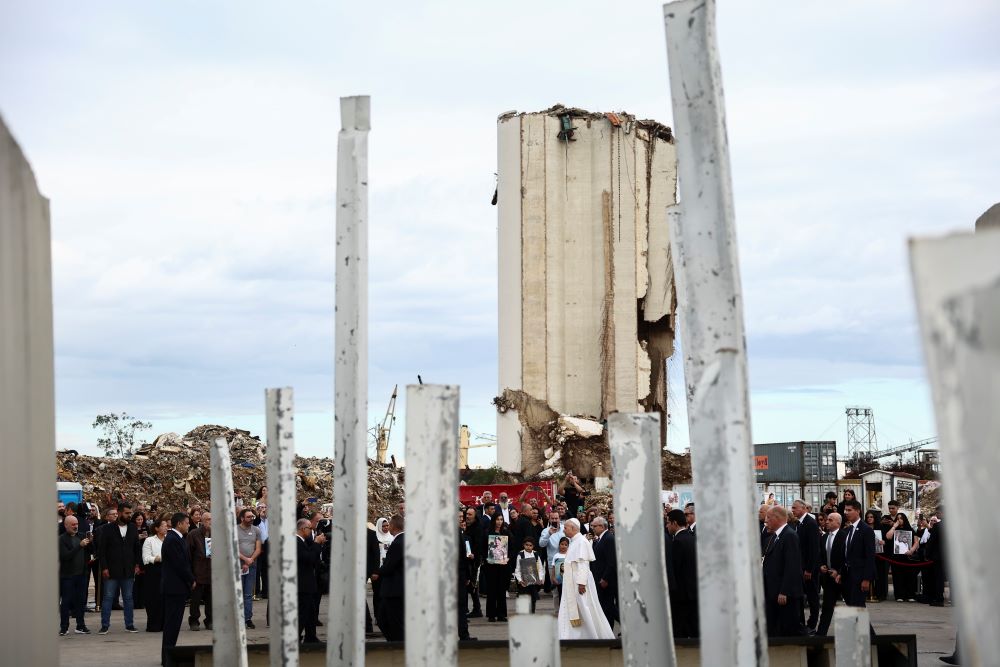
Pope Leo XIV visits the site of the August 2020 Beirut port blast in Lebanon, Dec. 2. Family members gave Leo a scarf with the faces of all the victims of the blast. (CNS/Yara Nardi, pool via Reuters)
The blast, caused by hundreds of tons of improperly stored ammonium nitrate, is widely seen as a symbol of the country's entrenched political corruption and negligence. Investigations into the disaster have repeatedly stalled due to political interference.
Both Leo and Pope Francis before him have publicly pressed Lebanese authorities to ensure justice for the victims.
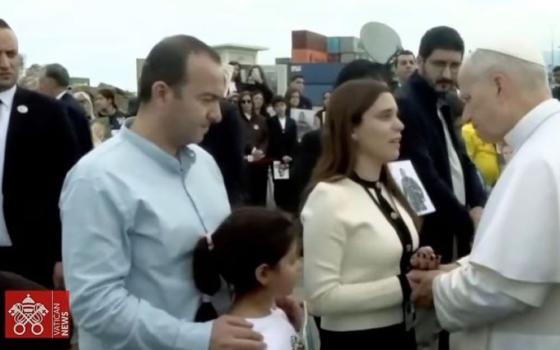
At the memorial marking the blast site, Leo solemnly prayed in silence, placed a wreath and lit a candle. Surrounded by mountains of rubble that remain more than five years later, he greeted families clutching photos of their loved ones: Some were photographed in military uniforms, some in wedding attire and others with captions calling for justice.
Several fought back tears, while others wept openly as they met the pope.
Lebanese Prime Minister Nawaf Salam, whose mother was killed in the 2020 explosion, was also present.
The family members, who met with Francis at the Vatican last year, gave Leo a scarf with the faces of all the victims of the blast, just as they had to his predecessor.
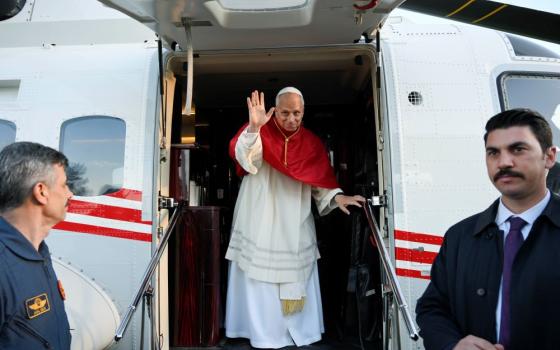
After celebrating Mass, the pope boarded the plane for his four-hour flight to Rome. This return trip from a papal visit is typically an opportunity for an open question-and-answer session between the pope and journalists, something reporters had already experienced on the short flight from Istanbul to Lebanon when Leo took two questions from Turkish media.
The National Catholic Reporter's Rome Bureau is made possible in part by the generosity of Joan and Bob McGrath.