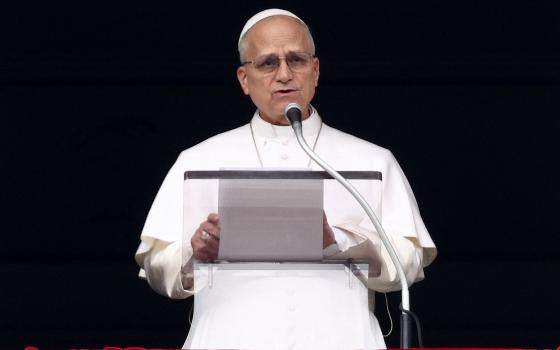
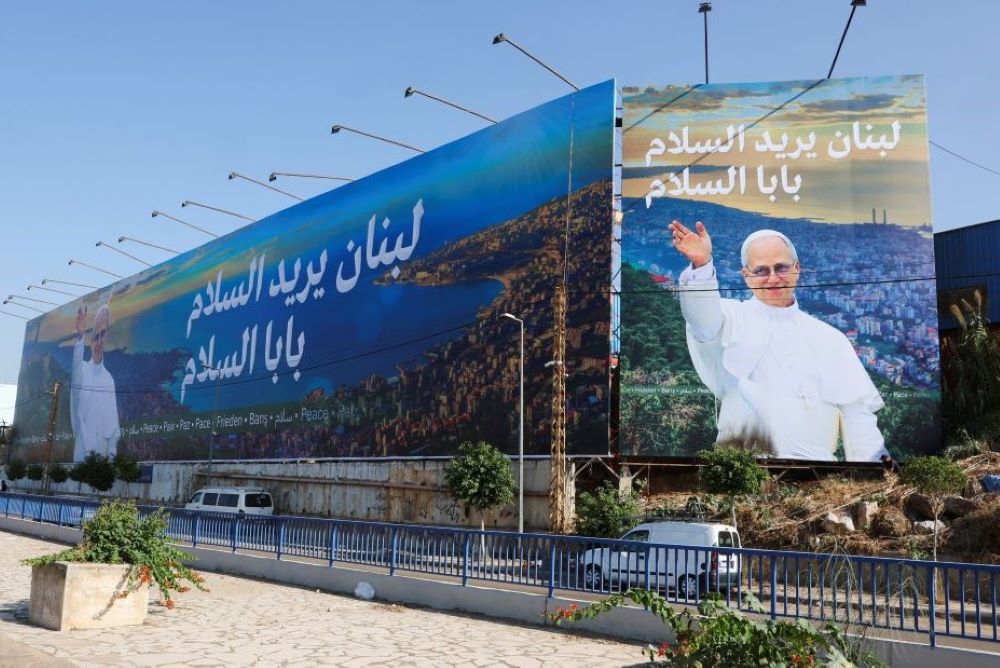
A billboard depicting Pope Leo XIV ahead of his planned visit to Lebanon stands along the main airport road in Beirut Nov. 21. The pope will visit Turkey and Lebanon Nov. 27-Dec. 2, his first trip outside Italy. (OSV News/Reuters/Mohamed Azakir)
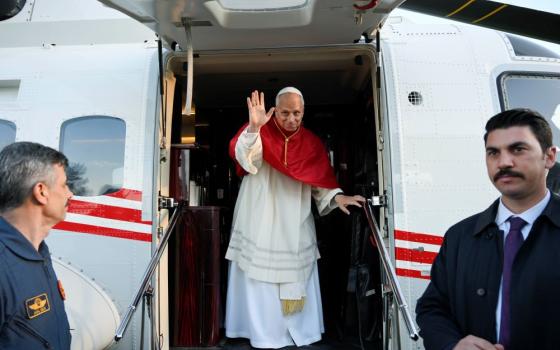
When Pope Leo XIV departs on the first international journey of his pontificate on Nov. 27, he will bring with him the emphasis on unity that has shaped his first six months as pope.
Originally planned under Pope Francis, the trip now offers Leo a chance to show whether his early calls for peace can translate into real momentum, both diplomatically and across religious communities.
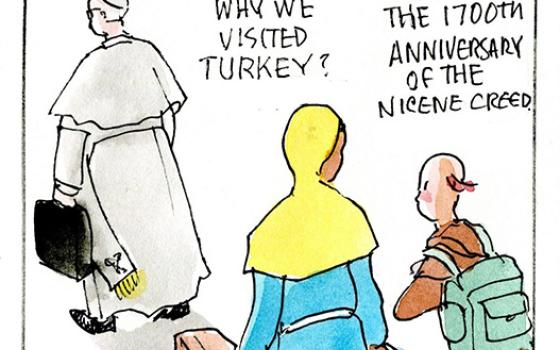
The visit has implications for the Vatican's efforts to shape outcomes in the wars in Ukraine and Gaza, but its centerpiece will be Leo's third meeting with Ecumenical Patriarch Bartholomew, the spiritual leader of the world's 300 million Orthodox Christians, to mark the 1,700th anniversary of the Council of Nicaea.
That fourth-century meeting, convened by the Roman emperor Constantine, produced the original version of the profession of faith still recited by millions of Christians today.
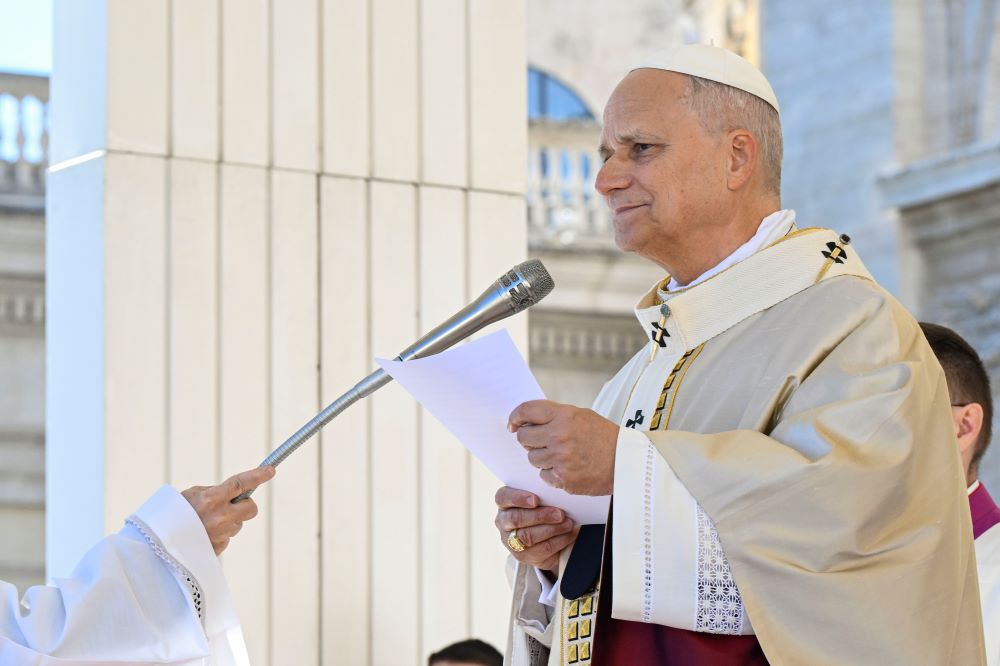
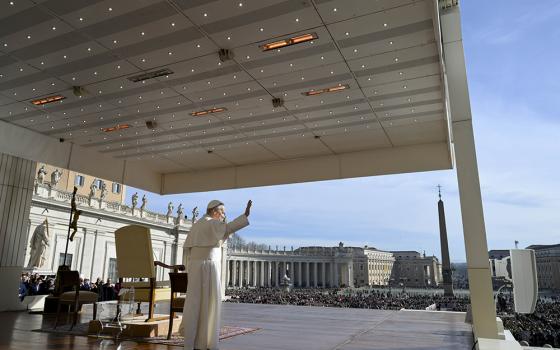
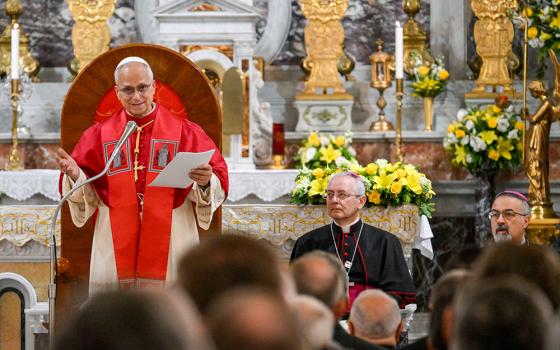
Pope Leo XIV speaks to visitors and pilgrims attending Mass for the Jubilee of Choirs and the feast of Christ the King Nov. 23. At the end of Mass, the pope announced the release of his apostolic letter, "In Unitate Fidei" ("In the Unity of Faith") on the creed and the 1,700th anniversary of the Council of Nicaea. (CNS/Vatican Media)
Ahead of the Nov. 27-Dec. 2 trip, Leo published an apostolic letter — In Unitate Fidei ("In the Unity of Faith") — in which he extolled the "great ecumenical value" of the Nicene Creed and praised it as a "model of true unity in legitimate diversity."
"In a world that is divided and torn apart by many conflicts, the one universal Christian community can be a sign of peace and an instrument of reconciliation, playing a decisive role in the global commitment to peace," Leo wrote. "We must therefore leave behind theological controversies that have lost their raison d'être in order to develop a common understanding and even more, a common prayer to the Holy Spirit, so that he may gather us all together in one faith and one love."
Peacemaking and prayer in Turkey
When Leo touches down in Ankara on Thanksgiving Day, he will meet with Turkish President Recep Tayyip Erdogan. The pope will have been preceded in his visit to the Turkish capital by Ukrainian President Volodymyr Zelenskyy, who has said on X that Turkey "is ready to provide the necessary platform" for discussions to end the war in Ukraine.
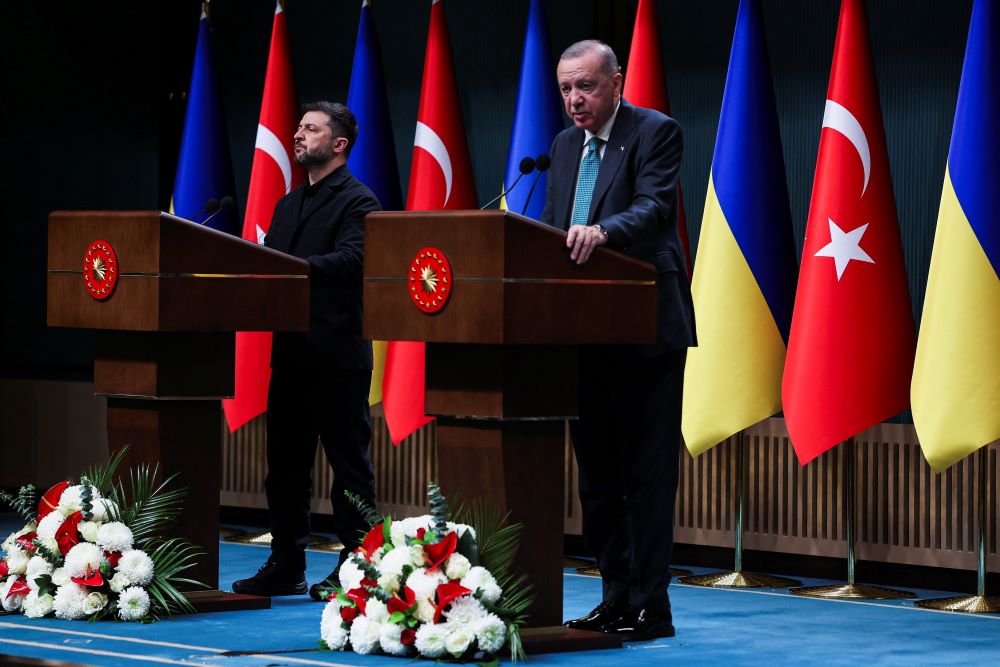
Ukrainian President Volodymyr Zelenskyy and Turkey's President Recep Tayyip Erdogan attend a joint press conference in Ankara, Turkey, Nov. 19. (OSV News/Reuters/Umit Bektas)
Turkey hosted direct talks between Ukraine and Russia in Istanbul three times between May and July, but they failed to produce major breakthroughs. Still, Ankara is one of the few remaining capitals able to speak to both sides, giving Leo's stop there a clear diplomatic dimension.
After the first day of the trip in Ankara, however, Leo's focus will quickly pivot to promoting unity among Catholics and Orthodox Christians.
The pope will travel to Iznik on Nov. 28, the site of ancient Nicaea where the ecumenical council that established a common creed for Christians was first held.
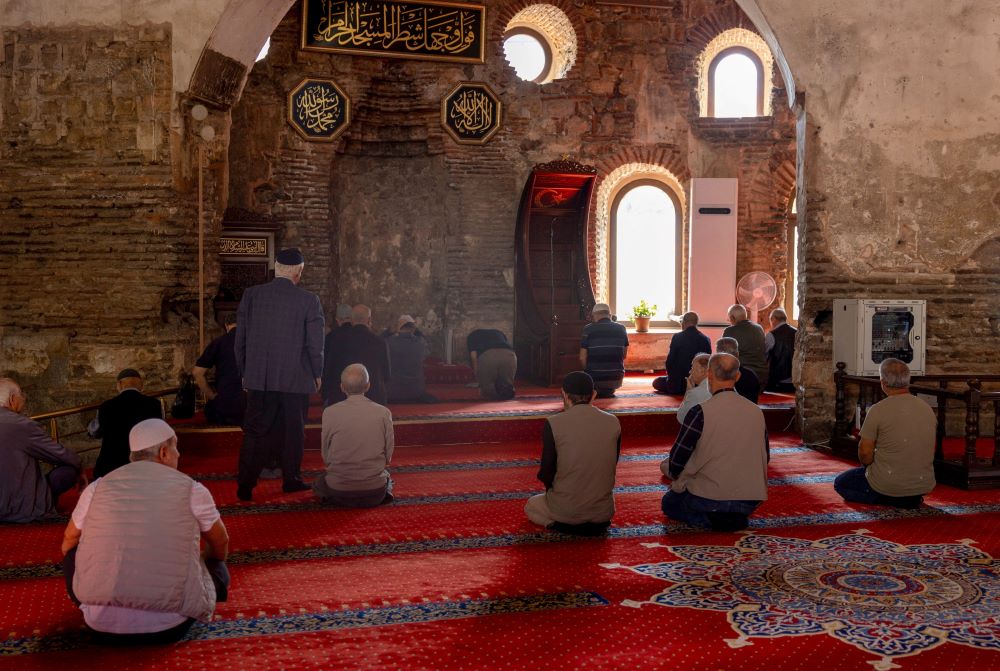
Worshippers attend a noon prayer at Hagia Sophia Mosque in the Turkish northwestern town of Iznik, also known by its ancient name Nicaea, Oct. 8. Pope Leo XIV will visit Iznik city Nov. 28 to mark the 1,700th anniversary of the First Council of Nicaea. (OSV News/Reuters/Umit Bektas)
"The Council of Nicaea was a council of unity in the fourth century, which fortified and strengthened the unity of the church, which was at that time very much divided because of heresies and schisms," Orthodox Metropolitan Job Getcha of Pisida, co-president of the joint international commission for the theological dialogue between the Catholic Church and Orthodox Church.* "Celebrating together the Council of Nicaea is a very powerful message."
Getcha said the joint prayer is historic not only because of the anniversary but also because of the point it comes in Catholic-Orthodox relations, centuries after the official split between the two churches in 1054.
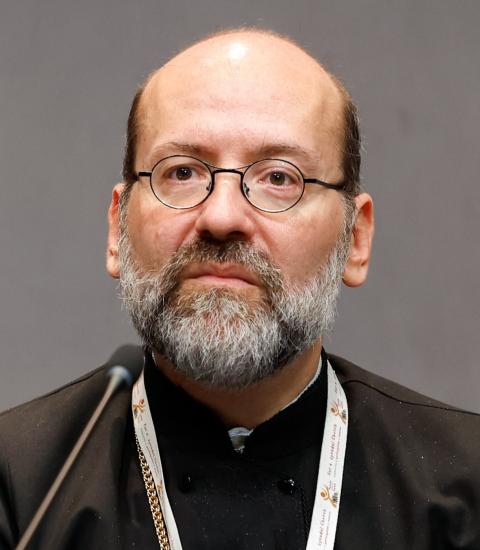
Orthodox Metropolitan Job of Pisidia is the co-president of the joint international commission for the theological dialogue between the Catholic Church and Orthodox Church. (CNS/Lola Gomez)
Recent work in the Joint International Commission for Theological Dialogue between the Catholic and Orthodox Churches has helped advance consensus among the churches on the relationship between synodality, the effort to make a church more communal and participatory, and primacy, the authority exercised by a church's leader.
"These efforts these last few years with Pope Francis, to reflect within the Roman Catholic Church on synodality, I think it's a fruit from that dialogue," Getcha said. "Having reached that mutual understanding now the commission feels that it has matured enough to discuss dividing issues of the past."
On Nov. 29, the pope will visit the Sultan Ahmed Mosque in Istanbul, known as the Blue Mosque and meet with the leaders of various Christian communities before meeting again with Bartholomew to sign a joint declaration.
Paul Gavrilyuk, a professor of modern Orthodox theology at the University of St. Thomas, told NCR that in the declaration "a commitment to potentially formulate the ways in which we could celebrate Easter together would be significant," as well as a pledge "to make peacemaking efforts, both in the Middle East and also in Ukraine."
While recent developments have been encouraging, Gavrilyuk said, several nontheological obstacles prevent a straightforward trend toward unification, namely the uneven reception of ecumenical advances across the Orthodox world.
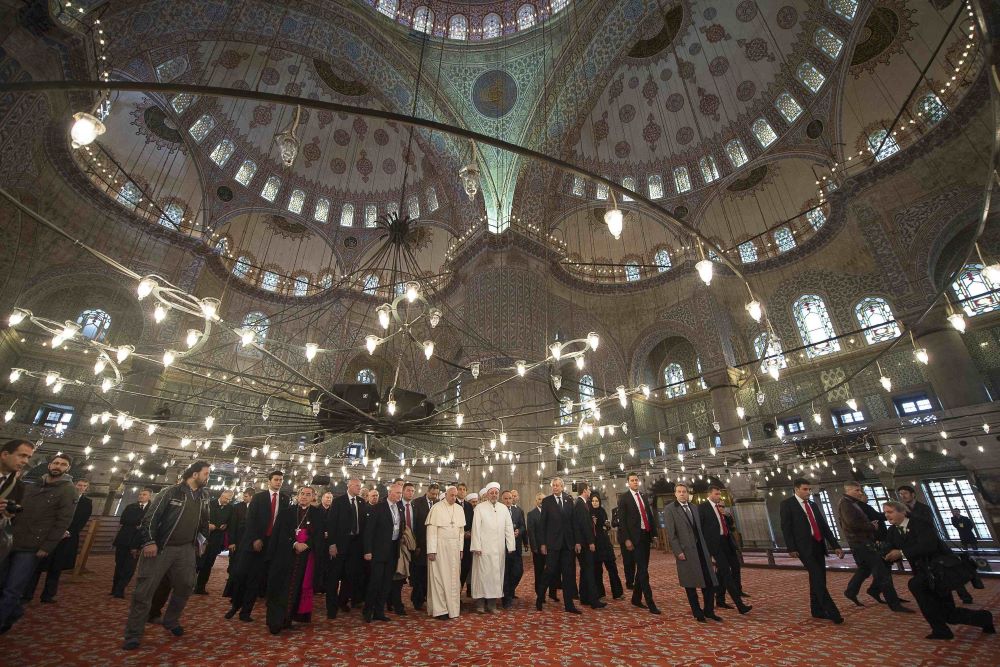
Pope Francis visits the Sultan Ahmed Mosque, also known as the Blue Mosque, in Istanbul in this 2014 file photo. In his first international trip as pontiff, Pope Leo XIV is scheduled to visit the mosque Nov. 29. (CNS/Vatican Media)
"Local churches, especially those that are within the Russian orbit of influence, have paid far less attention to ecumenical developments," Gavrilyuk said. "We are simply on very different ecumenical clocks."
The Orthodox Church has also undergone its own recent schism, after the Moscow Patriarchate unilaterally severed communion with the Ecumenical Patriarchate of Constantinople over its decision to grant independence from Moscow to the Orthodox Church of Ukraine in 2018.
Yet, Gavrilyuk said, praying with the pope at the site of ancient Nicaea sends a message to the entire Orthodox community.
"Symbolic gestures mean a lot," he said. "I think that they signal to the worldwide Orthodox community that there is clarity of vision on the part of Patriarch Bartholomew regarding union, and that he too regards the union with the Catholics as his priority.
Pope in the Middle East
After three days in Turkey, Leo will travel Nov. 30 to Lebanon, arriving in Beirut a week after the capital was struck by an Israeli air raid on Nov. 23 despite an ongoing ceasefire.
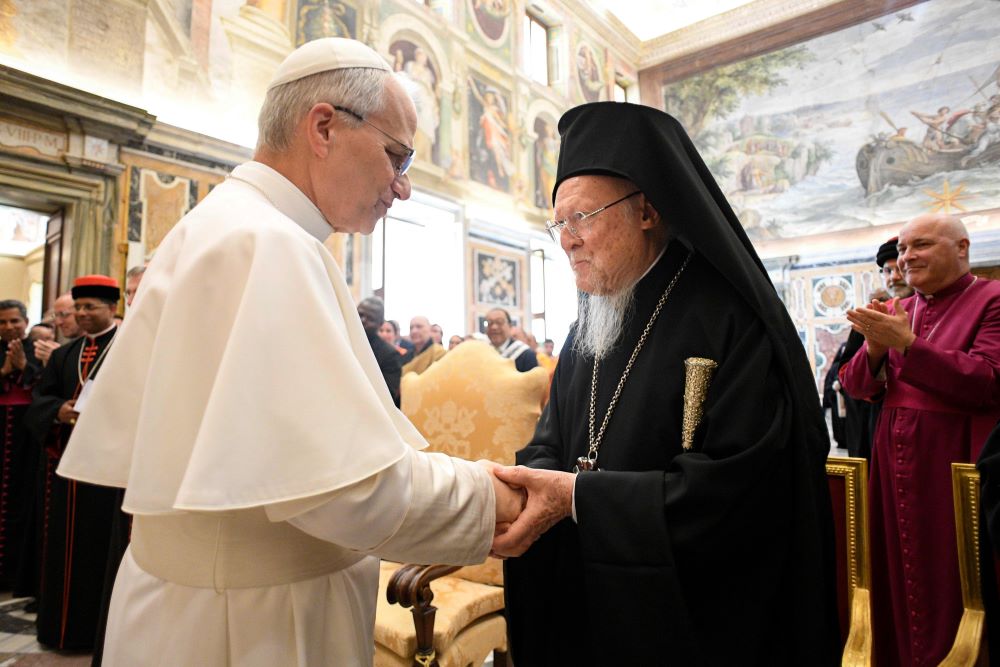
Pope Leo XIV greets Orthodox Ecumenical Patriarch Bartholomew of Constantinople at the Vatican May 19. The patriarch will host Leo at several prayer services and meetings in Istanbul during the pope's first international trip. (CNS/Vatican Media)
The pope's words in the Middle East will be closely scrutinized, offering him the chance to stake a firm position on peace a year after Israel invaded southern Lebanon to attack Hezbollah, the Iran-backed militant group operating out of the country.
But the Vatican's interest in Lebanon predates the most recent rounds of violence. Francis often expressed his desire to travel there and praised its pluralistic society as a model of coexistence.
"The Vatican historically has had a keen interest in Lebanon and specifically a genuine concern for its Christian community," said Habib Malik, a retired professor of history at the Lebanese American University. That concern, he noted, is rooted in the fact that Lebanese Christians, and especially the Maronites, have managed to retain a degree of freedom in practicing their faith that distinguishes them from other native Christian communities across the Middle East.
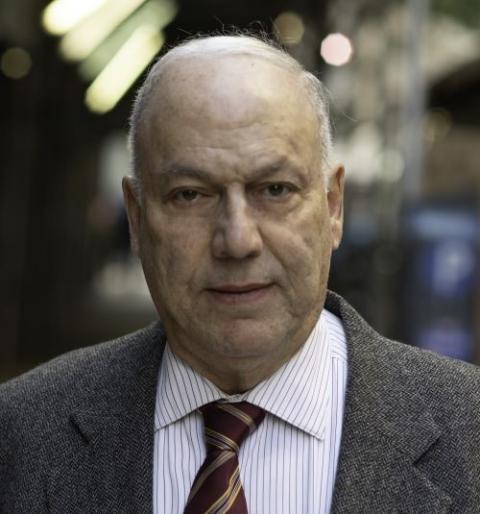
Habib Malik is a retired professor of history at the Lebanese American University. (Courtesy of Habib Malik)
The Christian population has declined from about half of Lebanon's population in 1932 to roughly one‑third today, according to 2021 CIA Factbook data.
While Leo will address Lebanon's Christians, who make up the highest proportion of Christians in any Arab country, the message of coexistence and collaboration he is expected to deliver will resonate across the country's diverse religious communities.
"Emphasizing free, native, rooted communities, especially among Christians," Malik told NCR, "that has an osmotic, positive effect on other communities that coexist with it."
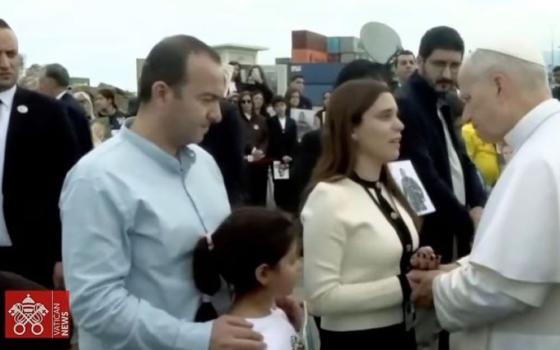
Since 2019, Lebanon has been marked by economic collapse that has induced widespread poverty. In 2020, an explosion in the port of Beirut, where Leo will go to pray Dec. 2, killed 220 people and razed buildings and infrastructure in a predominantly Christian area of the city. Last year, southern Lebanon was invaded by Israel during its conflict with Hezbollah which continues to produce violence.
Yet on the tail of those hardships, "there is a very unique historical opportunity for Lebanon to turn the page," Malik said. With Hezbollah significantly weakened by its conflict with Israel and neighboring Syria reaching a stability unseen since its civil war began in 2011, Leo can articulate the role that Lebanon can play in rebuilding the region.
"A good message would be to emphasize positive neutrality on the part of Lebanon, and that this should be accepted by its neighbors and the international community," he said. Leo could advocate for a Lebanon "not beholden" to surrounding powers or drawn into regional power dynamics, he said.
Leo's first international trip
Tethered to Rome to see through the current Jubilee year opened by his predecessor, Leo has until now revealed himself largely through scripted Vatican events. His first international journey places him in a new context where a different side of the pope may come into view.
While he has generally stayed close to his prepared texts, Leo has not hesitated to issue forceful public appeals for peace or to speak plainly about human dignity, including in comments to reporters on U.S. immigration. Observers will be watching whether that directness surfaces during moments such as the open-air Mass in Beirut, which is expected to draw some 100,000 people.
What remains to be seen is how Leo will step into the larger stage his first international trip affords him: how he will meet the energy of the crowds gathering to see him, whether unscripted gestures will emerge and what tone he will set during the highly anticipated airborne press conference on the return to Rome — a venue that, during the Francis pontificate, often proved fertile ground for headlines.
The National Catholic Reporter's Rome Bureau is made possible in part by the generosity of Joan and Bob McGrath.
*Editor's note: This story has been updated to reflect Getcha's new title.
Advertisement