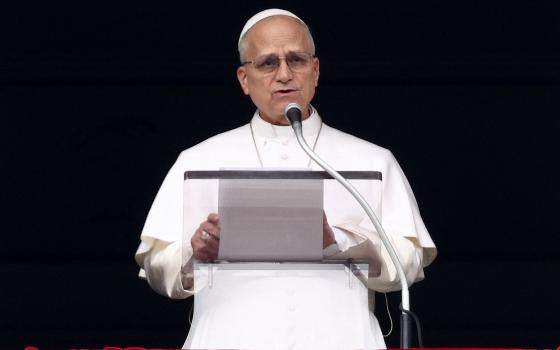
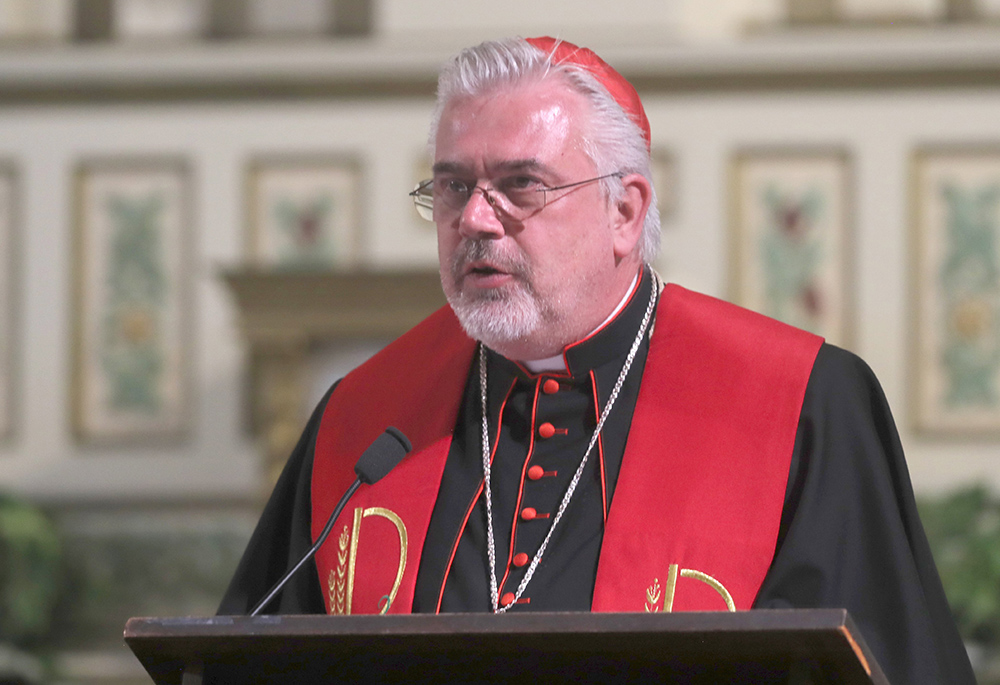
Cardinal Fabio Baggio of Bassano del Grappa, Italy, the undersecretary of the Vatican's Dicastery for Promoting Integral Human Development, speaks during a prayer vigil at Sacred Heart Church in El Paso March 24, 2025, following a rally and march against mass deportations by the U.S. government. (OSV News/Bob Roller)

The cardinal charged with overseeing the Vatican's study and response of the global migratory phenomena called for expanded legal pathways for migrants and called out a misrepresentative "negative narrative" about the church's migration work.
Cardinal Fabio Baggio, undersecretary of the Dicastery for Promoting Integral Human Development and the Vatican's chief reference point on migration, told the National Catholic Reporter Feb. 19 that Pope Leo XIV shares the "the same pastoral concern" on migration as Pope Francis, who made caring for migrants a cornerstone of his pontificate.
In the same conversation, conducted in Italian, the cardinal pushed back on criticism that the church engages in issues around migration because it seeks funding from governments, stating that the global Catholic Church often acts to support migrants "without the necessary funds to do so."
Migrants present in countries in irregular situations, he said, "are children of God and persons knocking at the door of charity from our communities" who must not be discriminated against.
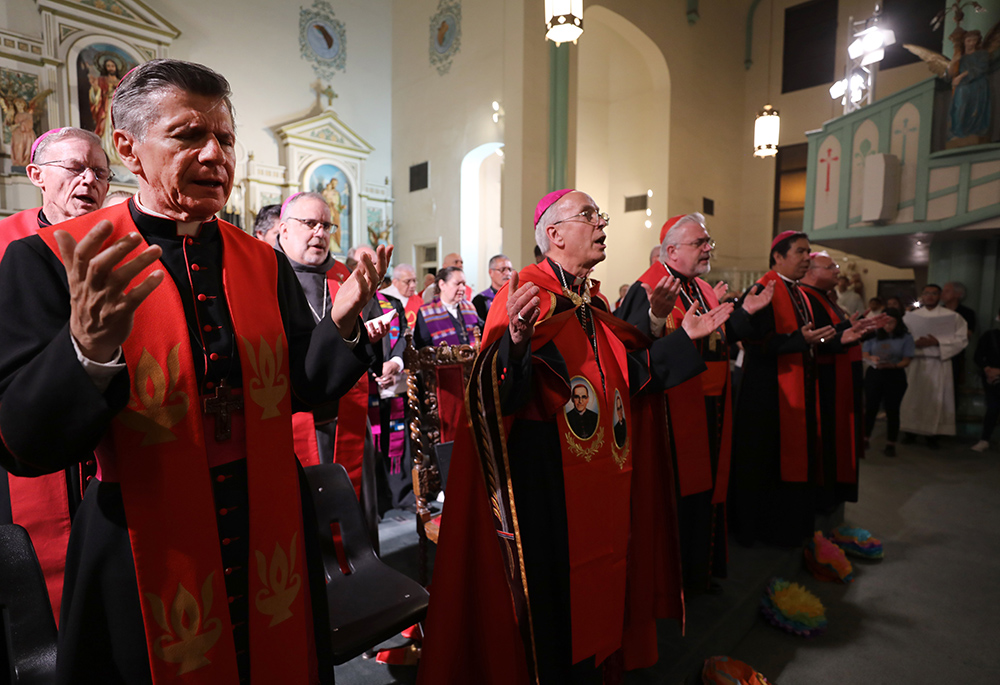
Archbishop Gustavo García-Siller of San Antonio; Archbishop John C. Wester of Santa Fe, New Mexico, back left, Bishop John E. Stowe of Lexington, Kentucky; Bishop Mark J. Seitz of El Paso, Texas, front center, and Cardinal Fabio Baggio of Bassano del Grappa, Italy, the undersecretary of the Vatican's Dicastery for Promoting Integral Human Development, and other prelates pray during a vigil at Sacred Heart Church in El Paso March 24, 2025, following a rally and march protesting mass deportations by the U.S. government. (OSV News/Bob Roller)
The cardinal said that Leo, who he meets with monthly, is on the "right path" in how he engages with local churches in effecting responses on issues around migration. Baggio said the technocratic challenges before the pope and the church include "artificial intelligence that will affect employment and a widespread sense of producing elite communities" that disproportionately hoard society's resources.
On the same day as NCR's interview, the Vatican announced that Leo will visit Lampedusa on July 4, the same migrant hotspot that Francis visited for the first trip of his pontificate outside Rome and which set the tone for his advocacy on behalf of migrants over his 12-year pontificate.
This interview has been edited for length and clarity.
NCR: As a Scalabrinian missionary, you have long worked with migrants. Among your postings was serving in Argentina from 1997-2002 where you worked with then-Archbishop Bergoglio, the future Pope Francis. Could you see then how migration would later become a priority for the future pope?
Baggio: In Buenos Aires, I worked as director of the office dedicated to migrant pastoral care of the archdiocese. In my first year [Bergoglio] was engaged with other matters as coadjutor bishop. Beginning in the second year, however, he drew closer to the office. From that moment a kind of spark was born. He immediately demonstrated great concern. He always had this focus on the least, on the poor, on the marginalized. And he discovered that the villas miserias [shanytowns] of Buenos Aires were heavily populated by migrants who, in addition to poverty and the difficulty of not being able to sustain themselves, also carried the stigma of being foreigners, sometimes with an irregular status in the Argentine context, in a capital city that already had its own difficulties.
And it was Pope Francis who named you undersecretary of the Dicastery for Integral Human Development in 2016 to lead its section on migrants and refugees. Ten years later, what have you seen to be the biggest shifts in the global migration landscape?
I must say that beginning with the third millennium there have been significant changes in how we read migration flows. These changes have been due in particular to processes of globalization which have led, for example, to easier access to migration for many people who were previously excluded. Globalization meant that many countries that previously were not countries of departure, transit, or arrival became so. Travel has become cheaper and easier. There has also been greater attractiveness, especially for migrants with particular skills, movements of so-called white collar workers, professionals. I must say that in the last 10 or 20 years, forced migration has increased enormously. We see that more and more people are compelled to leave their territories because of conflicts. There has been an increase in those displaced because of natural disasters and the climate crisis that we are living through.
At the same time, there has been what we could call a negative response from some communities and countries. They perceive this increase — especially when it involves forced migrants who arrive without passing through formal channels such as visas or passports — and they perceive it as a strong threat.
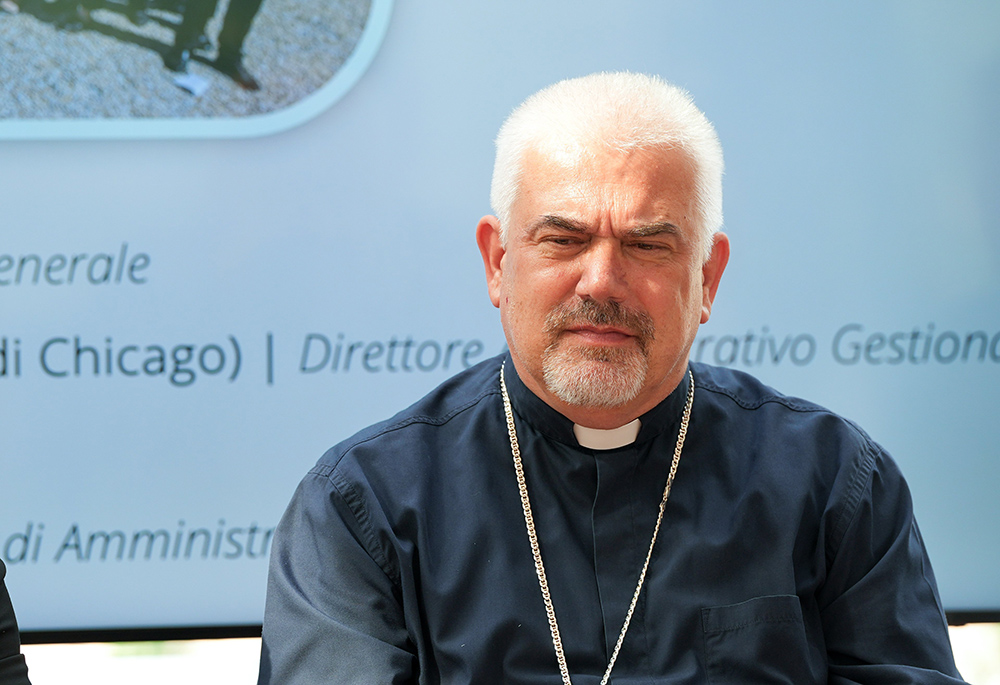
Cardinal Fabio Baggio, undersecretary of the Dicastery for Promoting Integral Human Development and director general of the Laudato Si' Center for Higher Education, speaks during a press preview of the Borgo Laudato Si' initiative in Castel Gandolfo, Italy, Sept. 2, 2025. (CNS/Lola Gomez)
You have spoken before about an increase in the spread of "negative narratives" around migrants in recent years. How do you explain this phenomenon?
I am a historian by profession, and I must say that this has never been absent, even in other moments of mass migration, for example at the end of the 19th century, or after the Second World War. These attitudes and expressions that oppose large arrivals of people in communities that are not prepared, or have not been prepared, for such arrivals have always existed. When there is an identity crisis, the arrival of new cultures and new religions can create additional fear. These fears can be exaggerated and exacerbated by narratives that focus only on negative issues — lack of integration, criminality, terrorism, just to name a few. If attention is focused only on those aspects, one is left with a substantially negative image of the migrant and the refugee.
Language itself is a very important factor. When language shifts, it can itself lead to discrimination. We move from speaking of a person, the subject, to substantivizing adjectives: "migrant" in itself is a present participle, a person who is traveling. But now it becomes "the migrant," as if that person never ceases to be a migrant. It seems that even in the third generation someone can still be labeled that way, when grammatically it is only a participle.
Or even, "criminal," which is often said.
Yes, the use of "clandestine," or worse still the use of "illegal." Today the person as subject has been lost, the migrant, and people speak only of "illegals," and everyone knows what we are referring to. As if the only people who violate a law are migrants who enter illegally into a country. But someone who runs a red light, is he an illegal driver? Why is only this category [migration] labeled with illegality, when there are many other forms that are far more serious? We find ourselves faced with a language that is itself an instrument, let's say, for perpetuating fear or exacerbating fear.
There are more or less 280 million international migrants around the world. The vast majority of these have documents, are legally present in the countries where they live, they work, they are integrated. Yet a small group of people who are present in irregular situations, or an even smaller group of criminals, seems almost to become more important or to at least determine the majority of people's perception regarding migrants.
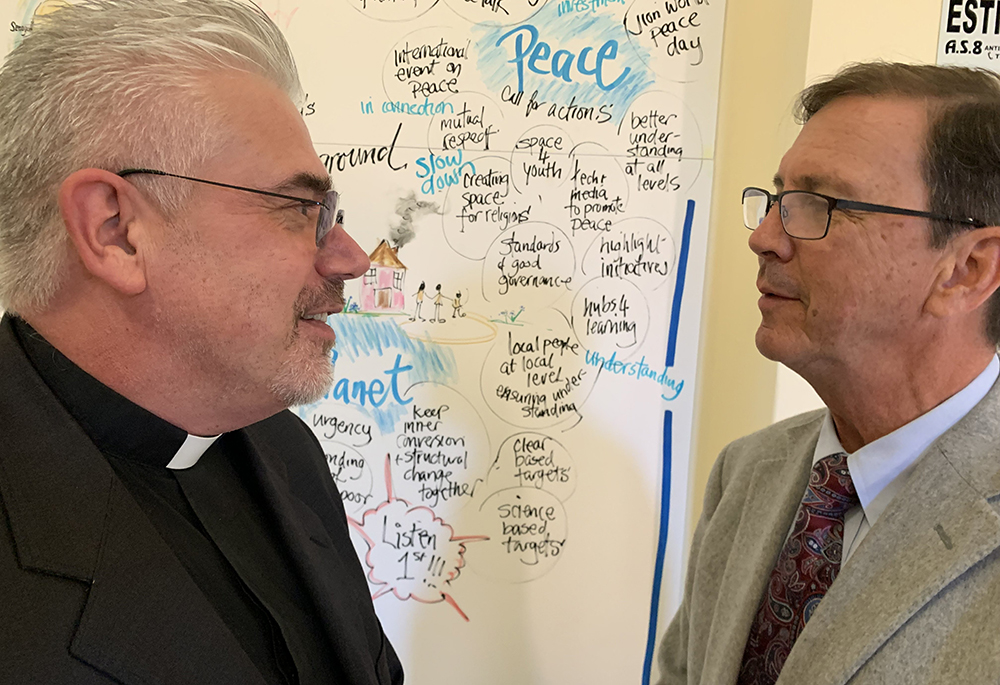
Scalabrinian Fr. Fabio Baggio, undersecretary of the Dicastery for Promoting Integral Human Development, and William Canny, executive director of the U.S. bishops' Migration and Refugee Services, talk during a break at a conference on immigration in Rome Sept. 26, 2022. The conference looked at ways to promote and support community sponsorship of refugees. (CNS/Cindy Wooden)
In the debate around migration, many, including Catholic civic leaders, cite the catechism's teaching that states have an obligation to welcome the foreigner "to the extent they are able." What kind of guidance can you provide in terms of how to apply that?
Many articles have been written about this. We wrote the "20 Action Points" in preparation for the [United Nations] global compacts on refugees and migrants [in 2018] where we addressed, from various perspectives, the question of reconciling rights and duties imposed by international conventions.
The national sovereignty of each country and the right to monitor and to identify all those who request access and, to even deny access in case of danger, has never been questioned. I think that has never been put up for debate. The problem is creating alternatives to the irregular flows of people, because restrictive measures can sometimes produce the opposite effect. Instead of slowing migration, they open back doors.
This absolutely does not mean that the church has favored illegal immigration. I do not think there has ever been a document saying, "Yes, let us favor illegal immigration." Absolutely not. What we have always said is that in order to combat illegal immigration, which is often exploited for profit by immigration agents, traffickers, and so on, one must expand regular corridors of migration. These legal flows of migration have always existed historically, and at certain historical moments, for reasons of fear, they are no longer considered feasible.
Advertisement
We are convinced that particular attention must be paid to those who knock at the doors as forced migrants. There is a Geneva Convention that obliges us to pay attention to these persons, at least for the signatories. And the second point, equally important, is how people are treated. Nobody loses their rights. Fundamental rights remain fundamental rights. A third important point is that the person is not alone but part of a family. Hence our insistence on family reunification, that families be allowed to remain united.
And finally, even people in irregular situations: While they must be guided toward regularizing their situation, they are children of God and persons knocking at the door of charity from our communities. They must not be discriminated against in that charity. They must always be accompanied toward regularization, which we hope will increasingly be offered, because in the end whether a visa or a passport is granted is largely an administrative question.
How can the church respond to criticism that it is becoming too political by engaging on issues of migration?
I would respond as [Jacques] Maritain [a French Catholic philosopher and theologian] explained: We are not political actors because we are Christians, but we are political as Christians. That is to say, whenever we engage in the political sphere, we do not do so because we are Christians representing a political party, but we do so as Christians guided by the principles of Catholic social doctrine, principles from which we cannot exempt ourselves and which we cannot set aside when we exercise our public responsibilities, because they are the ethical and moral guide of our lives.
To state it more clearly: I never cease to be a baptized disciple of Jesus Christ. The fundamental law for me is always the law of the Gospel. I will therefore try to ensure that it is always present when interpreting legislation in one situation or another. The law of the Gospel is important. And it is important not to fall into the temptation of a selective reading of the Gospel, taking only those parts that suit a particular position and forgetting the other parts that are very, very important. Prophecy does not mean political engagement in a partisan sense. One cannot simply move from one side to another, but prophecy means the capacity to say what, according to the heart of God, must be said at a particular moment.
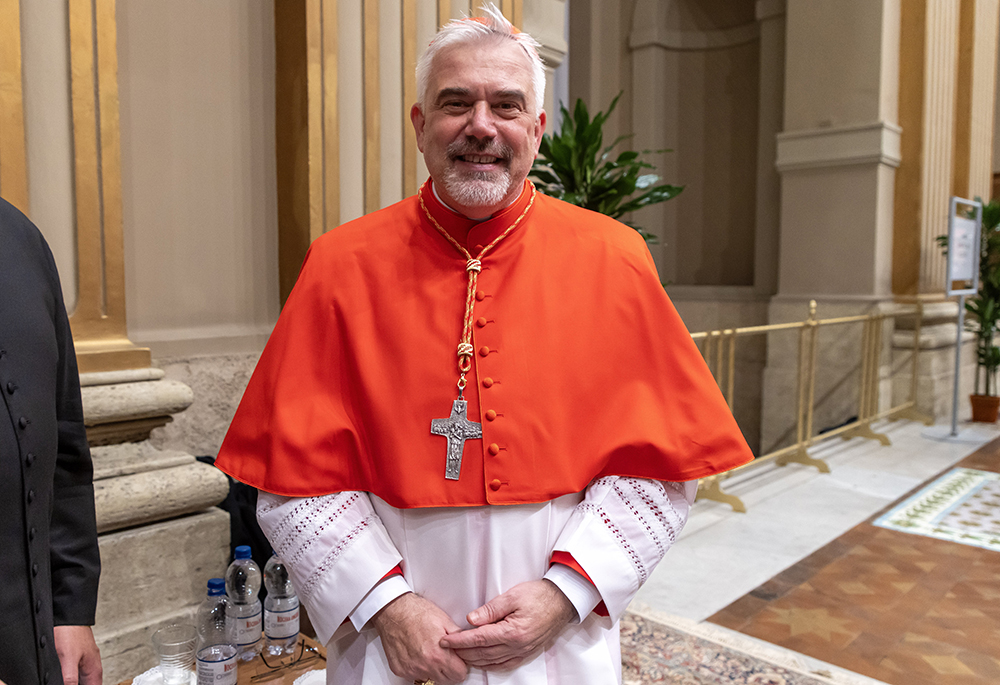
Cardinal Fabio Baggio, undersecretary and head of the section for migrants and refugees at the Dicastery for Promoting Integral Human Development, poses for a portrait in the Apostolic Palace at the Vatican Dec. 7, 2024. (CNS/Pablo Esparza)
How do you respond to the perception that the church is involving itself in issues of migration to solicit funding from the state, that it becomes a sort of business for the church?
Let us say this clearly: if the commitment made by church authorities [on migration] were determined only by financial gain, obviously it would make no sense. It certainly would not be praiseworthy. In my experience, and I say this after having visited many local churches, I have found instead a great deal of commitment carried out even without the necessary funds to do so.
I would like to observe all the good practices of the Catholic Church throughout the world and see how many of them are financed by government funds and how many are financed by the charity of our communities. From my experience as a missionary, I must say that much more often it has been the charity of the people we have encountered. I do not want to cite percentages, but in my experience a very large percentage has been sustained by charity. Moreover, many services are not paid at all because they are the fruit of volunteers who place themselves at the service of the church. So once again, this is part of a negative narrative that perhaps highlights some problem or some critical case that may have existed, but that does not represent the general picture.
A criticism that has been made when confronted with the church's position on immigration is to say, "The Vatican has walls. Why doesn't the Vatican open its walls and let migrants enter there?"
This criticism is rather superficial, let's say. The Vatican is 43 hectares [about 106 acres] of land — Vatican City — with, I believe, 600 or 700 citizens. I am one of them, even if I do not live inside the territory. Pope Francis personally responded to this criticism by welcoming people within the Vatican. I want to recall that he received some people through humanitarian corridors together with the Community of Sant'Egidio, even bringing families with him on the plane.
But that is not the point. The church's response is seen in what the Italian church and local churches throughout the world have done by striving to ensure that once legal permissions are granted, processes of accompaniment and integration are initiated. We have collected hundreds of good practices, which we gather each year in small volumes available on the website under the heading "Pastoral Reports."
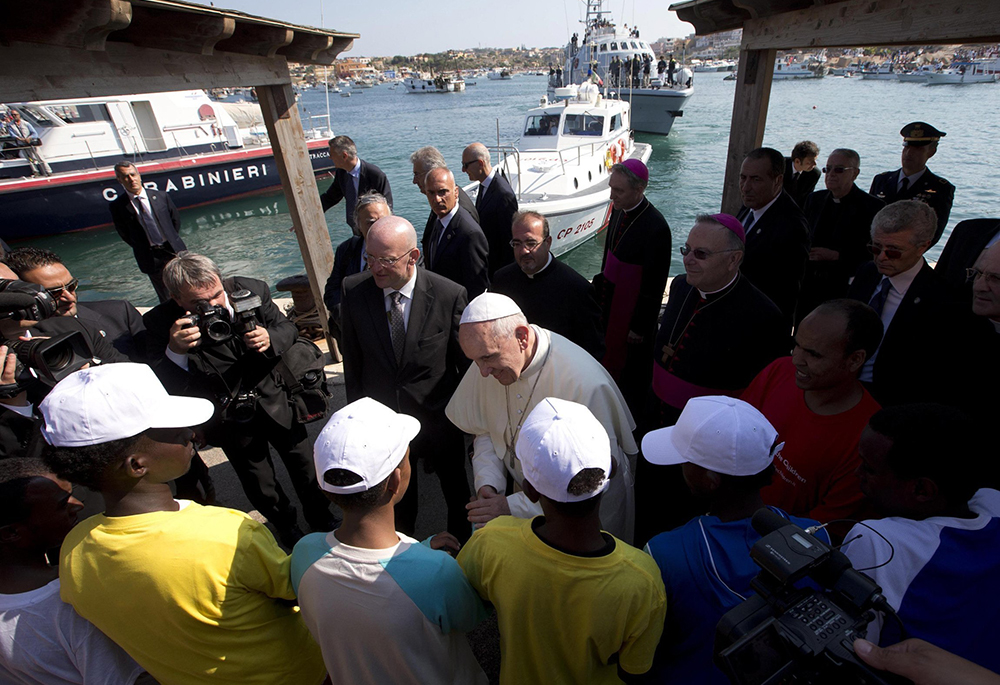
Pope Francis talks with immigrants at the port in Lampedusa, Italy, July 8, 2013. Two months after his election, the late pope visited the tiny Italian island in the Mediterranean Sea to draw attention to those who had lost their lives attempting the crossing from the African coast. On Feb. 19, 2026, the Vatican announced that Lampedusa will be one of six destinations for upcoming day trips Pope Leo XIV will make. (CNS/pool via Reuters)
Can you try to explain the impact that Pope Francis had on the global conversation around migration?
Given the particular situation that developed from 2013 onward with these great upheavals caused by forced migration, Pope Francis' voice was, on many occasions, the only authoritative voice raised in defense [of migrants]. I remember very clearly that beautiful homily in Lampedusa, the first trip of his pontificate, where he drew our attention to the human poverty and abandonment of the least revealed there in such a tragic way. I believe that all of his engagement in the years that followed effectively highlighted a way of being that took root among the church's pastoral workers. He created a sensitivity around this topic that was not previously present.
[Migration] became much more discussed within the church; many bishops began asking themselves more questions. Many offices for migrants were established during those years. I don't know how many religious congregations went so far to even change their constitutions to include, among the recipients of their mission, migrants, refugees, displaced persons, victims of trafficking. I believe this is undoubtedly a merit of Francis' pontificate.
But Francis rooted everything in what had already been done before. If one takes the whole trajectory from Rerum Novarum onward, the church has always been present in crucial moments, even if it codified its thinking particularly with the apostolic constitution Exsul Familia of Pius XII. And Pope Leo [XIV], interestingly enough, is himself a migrant as Bergoglio was, with his own family history and different cultural elements. In his missionary experience he himself lived as a migrant, traveling in his religious life and as a bishop and then coming to Rome. I believe it was almost a natural preparation to continue in the same line as Francis and with the same concern [on migration].
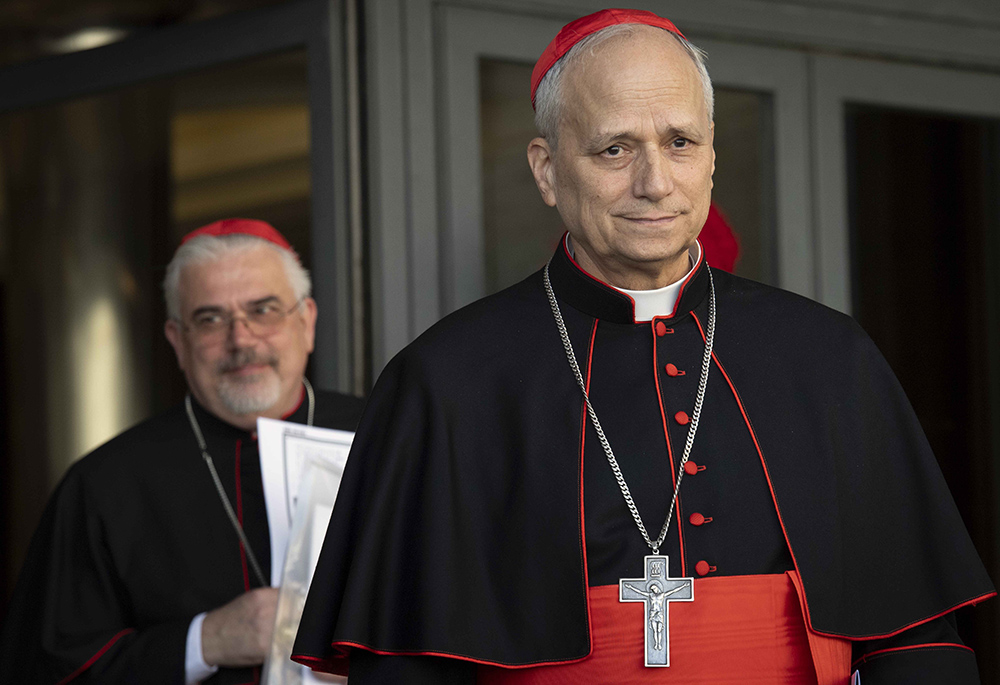
Then-Cardinal Robert F. Prevost, prefect of the Dicastery for Bishops under Pope Francis, leaves the Vatican Synod Hall April 22, 2025, after the first general congregation of the College of Cardinals. Cardinal Fabio Baggio, undersecretary of the Dicastery for Promoting Integral Human Development, walks out behind him. (CNS/Vatican Media)
Did you have much collaboration with Cardinal Prevost before he became pope?
As dicasteries we met from time to time. We have actions that we normally carry out as interdicasterial initiatives. Under the Dicastery for Bishops there is also the Commission for Latin America, with which we always collaborated. So there was always the opportunity to see one another and to get to know one another better. And I must say that from my point of view, the action of the Holy Spirit in the conclave was evident. It gave us the right person for the time.
So surely it seemed to me from his early speeches that this idea of sustaining ecclesial communion, of being united in this particular moment of history, is very important for us. That we not give in to temptations of division, but unite more and more. If love for the poor and the least, among whom migrants and refugees have often been mentioned, is important, then so is a commitment to global justice, to a just economy, and at the same time to care for our common home. And here I see, once again, the concerns of Pope Francis.
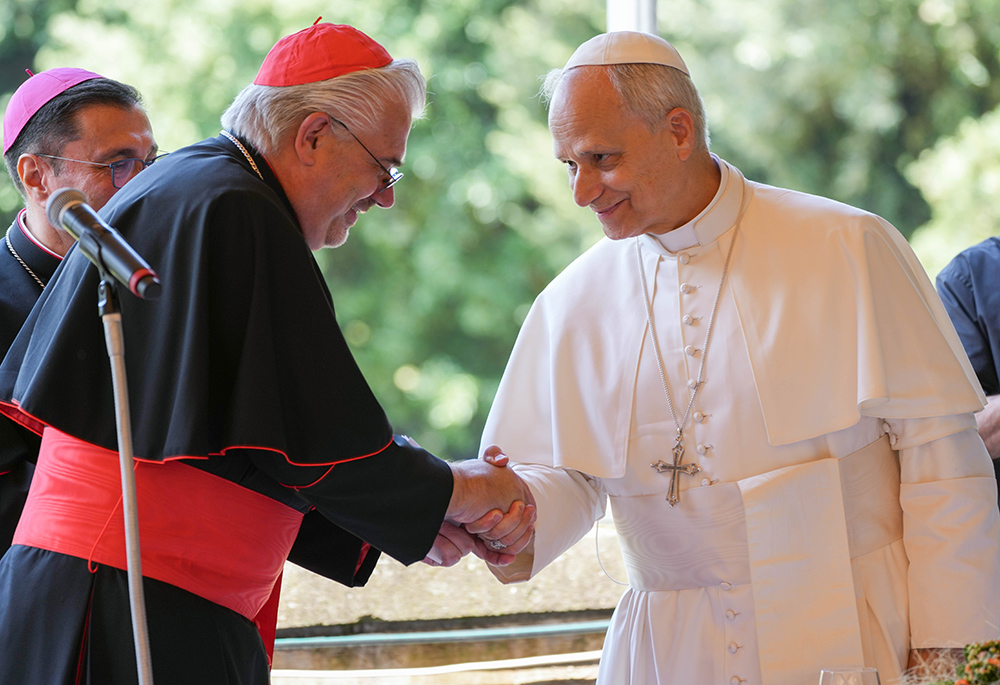
Pope Leo XIV shakes hands with Cardinal Fabio Baggio, undersecretary of the Dicastery for Promoting Integral Human Development, at the start of a luncheon with guests assisted by the Albano diocesan Caritas agency at the Borgo Laudato Si’ in Castel Gandolfo, Italy, Aug. 17, 2025. (CNS/Lola Gomez)
How have you seen Leo continue to be a prophetic voice on migration?
Pope Leo certainly has a different way of expressing his concern than Pope Francis did. Pope Francis emphasized very symbolic gestures that often accompanied his words. Pope Leo, I see, is very prepared in his words. When he speaks, his words are extremely dense in meaning. This is a difference in attitude between the two pontiffs, but they are not different in substance. I say this from the perspective of someone responsible for migration within the dicastery, receiving instructions on these matters and meeting monthly with Pope Leo. I see the same pastoral concern and pastoral solicitude that Pope Francis had, expressed in different ways because they are two different people. I believe that the times also determine the choices that must be made. As I said before, every pope is right for his time, and one must give each pope the time of his pontificate to put into practice what he has in mind.
If we think about the beginning of Pope Francis' pontificate, in the first two or three years he refined and focused on certain themes. Laudato Si', for example, also emerged in the context of the [2015] Paris Climate Conference, showing how ecological concern was a major step forward in Catholic social doctrine under Pope Francis. Time is necessary. Each will have his time to manifest clearly the fundamental points that will characterize his pontificate.
After Francis, what are the steps that Leo needs to take on the issue of migration?
I am convinced that Pope Leo has taken the right path, which is to continue engaging directly with local churches and bishops to ensure that there is sensitivity, awareness, and a pastoral capacity to respond to the various needs and critical situations that are coming up. We must look at the world 20 years from now, 30 years from now, with all the technocratic challenges that we will have and which will affect work, artificial intelligence that will affect employment and a widespread sense of producing elite communities that live with all the resources while the rest work so that those elites may have them. This was something Pope Francis pointed out, that we are moving in a direction where a few will enjoy great resources and many will enjoy very few. The inversion of this paradigm is still possible, but it must begin with small changes made at the local level.
If I had to identify the challenges for the near future at the level of migration, I would say this: While we work so that every country can develop and guarantee the right not to emigrate, we must also work so that migration becomes increasingly safe, regular, and orderly as the [UN] Global Compact says, so that families can remain united and everyone is treated equally. This can only be realized through bilateral and multilateral dialogue, by implementing what has already been written in various conventions and especially in the Global Compact. And above all, the person must be at the center of every consideration and every plan.
The National Catholic Reporter's Rome Bureau is made possible in part by the generosity of Joan and Bob McGrath.