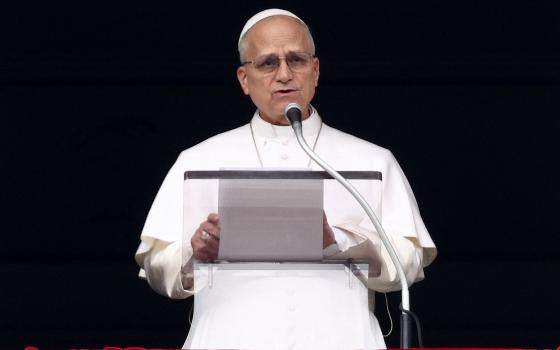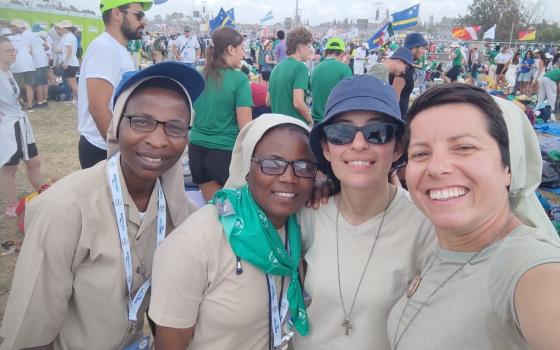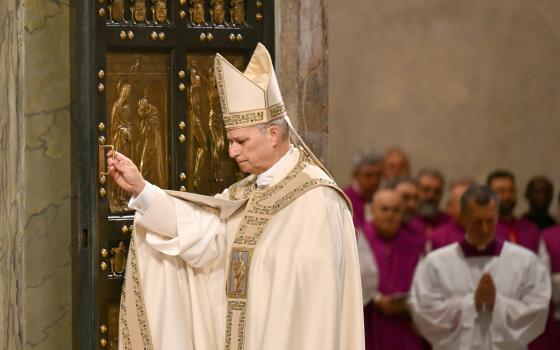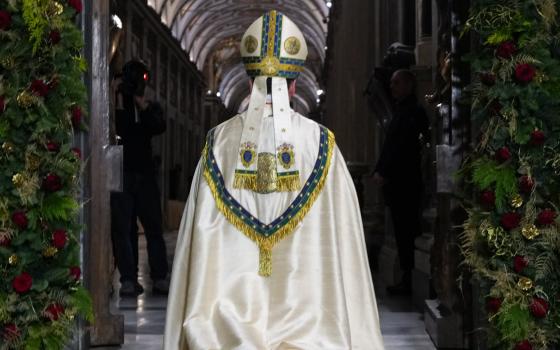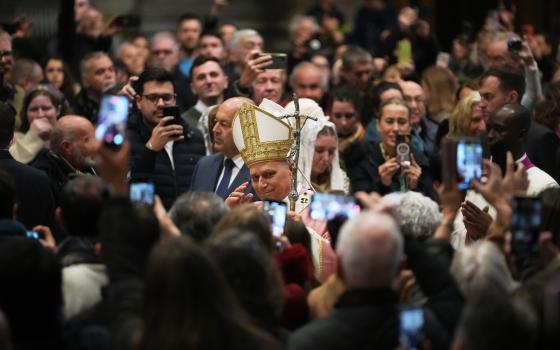
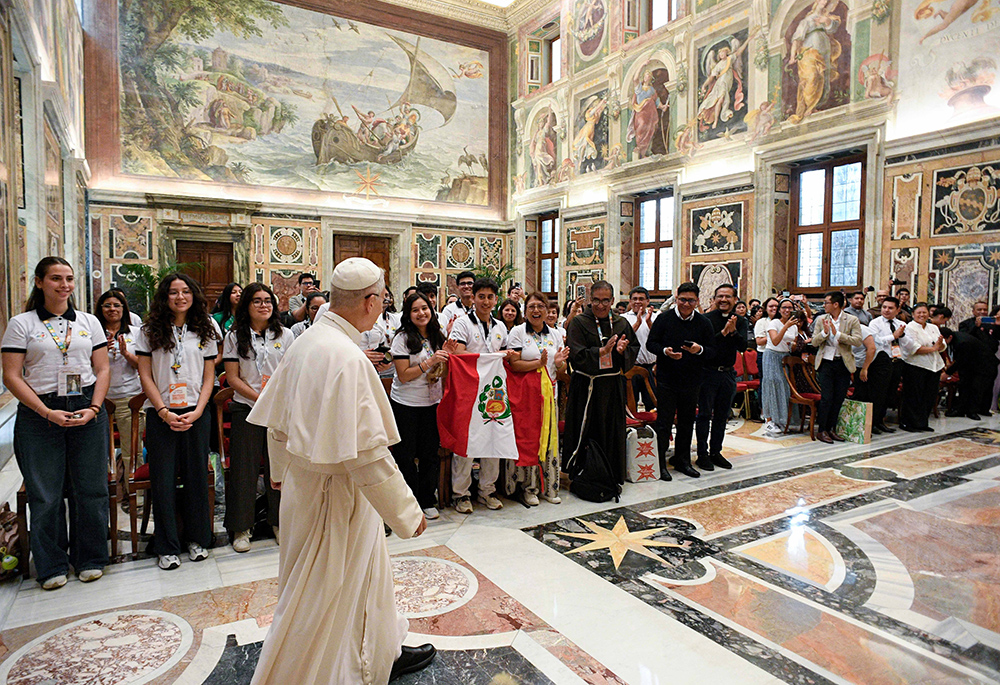
Pope Leo XIV meets with a group of young people from Peru at the Vatican July 28, 2025, as the Jubilee of Youth kicks off in Rome. (CNS/Vatican Media)

"Todos, todos, todos." With those three unscripted words, Pope Francis distilled a decade of his pontificate into a single moment and delivered a rallying cry for its final 20 months. The church, he told thousands of young people gathered in Portugal for World Youth Day celebrations, is for "everyone, everyone, everyone."
Such encounters between popes and throngs of young people — spontaneous, emotionally charged, and widely echoed — have often become illuminating moments, encapsulating a pontiff's tone and style in a single exchange.
A phrase, a gesture, even a smile can crystallize how a papacy is perceived.
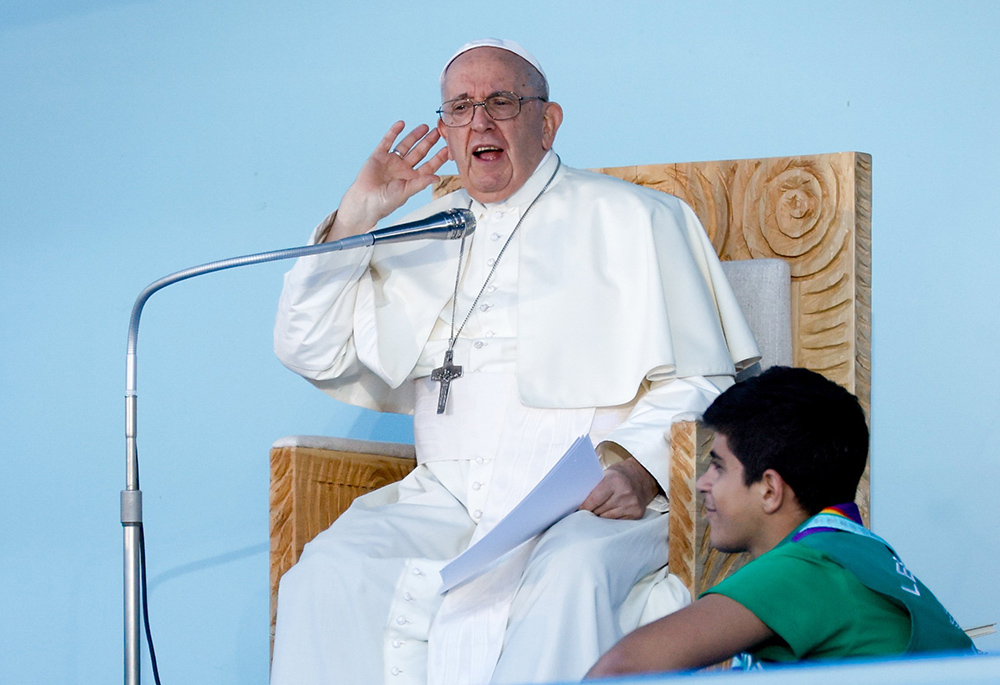
Pope Francis signals that hundreds of thousands of young people are not loud enough after he asks them to repeat that there is space for "everyone, everyone, everyone" in the church. Francis spoke at the World Youth Day welcome ceremony at Eduardo VII Park in Lisbon, Portugal, on Aug. 3, 2023. (CNS/Lola Gomez)
These exchanges don't just mark a pope's relationship with youth; they often come to define his relationship with the world.
So it was in August 2023, when Francis offered his now-famous refrain to the 500,000 in Lisbon's Eduardo VII Park. Seated beside him under the Portuguese sun that day was Bishop Robert F. Prevost, not yet a cardinal.
Today, as Prevost settles into the papacy as Pope Leo XIV, the Jubilee of Youth July 28-Aug. 3 may offer him the first true opportunity for a moment of his own.
About a half-million young people from 146 countries are expected to descend upon Rome for the Jubilee gathering.
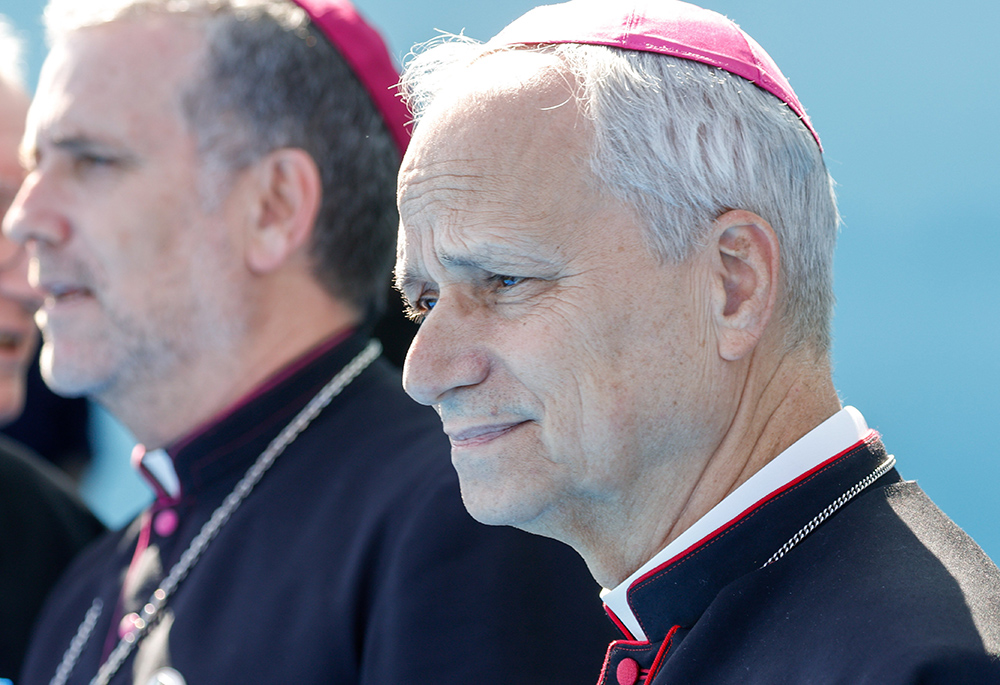
Then-U.S. Cardinal-designate Robert F. Prevost, prefect of the Congregation for Bishops, attends Pope Francis’ World Youth Day welcome ceremony at Eduardo VII Park in Lisbon, Portugal, on Aug. 3, 2023. (CNS/Lola Gomez)
Billed by organizers as the most anticipated event of the Jubilee Year 2025, the weeklong gathering blends catechesis, confession and cultural events across Rome, culminating in a Saturday night vigil and Sunday Mass with the pope.
Already on the first morning of the jubilee, groups of young people were waving their national flags and breaking out into chants around the Vatican. Dominican Fr. Kimat Nangavulan, who traveled to Rome from Taiwan with a group of 21 young people and adults, told the National Catholic Reporter that these days in Rome are "a good chance to encourage us, to let our youth know that our faith is very strong," since Catholics only make up about 1% of the population in Taiwan.
And Tobias Aquilón, a pilgrim from Paraguay, told NCR that while he likes the new pope so far — especially that he speaks Spanish — he hopes "the energy that young people create will open him up a bit."
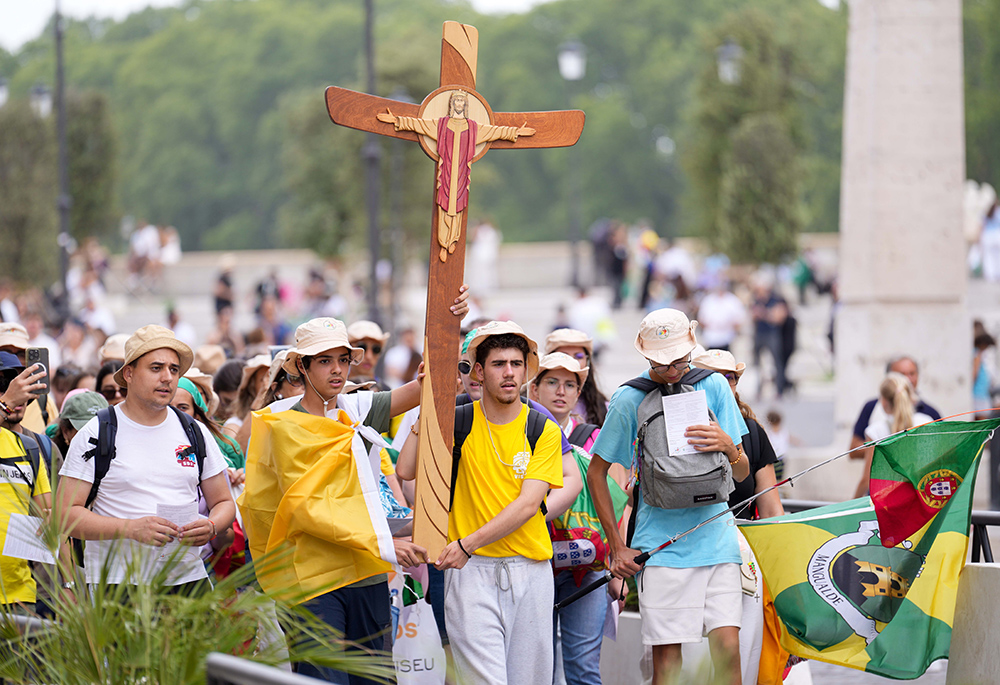
Young pilgrims carry a cross as they walk toward the Vatican during a pilgrimage in Rome, July 28, 2025. (CNS/Lola Gomez)
For Leo, the sheer scale and symbolic weight of the event will be unlike anything he has faced so far. In just over 80 days since his election, Leo has earned a reputation as a calming, soft-spoken, and mild-mannered leader. The leading Italian daily Corriere della Sera ran a letter to the editor after his election dubbing him the "meek pope."
Compared to Francis' whirlwind first days, when he set aside papal protocol, paid his own hotel bill and declined to move into the Apostolic Palace, Leo has given the public fewer glimpses of the man beneath the miter.
While Francis leaned into improvisation in his early audiences, Leo so far has shown a preference for structure, carefully reading his homilies and rarely straying from prepared remarks.
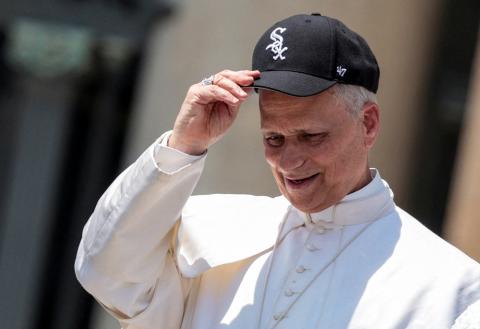
Pope Leo XIV wears a Chicago White Sox baseball cap during his weekly general audience in St. Peter's Square at the Vatican, June 11, 2025. (OSV News/Reuters/Remo Casilli)
The first weeks of Leo's papacy have been marked by restraint; they have been reverent, steady, but still waiting for a signature moment.
Leo has, to a small extent, gone off script. When celebrating the new formulary of the Mass "for the care of creation" he called for prayer for the conversion of those resisting climate action before continuing to read his prepared homily.
In personal encounters he has had moments of warmth and lightness, too. He joked with tennis champion Jannik Sinner during a private audience, images of him trying on a Chicago White Sox baseball cap and donning a large smile went viral after a general audience, and he caught a crochet doll of himself thrown from the crowd.
Still, for all his approachability, Leo has not yet had a chance to let his personality break through in a defining way.
Yet if history is any guide — and in the Catholic Church, it often is — the stage is set for something big to emerge when Leo takes the stage with young people this week.
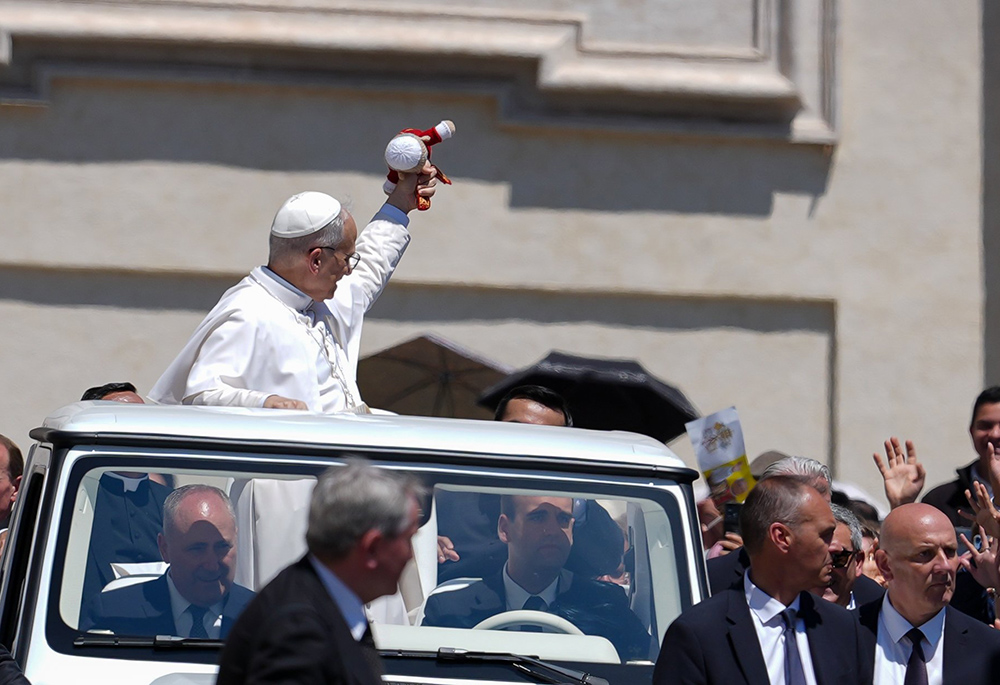
Pope Leo XIV catches a cloth doll thrown by a visitor as he rides in the popemobile following his second weekly general audience in St. Peter’s Square at the Vatican, May 28, 2025. (CNS/Lola Gomez)
It happened in the first year of John Paul II's pontificate, when he met with a raucous group of about 19,000 teenagers in Madison Square Garden in 1979. After touring the crowd in a popemobile, offering a thumbs up and pumping his fist in affirmation, he sat down to speak — then didn't.
Instead, he listened to the young people's chants and toyed with the crowd, humming and "woo-woo"-ing for almost nine minutes before Cardinal Terence Cooke of New York stood up to try to steer things back on track. "We shall destroy the program," John Paul said with a grin, explaining that "we," referring to the pope and the young people, were throwing off the planned schedule.
The Polish pope's meetings with young people became touchstones of his papal character. He established World Youth Day in 1985 and turned it into what would become known as "Catholic Woodstock."
His famous refrain, "Do not be afraid," first proclaimed in his 1978 inauguration Mass, became a recurring call to holiness directed toward young people across continents.
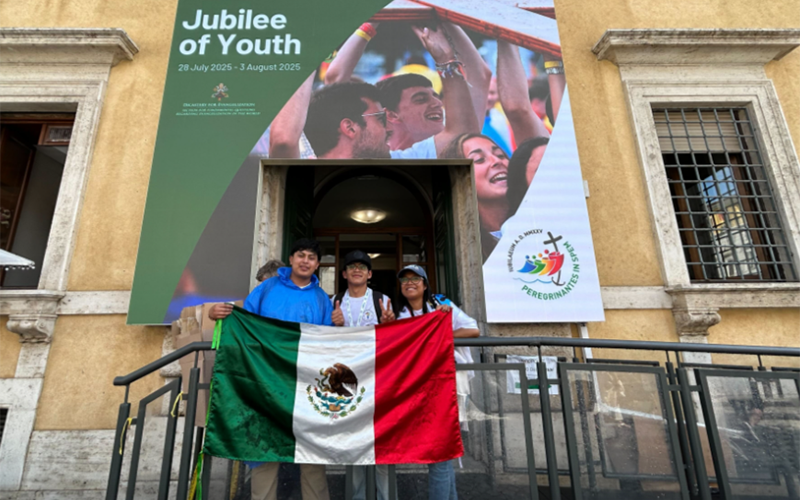
Jesus Antonio Romo Vásquez, from San Luis Potosi, Mexico, center, poses for a photo with two other young pilgrims in front of the Jubilee Office, a check-in spot for pilgrims, during the Jubilee of Youth at the Vatican, on July 28, 2025. (NCR photo/Justin McLellan)
Francis, too, had his breakthrough moment with youth early in his papacy. At World Youth Day in Rio de Janeiro in 2013, his first international trip as pope, he went off script while speaking to pilgrims from his native Argentina.
"Hagan lío!" he exclaimed, urging them to "make a mess" in their dioceses, stir up the church, and bring their faith into the streets. The phrase instantly stuck, becoming a shorthand for Francis' disruptive, hands-on pastoral style that invited young people not just to listen but to act.
Advertisement
Benedict XVI, though more reserved in character, also found such a defining moment during World Youth Day in Madrid in 2011.
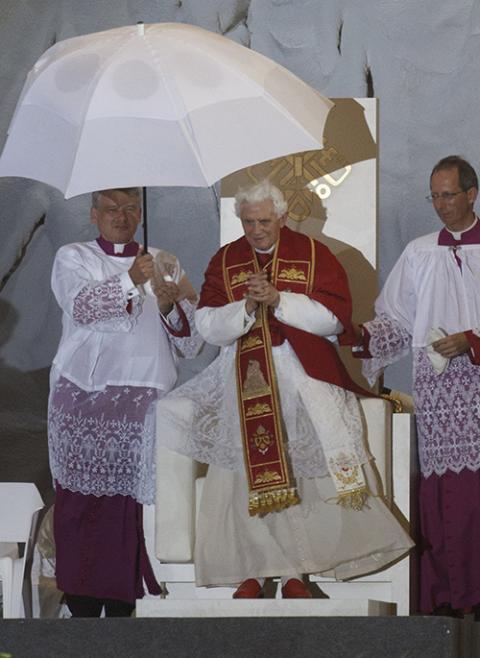
An aide holds an umbrella for Pope Benedict XVI as rain and wind moves through the Cuatro Vientos airfield in Madrid during the World Youth Day vigil Aug. 20, 2011. The pope and more than 1 million young people continued with the prayer service despite the storm. (CNS/Paul Haring)
When a violent storm struck during the evening vigil, aides urged the 84-year-old pope to seek shelter. He waved them off and remained on stage, quietly praying beneath a white umbrella as lightning flashed above.
Images of Benedict praying under a white umbrella became emblematic of his pontificate's quiet perseverance. His spokesperson, Jesuit Fr. Federico Lombardi, later called that moment "a metaphor for his whole pontificate," in which, through the storm, a "great peace" was reached.
For Leo, the field at Tor Vergata Aug. 2 may become more than a backdrop. Three young people from Italy, Mexico and the United States will pose questions to the pope during the vigil, inviting him to respond not with a homily or a document, but in his own voice.
For those closely watching the start of this new pontificate, the question remains: What will he say, and how far will it echo?
History shows that it takes just one night — sometimes one sentence — to begin writing a legacy.
The National Catholic Reporter's Rome Bureau is made possible in part by the generosity of Joan and Bob McGrath.