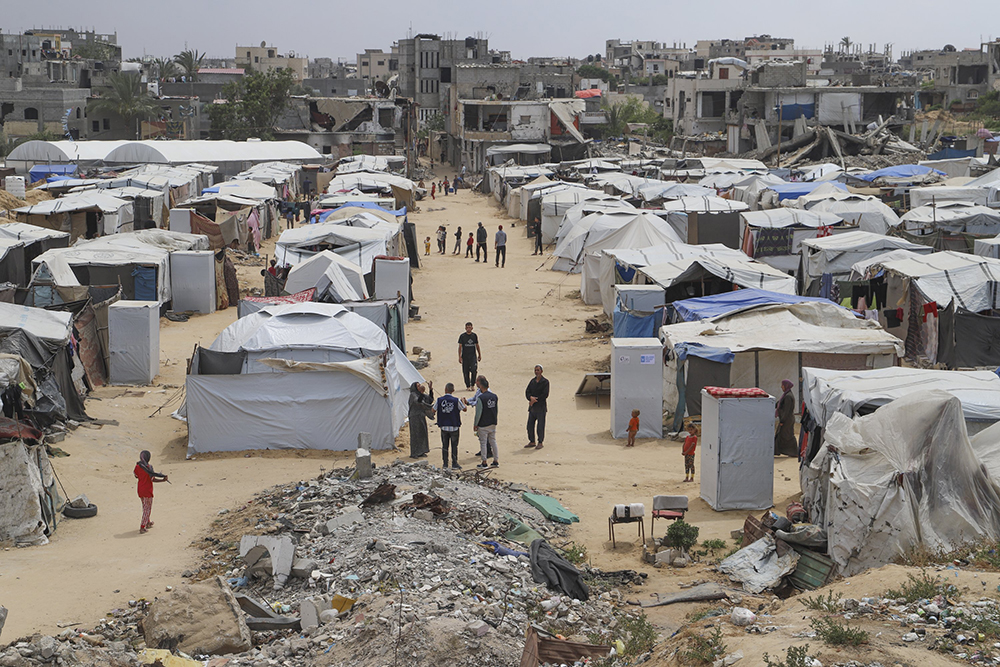
Catholic Relief Services workers talk with people at a tent camp for displaced Palestinians in Gaza May 5, 2025. (OSV News/CRS Staff)

In his book Being Jewish After the Destruction of Gaza, writer, journalist and commentator Peter Beinart argues that the destruction of Gaza might prove to be a turning point in Jewish history.
Why? Because it could become a moment of moral reckoning, contends Beinart, an editor-at-large of the progressive journal Jewish Currents.
A new Jewish narrative is needed that answers "the horror that a Jewish country has perpetuated, with the support of many Jews around the world," Beinart said in a New York Times bestselling book that is largely commentary and meditation but also includes elements of memoir and even Biblical exegesis.
"Its central element," Beinart argues for a new Jewish story, "should be this: We are not history's permanent virtuous victims. We are not hardwired to forever endure evil but never commit it."
He adds: "That false innocence, which pervades contemporary Jewish life, camouflages domination as self-defense. It exempts Jews from external judgment. It offers infinite license to fallible human beings."
Beinart concludes that a new Jewish narrative — based on equality in Israel rather than supremacy — is needed because "the current one doesn't endanger only Palestinians. It endangers us."
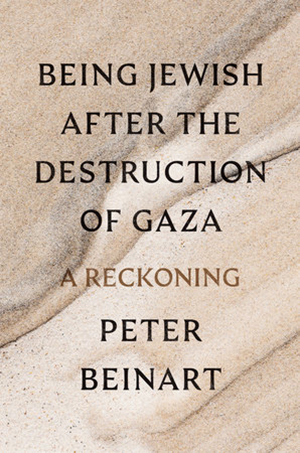
The book does not downplay the horrors committed by Hamas against Jews and Israelis on Oct. 7, 2023. Beinart calls Hamas "a corrupt and despotic organization with a long history of brutality against both Israelis and Palestinians." Nor does Beinart ignore the shadow of the Holocaust in Jewish life. "There are still fewer Jews alive today than there were in 1939," he notes somberly.
But, Beinart argues, comparing Palestinian violence to anti-Jewish pogroms or the Holocaust misses the fact that in 1930s Europe, the terror Jews experienced "was inextricably bound up with the oppression they endured. In Israel, by contrast, Jews enjoy legal supremacy, and it is Palestinians who lack basic freedoms."
Both praise and criticism have greeted Beinart's book. One of the harshest criticisms has come from the conservative journal Reason, under the headline "Peter Beinart has Gone Full Anti Semite," for Beinart's reflections on the Jewish holiday Purim that the reviewer found objectionable.
More favorably, The New York Times notes that, for many years, "and at great personal cost, Beinart has been one of the most influential Jewish voices for Palestine, even as he continues to attend a predominantly Zionist Orthodox synagogue."
In two recent interviews with National Catholic Reporter, Beinart touched on a number of topics, including his hope that Pope Leo XIV will continue speaking out on what is happening in Gaza, which Beinart called "one of the greatest crimes of the 21st century." The two interviews have been combined and edited for length and clarity.
Advertisement
NCR: How has this book been received by Jewish readers?
Beinart: American Jews are divided on these questions. The people who are most likely to read my book are people who have had some of the same instincts that I've had about what's happened [in Gaza].
Sometimes people will say, "I appreciate the book because you articulated things that I've really been struggling with, that I've been very alienated over the last 18 months, in particular from my community or from certain kinds of Jewish institutions."
There have obviously been very negative responses, too. But of the people who have really hostile reactions, very frequently there's not much evidence that they've actually read the book. Rarely do I find that there's a significant engagement with the text itself.
You speak of the dangers of nationalism and exceptionalism of all kinds, including Israeli and American. What do you observe of Christian nationalism?
I'm not an expert by any means on Christian nationalism, but what I notice as an outsider is the way in which there is among some particularly white conservative Christians, a kind of elevation of [President Donald] Trump and an elevation of the state, an elevation of America itself in ways that strike me as similar to the way in which the state of Israel is elevated. So that the fidelity to the state — in one case, Israel and the other case, the United States — becomes the test of whether one is a good Jew or a good Christian.
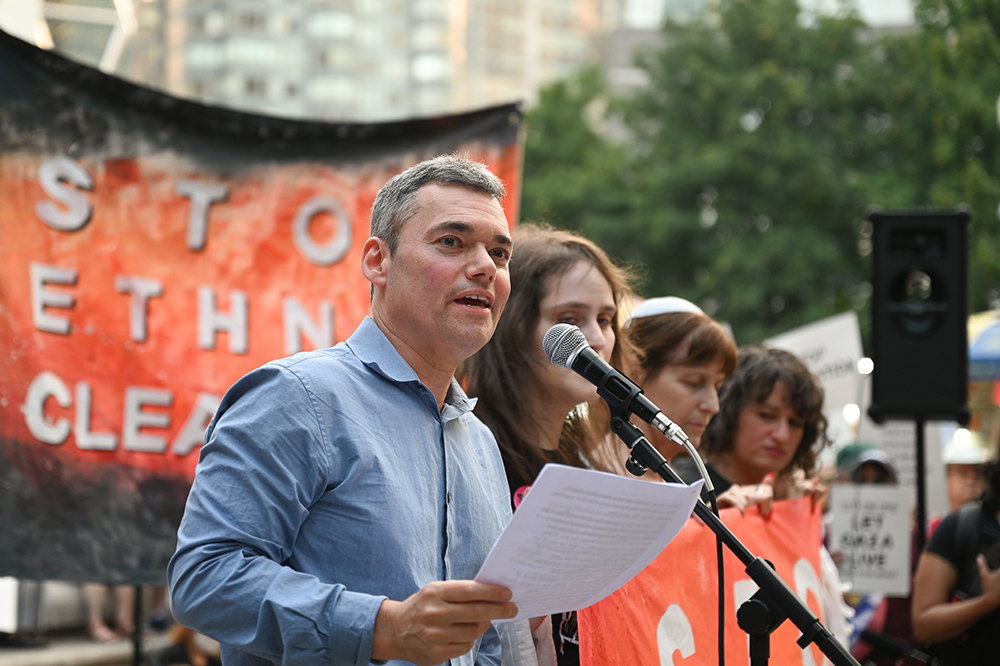
Peter Beinart speaks at a peace rally in New York City in August 2025. (Wikimedia Commons/Gili Getz)
Do you think religious institutions have addressed the situation in Gaza sufficiently?
In many synagogues, rabbis are unwilling to seriously challenge what Israel has done in Gaza, some because they genuinely support it, but sometimes rabbis are afraid of what the reaction will be if they do criticize [Israel].
So there's a culture of self-censorship that exists among many rabbis in which, even if they do have serious moral qualms about what was happening, they're reluctant to express them because they fear the consequences. There has been a real dearth of [American Jewish] religious leadership over the last year and a half.
In recent months, there have been well-publicized incidents of antisemitism — such as the murders of two Israeli embassy employees in Washington. How do you address that?
We're in a dangerous moment in which antisemitism is rising strongly on the right, and it is deeply interconnected with rising bigotry against other groups: Muslims, immigrants, LGBT people, Black people. Anyone who thinks that you can wall off bigotry against Jews from every bigotry of the Trump administration towards other groups is kidding themselves.
On the [leftist] anti-Israel side, we're seeing a rising hatred of Israel and a troubling tendency among some to not be able to distinguish between Israel as a state and Jews as a group of people. We have to continually emphasize that distinction.
But that's often a difficult line to hold, and it's made more difficult by the constant conflation of Israel and Jewishness by the Israeli government and establishment American Jewish organizations. They should be saying that Jews are not responsible for what Israel does. But instead they say that to be a supporter of Israel is inherent in being Jewish, which actually puts Jewish people at risk.
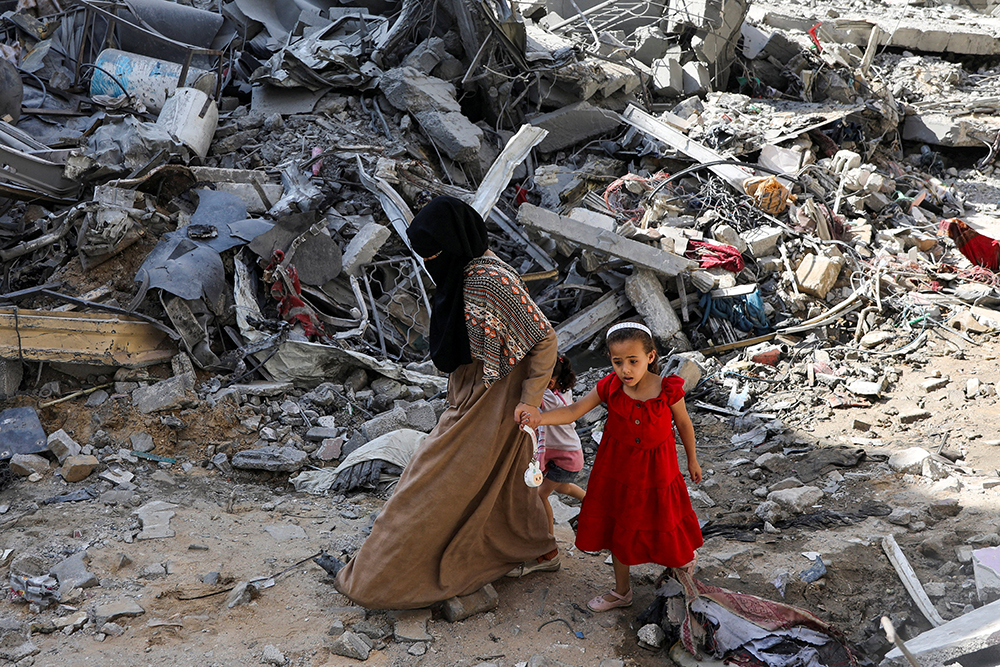
A woman and child walk among debris in the Nuseirat refugee camp in the central Gaza Strip, June 9, 2024, aftermath of Israeli strikes at the area, where Israeli hostages were rescued, amid the Israel-Hamas conflict. (OSV News/Reuters/Abed Khaled)
You've said Zohran Mamdani's win in the Democratic primary for the New York City mayoral race shows a real shift in attitudes about Israel. How so?
The polling on American attitudes towards Israel in the Democratic Party, but also among young Republicans, has shifted dramatically in the last few years. American politicians and media haven't quite caught up to how rapid this shift has been.
In New York, there were obviously contingent factors. He [Mamdani] had a very weak opponent. He ran a great race. He's a charismatic politician. But it was also partly possible because of this shift, including shifts among Jews. Mamdani may not have won the Jewish vote, but he had significant Jewish support, especially among younger Jews.
What advice would you give American Christians who are concerned about Gaza, but are also committed to fighting antisemitism in this fraught environment?
They should remember that bigotry — in this case, antisemitism — means denying equality. It's not bigotry to question ideas of Jewish supremacy. If you are criticizing a system that has been depicted as apartheid by the world's leading human rights organizations — even by Israeli human rights organizations — because you believe that Palestinians and Jews should be treated equally, that's not anti-Jewish bigotry. Christians have universal moral concerns, and there's no reason that those universal moral concerns should not include Israel and Palestine.
"Bigotry — in this case, antisemitism — means denying equality. It's not bigotry to question ideas of Jewish supremacy."
— Peter Beinart
Do you think the Catholic Church can have a useful role in what is happening in the Middle East right now?
It was very moving and powerful that Pope Francis was so concerned about what was happening to people in Gaza and was regularly checking in on them. A moral voice from a pope speaking against war and in favor of human dignity is valuable. That's an important thing to do, and hopefully can play a role in helping to galvanize this larger movement for Palestinian freedom.