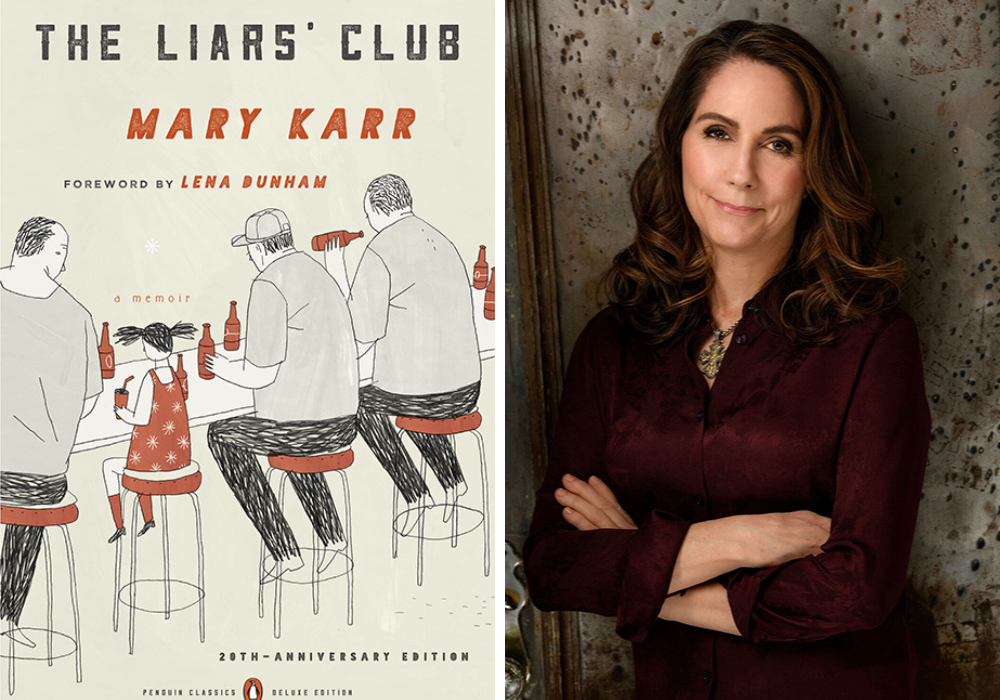
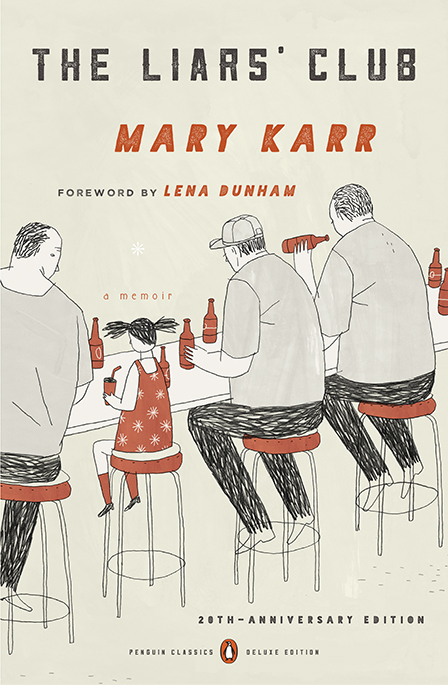
Book cover to The Liars' Club and author Mary Karr (NCR composite/Courtesy of Penguin Random House and Mary Karr)

by Ryan Di Corpo
The bloody, incarnadine cover of The Liars' Club blares like a warning, an alarm. Its language — frank, sturdy, trenchant, startling — details a southern upbringing marred by the violence and volatility of a Tennessee Williams play. A no-holds-barred narrative of a turbulent childhood in 1960s East Texas, it is decidedly impolite; it "sets prudence aside" and emerges as "one of the rawest memoirs by a serious American writer in years," proclaimed The New York Times in 1995. A bracing candor marks every page. Secrets be damned: This woman is telling the truth.
More than three decades ago, The Liars' Club arrived on The Times' bestseller list and fashioned author Mary Karr, already an award-winning poet, as a thrilling new voice in American literature. By the release of her third memoir, Lit, in 2009, chronicling her battle with alcoholism and improbable journey to Catholicism, she was well-established as a doyenne of the genre, a distinctive storyteller who reinvigorated the form for modern readers. Since its publication, The Liars' Club has only grown in stature; The Times named it among the top five greatest memoirs since 1969. "This is one of the best books ever written about growing up in America," wrote the journalist Dwight Garner.
At the level of the sentence, Karr is an enviable stylist. "His wife and son were slicing the white sheet cake when the shot came," she writes early in the memoir. Or later, on the same page, when she juxtaposes the sublime with the common: "The too-sweet smell of Grandma's hyacinth perfume hung in the car till Mother lit a Salem."
If her craftsmanship was obvious, her eventual conversion to Catholicism was not. Karr is, by her own admission, an unlikely Catholic — she once told a young writers' conference in Michigan she had "a better shot at becoming a pole dancer at 40" than joining the church. And her agnostic early years are a far cry from the self-described "black-belt sinner" who now begins each morning with lectio divina.
After the 30th anniversary of her debut memoir, NCR spoke with Karr about her literary influences and her love of the Spiritual Exercises. This interview has been edited for style, clarity and length.
NCR: In 1971, Joni Mitchell released her acclaimed album "Blue." When she played the album for Kris Kristofferson he was shocked by its intimacy. He reportedly exclaimed, "Joni! Keep something of yourself." I would imagine this is how some readers feel when encountering your memoirs. Why reveal such intimate details about your life to the general public?
Karr: Given the effects of Marx, Einstein and Freud on the 20th century, I think memoir came into its own based on a lot of forces that had nothing to do with me. I think I was 10 years old when I wrote in a journal, "When I grow up, I will write one-half poetry and one-half autobiography." I wanted to be a poet from the time I was 5 and I didn't know how to do it. So I read a lot of memoirs.
As a child, I remember reading Helen Keller and all those civil rights memoirs. My mother had The Autobiography of Malcolm X; there was Black Like Me. Maya Angelou's memoir hadn't come out yet. I think women have been told to shut up about things that make people uncomfortable for millions of years. Memoir was such a tatty form, but it was reserved mostly for men. I was interested in one voice — and somebody crying out. It was more an interest in the art form.
I finished graduate school in 1980 and was living in Cambridge [in Massachusetts] with a poet who was about to become my husband and my baby daddy. I often went to Lamont Library, which had a room with recordings of poets. And right by that room is a bookshelf with autobiographies. I read my way through that, and I read books that no one else took out. There was a copy of Harry Crews' that I must've taken out five or six times. St. Augustine, Rousseau — I was just obsessed with the form. They were also so particular.
I had been trying to write as a poet like T.S. Eliot. Then I went to graduate school and they told me that was a bad idea because I was not T.S. Eliot. I was kind of an idiot, and I certainly wasn't classically educated. And I had these stories in me. People think you sit down and write a thing like [The Liars' Club] because you feel like crap about it. But I felt much less like crap when I began to write it because I'd been in therapy for 15, 16 years.
Advertisement
Your memoirs include brutally honest, sometimes graphic descriptions of traumas that you have faced. How did you prepare to write about these episodes?
I grew up in a household of storytellers. My mother was actually a terrible storyteller but she was great with a one-liner. And this language that I grew up with in East Texas was so poetic and you just didn't hear it anywhere. I knew it was beautiful, the way I knew Son House or Beethoven were beautiful. Like all young writers, I was trying to sound more highfalutin than I was, and write from the mask of someone smarter or better educated. You spent 13 years in Cambridge and realize you're just not that smart. [laughs]
Therapy was life or death. That was either I'm gonna kill myself or try to figure out why I'm waking up screaming all the time. And what is therapy but telling stories and making narratives out of your memories? I had the advantage of living among storytelling people, and I had this autobiographical poetry I'd been trying to do something with. At that time, nobody read memoirs like I did.
I used to make a joke about it and say, "I wrote the book for money." But I really did. I tried to write The Liars' Club as a novel maybe four or five years before I wrote it as a memoir. For me, fiction was an excuse to lie. For a real fiction writer, it's an excuse to tell the truth.

Mary Karr (Courtesy of Mary Karr)
Your recall of detail about events decades ago is really astounding. I understand that you will send stories out to others — friends, family members — to fact-check. Can you describe that process?
I had a very good visual memory as a child, but I also had a great memory for language. And I memorized a lot of poetry. The people in my family talk in a really interesting way. They're all pretty dramatic and verbally adroit. Clever, witty, funny. In that house, I was like a soldier on the battlefield. The memories were so vivid. But I also didn't remember what I remembered. You pull on a thread or hit a moment and it's like clowns coming out of a car. It just blooms. It opens up.
I want to transition here to your faith journey. You've variously described your upbringing as both agnostic and somewhat anti-Catholic. Growing up, what, if anything, did you know about Catholicism?
I knew more than most people in the Bible Belt because where I grew up is very Cajun. Thibodeaux, Robicheaux — those were normal names where I grew up. A lot of my best friends were Cajun. In the South, if you see a couple of kids who aren't being taken to church, people will take you to church. They will bring you and try to save your little heathen soul. But we were so agnostic that it took me a while before I figured out people were really serious about believing this stuff, which was just clearly bullshit. I thought it was social convention. We'd have casseroles, we'd have an egg roll on the football field, we'd go to the department store to sit on Santa's lap. I didn't know people really believed it. It just so clearly seemed made up.
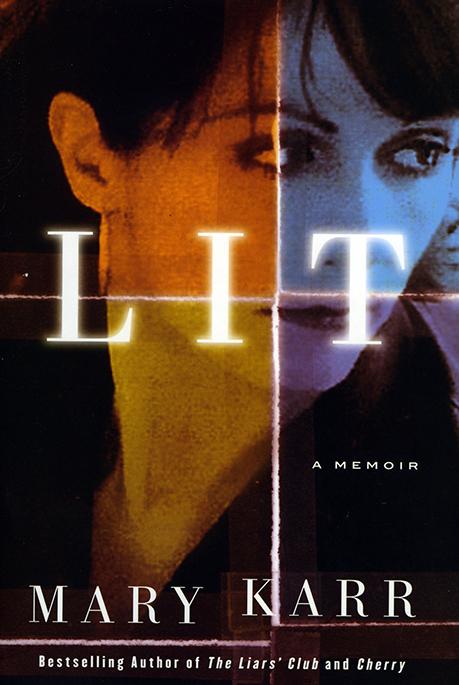
Book cover of Lit by Mary Karr, her third memoir (CNS)
You did an interview in 2011 where you said, half-joking and half-serious, "What keeps me from being the person that Jesus I think calls us all to be, whether we're Catholic or not, is wanting to kill my fellow human beings." Do you still feel this way?
After I did the Spiritual Exercises of St. Ignatius — it must've been '97 or something — every year my New Year's resolution is that I will be less judgmental. And I pray about it; a lot of my confessions are about my judgments of others. I am less judgmental every year, and that's really through the practice of my faith. I'm also more present and happier.
I think I was depressed as a child. And if you're depressed for over a decade — seriously depressed, like crying every day — you memorize the bad news. It's like that Hawthorne story, "The Minister's Black Veil," where you see everything through this scrim of horror, because your mind doesn't have enough serotonin or something. I gotta say, I feel really rescued by the church. [laughs] Nobody expected me to be Catholic. When I converted, Richard Ford sent me a postcard that said, "Karr! Say it ain't so. You on the pope's team."
You've called yourself a very unlikely Catholic. And yet there are many passages in The Liars' Club where you resort to prayer in moments of crisis. Do you not consider that religious feeling?
It is, but I never really believed it. The only reason I started praying everyday was because I couldn't stay sober. And I kept getting drunk and I had a baby. The crazy thing about me was even though I didn't believe it, I did it. I realized that I believed in evil, I believed in Satan, a long time before I believed in God.
How did your view of God change or morph over time? Or did it?
Oh, it completely did. Fr. Joseph Kane was probably the only priest who could've gotten me baptized, in this little church in Syracuse where Toby Wolff and his wife went. Before I got baptized, I said, "Joe, I'll tell you the truth. I'm not sure I believe in God. I believe in the Holy Spirit. I believe there is a force for good. When I come to Mass, I'm a crank and I resent everybody and when I leave, I feel better. I feel like I wanna go eat donuts with everybody in the basement. I'm comin' in on the Holy Spirit. I don't even like Jesus much."
All I knew about Jesus was some guy holding his shirt open saying, "Look what I did for you." Which, if you grow up in an alcoholic family, is like your idea of hell. I just didn't understand anything about God or Jesus at all. Right after I was baptized, I did the Ignatian Exercises — and that changed everything. Nothing has changed my life more, other than getting sober.
Those exercises showed me how I was projecting certain kinds of neglect that I experienced as a kid onto whatever higher being. When I conceived of God, it was almost like somebody reckless and indifferent, smiting people.
You've described your path toward Catholicism as "a journey into awe." What is awe? How would you describe it?
Well, you know what it is. We all know what it is. "Stay awestruck" is something I say to people all the time. Just the past two or three years, I've had this amazing phenomenon: People's faces, just regular folks walking around, sometimes look so beautiful to me. The mystery of each human being, and the love in them and the light in them and the terror in them and the pain in them — all of it just wandering around.
I'm much more given to tearing up, like multiple times in the course of the day. A lot of people do it with nature: the sunsets and the sea, the mountains and the trees. None of that means anything to me. I don't care, I don't get it, I feel nothing. I looked at the Grand Canyon and said, "Oh." But human beings, their faces, I can't tell you what they look like to me.