
"The Sermon on the Mount" (1635) by Jacques Callot (Artvee)
Of all of the subgenres of Christian writing, apologetics is one of the hardest to get right. If you're writing for an audience that's already Christian, they don't need convincing of the existence of God or the need for prayer. If you're hoping to convert atheists or agnostics, they're pretty unlikely to pick up a book about Christianity in the first place.
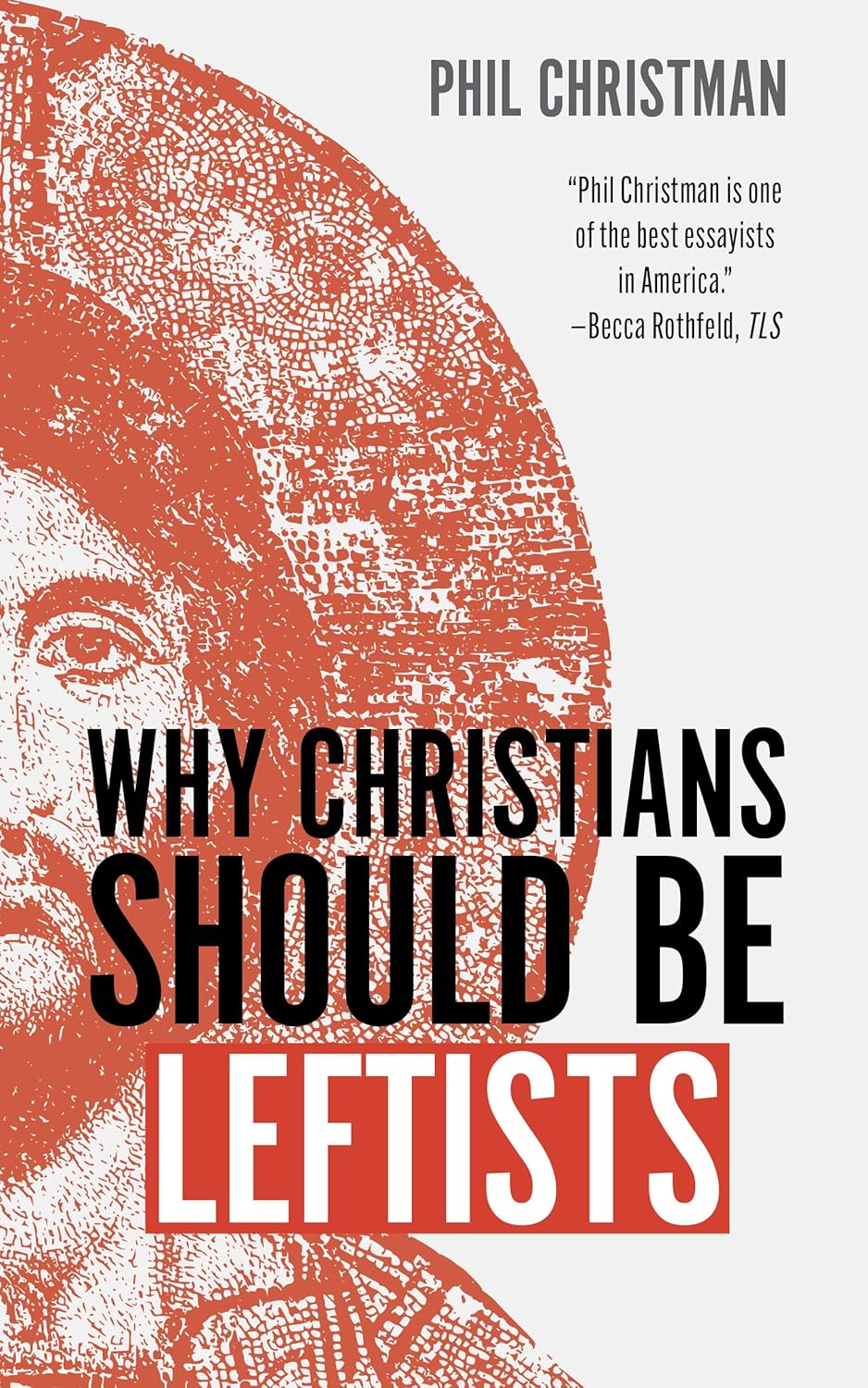
But in a time when American Christianity is so politically polarized as to essentially be two different sets of beliefs, books like Phil Christman's Why Christians Should Be Leftists need to exist. With his background as a fundamentalist Baptist conservative-turned-mainline Protestant leftist, Christman can actually talk to people on both sides of the divide and can make the argument for Christianity to members of the often religiously averse left. It's easy to find dozens, if not hundreds, of books arguing for conservative or right-wing understandings of Christianity. It is much rarer to see a writer attempt to argue for Christianity from the other side.

Phil Christman (University of Michigan)
Christman, who attended Calvin University, had a Thomas Merton-esque religious experience as a student while reading the Sermon on the Mount in a Bible study group. The passage transformed the way he saw the world and the people around him. "That whole economy of winners and losers," he writes, "with its implied scarcity of worthiness, had disappeared." For those who grew up fundamentalist, Christianity is often presented as "promoting and following a certain moral code," but Christman's encounter with the Beatitudes showed him Jesus' broader and kinder vision for the world.
Christman sets up the book as a series of arguments for the idea that Jesus' teachings do not point us to a society where the wealthy and powerful belong at the top, but instead that Christianity "lays out an ethic that would make it next to impossible for any human being to successfully hang onto power forever."
In its lack of the kind of centralized power and leadership that the right now holds, leftism can seem nebulous in its goals. The vision of a stronger social safety net, shared property or horizontal models of leadership rather than vertical ones can also come off as overly optimistic. Yet that is exactly what much of the Gospels tells us about Christ's vision for the world. As Christman reminds us, "according to Jesus, losers define what humanity is and should be."
Jesus told us to love our neighbors, which not only means trying to love our enemies, impossible as that task can be, but to love the people who get on our nerves on our side of the aisle.
The current president's fondness for using the word "losers" to describe anyone from an immigrant to a transgender kid to a Democratic representative, coupled with the Christian right's enthusiasm for him, is yet another reminder of how countercultural the message of the Gospels actually should be.
So why has Christianity gone so wrong? Power and greed, of course, are the root of much of the world's evil, and capitalism violently reverses Jesus' vision of a Kingdom where the poor and weak come first. Christman spends careful time explaining how much economics is intertwined with politics, and how "capitalism tells us lies about what we are" and "it also tells us lies about what we do."
For every Franciscan walking around in worn out sandals or every church that scrapes together a food pantry, there's a megachurch where the pastor wears $1,200 Air Jordans or a billionaire whose wedding requires guests to arrive in 96 separate private jets. If Christians should be leftists, leftists increasingly look like losers to most people in an "America first" vision of the world.
But losers also get crucified, and taking up a cross is exactly what Jesus told us to do. Online leftists like the hosts of the "dirtbag left" Chapo Trap House podcast or the much reviled stereotypical "Bernie Bro" can also, frankly, be annoying and just as divorced from reality as Elon Musk when he's deep in a K hole.
Like Christman, who is on the faculty at the University of Michigan, I too teach at a highly ranked, liberal public university and I too am a leftist, yet I daily encounter people whose politics align closely with mine who also make me physically squirm in embarrassment.
But, perhaps unsurprisingly, the same thing happens when I go to church.
Christman himself is a big supporter of Bernie Sanders and refers to Sanders frequently in the book. But he is a generous enough thinker to admit that "every strain of leftist can become culty," and that many leftist groups, from co-ops to anarchist squats, can be just as unhealthy as church communities where there is "too much emphasis on persons rather than principles." Jesus told us to love our neighbors, which not only means trying to love our enemies, impossible as that task can be, but to love the people who get on our nerves on our side of the aisle.
Advertisement
When you choose a neighborhood, you don’t control its demographics. When you choose a politic, you can choose one that covets power or one that sees power as something to be shared. It really is that simple. In Christman's words, Jesus teaches that "we are supposed to regard anybody, everybody as our neighbor; as the sort of person we hasten to reach agreement with, even at a disadvantage to ourselves; as the sort of person we try not to be angry with; as the sort of person we wouldn't swear at or sexually objectify."
There is no such thing as a perfect political party, of course, just as there is no such thing as a perfect church or denomination. Choosing to participate in any kind of activism, from writing to marching to forming a union, means being in kinship with people who get on your nerves. Christman reminds us that "political work is socially hard in all the ways that church work is socially hard." But it is a collective responsibility for anyone who cares about the least among us.
An elderly priest once reminded me that the word "vocation" has at its root the word vocare, which does not just mean understanding your life as a calling, but understanding that you can call others to different ways of understanding the world. That is what Christman's book succeeds at doing.
Perhaps that's what apologetics should really be: not an argument for conversion or a shout from a defensive crouch, but an attempt to persuade those who already believe in something to see it differently, whether that be a country, a political party or a church.
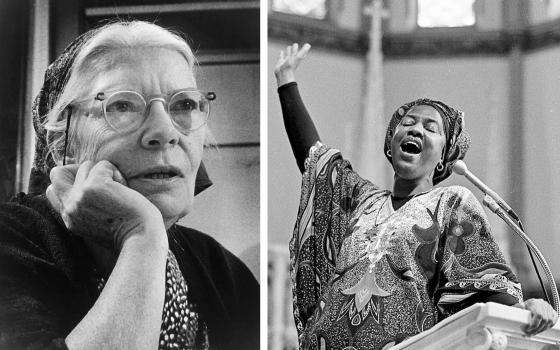
To be a leftist means accepting that you are voluntarily surrendering power, money and control for the sake of those around you having a better chance at a better life. To be a political person doesn't mean you simply vote every few years; it means you work every day to bring about what Dorothy Day called "the revolution of the heart," even if that work is always going to feel like a losing battle.