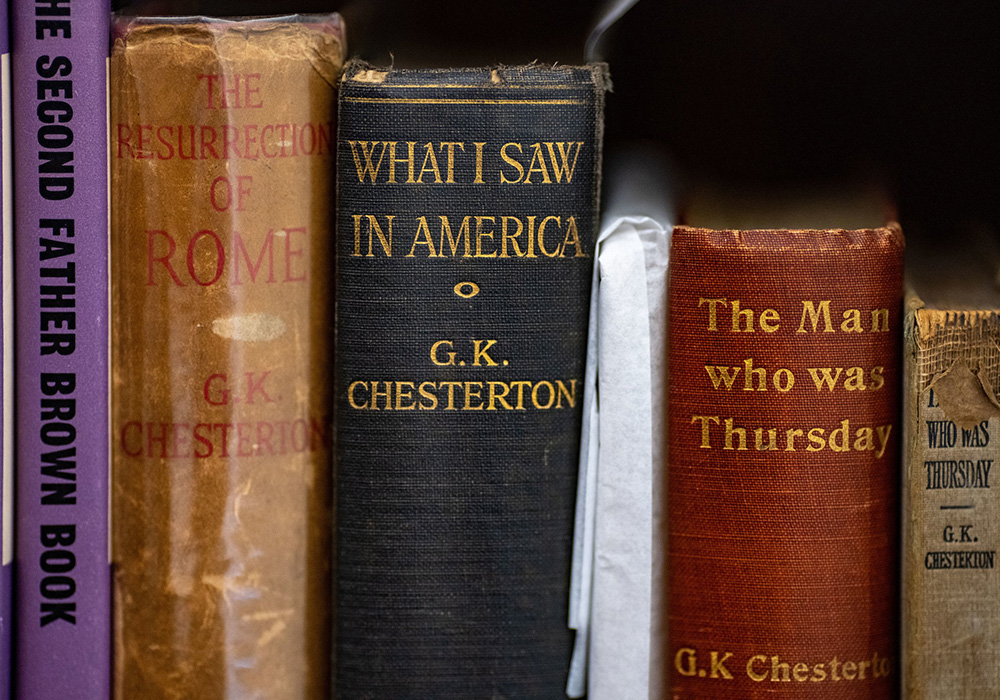
Books by Catholic writer G.K. Chesterton are seen in the Chesterton Archive housed at the University of Notre Dame's London Global Gateway in England Oct. 26, 2022. (CNS/University of Notre Dame/Matt Cashore)
G.K. Chesterton. Flannery O'Connor. Graham Greene. J.R.R. Tolkien. For many Catholics raised within the church's intellectual tradition, these 20th-century British and U.S. Christian authors tower like saints, underpinning our understanding of what it means to be a thoughtful, engaged member of the church today. But Rebecca Bratten Weiss, a prominent journalist and former educator at a Catholic college, argues that the texts we regard as Christian classics should be studied with a watchful, critical eye.
Part memoir, part work of literary criticism, Bratten Weiss' The Books That Made Us: Deconstructing the Modern Christian Classics seeks to shed new light on well-loved works of Christian literature, reinterpreting them in our current social and political context.
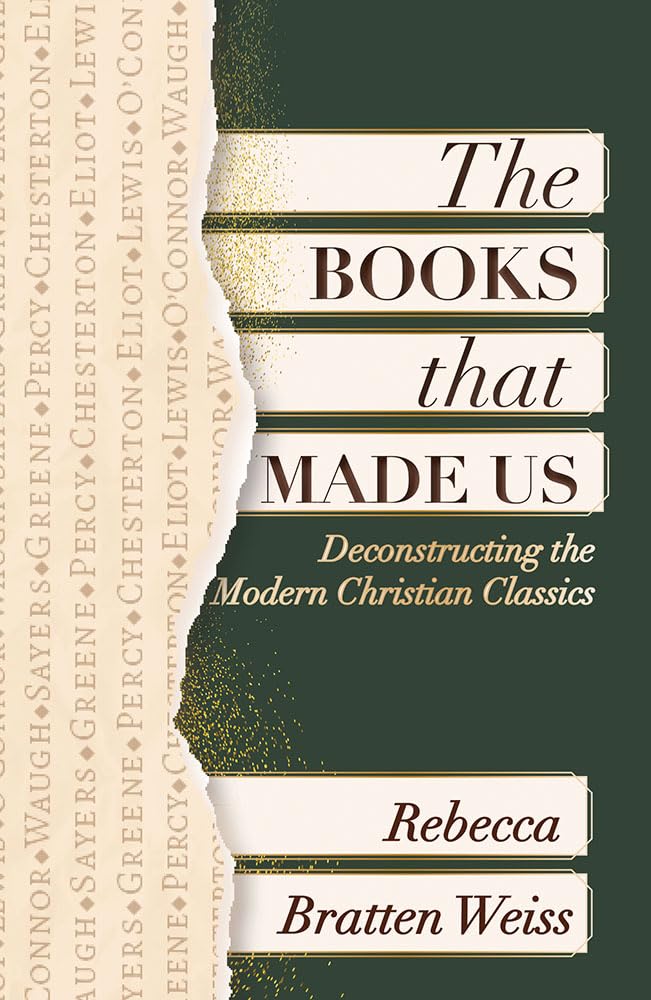
Bratten Weiss raises a question that many educators, myself included, have repeatedly asked: Does reading good books turn us into good people? For Bratten Weiss, the answer is no. She cites voracious reader and slaveholder Thomas Jefferson, modernist poet and fascist sympathizer Ezra Pound, and her many friends and colleagues who have opted to support Donald Trump's dehumanizing economic, immigration and environmental policies as evidence that the classic works of Christian literature we love may not make us more Christlike. She urges Christians to be self-critical and to remember that we may often act like Judas more than Peter.
Bratten Weiss also challenges the perennially expressed viewpoint that Christian literature has been marginalized within a secular culture and that we need to seek the idea of a uniquely Catholic literary imagination — an idea put forth in a series of biennial conferences that has run for about a decade. She urges readers to deconstruct the classics we have been exposed to; that is, to look at them through a critical lens.
"Deconstruction often yields the conclusion that many of the sacred institutions implemented by churches are really human inventions," she warns. "This doesn't mean deconstruction is incompatible with religious belief, however. There is no one path of deconstruction, and while many lead out of the church, others lead to a deeper, more authentic faith."
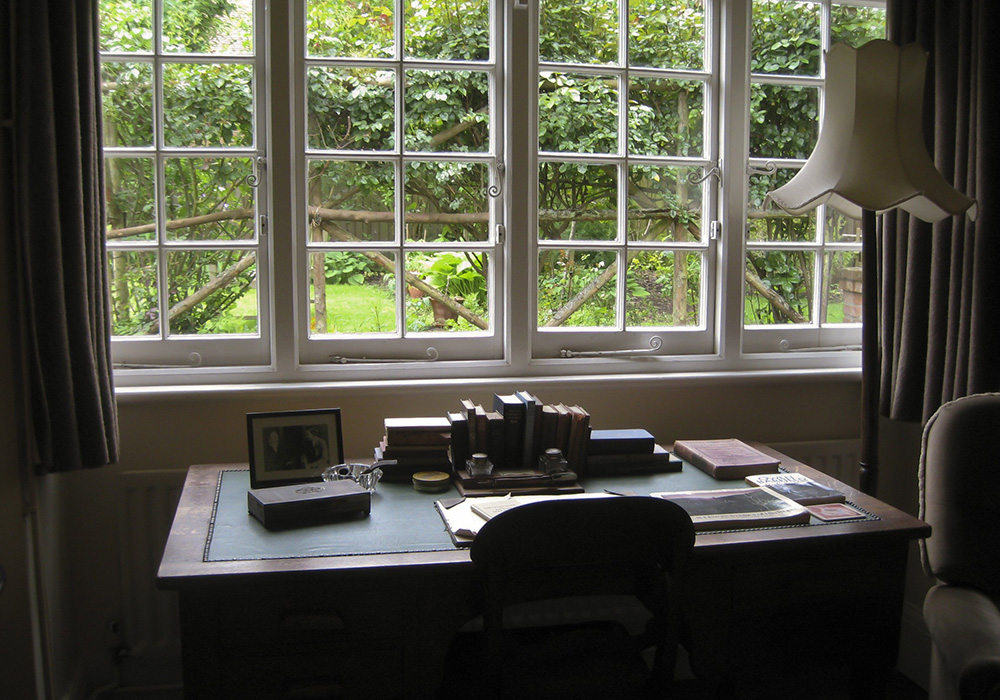
A desk overlooks the garden in The Kilns in Oxford, England, where C.S. Lewis penned his Christian stories, including "The Chronicles of Narnia." (CNS photo)
Bratten Weiss informs us that when selecting nine writers (including T.S. Eliot, Dorothy L. Sayers, Evelyn Waugh, C.S. Lewis and Walker Percy, in addition to those already mentioned) she had two criteria: "They needed to be taken seriously by a wider audience, and they needed to be practicing Christians, as opposed to people brought up as Christians who left the Church."
In the chapters that follow, Bratten Weiss deftly weaves her personal experience as a reader of these texts with an insightful analysis of them. At times her rereading leads her to realize that some of the authors — particularly Chesterton and Waugh — are not all she once believed them to be. In other cases, such as Lewis, she makes discoveries that are delightfully surprising: that an author typically viewed as conservative on men's and women's social roles paradoxically allowed her to conceive gender with greater openness and fluidity. Bratten Weiss specifically cites Lewis' Space Trilogy, where he imagines beings with more than two genders. "I'd always felt constrained by essentialist expectations surrounding the feminine, so the possibility that there was more to gender identity was appealing […] Over the years, thanks to Lewis, I played with different approaches to the concept of gender."
(Unsplash/Mark Stuckey)
Bratten Weiss includes many such personal reflections on the ways these classic texts shaped her worldview, particularly as she changed from a very conservative perspective to a progressive one while maintaining her commitment to the Catholic faith. It is fascinating to follow her story, and as a writer and literary scholar who also has always loved reading, I relate to much in her journey — to a point.
Readers should note that Bratten Weiss has a very specific group in mind when she speaks of "the books that made us" — and this group includes a very small sliver of practicing Catholics: highly educated ones who were formed in the church's intellectual tradition. While the book is very engaging, it must be noted that she assumes a certain prior knowledge of the works she discusses; knowledge that many Catholics, even highly educated ones, may not have.
Though I was raised in the church and attended Catholic schools up to 12th grade, I completed my postsecondary schooling in secular spaces: a small private liberal arts college and a large public university. Though I hold a doctorate in comparative literature, I have read very few of the authors Bratten Weiss discusses — even the most canonical ones. To the author's credit, her descriptions have made me want to go and read these writers (particularly Graham Greene, whose novels seem gripping and absolutely devastating). But readers should be aware that this text includes many spoilers.
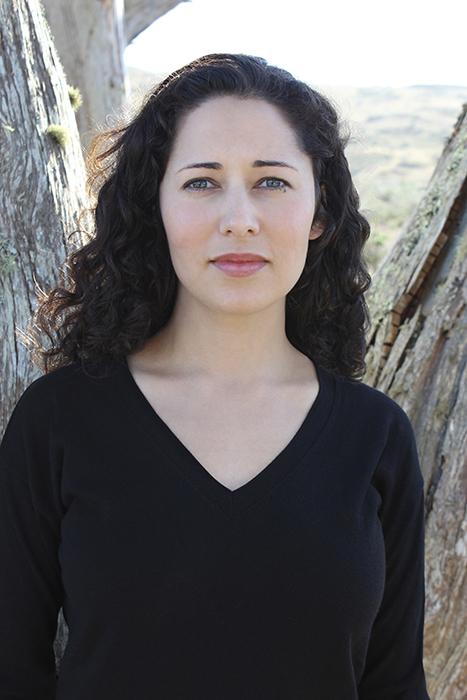
Writer Kirstin Valdez Quade is pictured in an undated photo. (CNS/Maggie Shipstead)
Toward the end of the book, Bratten Weiss makes a case for opening the canon to underrepresented voices, such as Nigerian-U.S. writer Uwem Akpan and Latina author Kirstin Valdez Quade — both of whom I have taught in my own class on the Catholic literary imagination. But it's worth pointing out that, other than Norwegian writer Sigrid Undset and Colombian novelist Gabriel García Márquez, all of the works she notes have origins in English.
This nearly exclusive focus on Anglophone writers is one I see throughout the U.S. literary landscape, not just in Christian literary spaces. In a publishing landscape where only 3% of literature originates in other languages, I am not surprised by this focus on texts originating in English. But I would urge readers to look farther, exploring the full diversity of the Catholic world, from Nicaraguan priest Ernesto Cardenal to Polish Catholic feminist Anna Kamieńska.
This is the same critique I levy against the biennial Catholic imagination conference, which, though a wonderful starting point for studying the Catholic tradition in an Anglo-American context, does not extend to the global literary landscape. I would say the same is true of Bratten Weiss' book: it is a starting point, a solid critique of texts familiar to many Catholics — and this is an important part of her point: There is so much more to discover and explore.
How we read matters as much as what we read. Bratten Weiss expresses a concern that while scholars such as Dana Gioia seek to define characteristics of a "Catholic literary imagination" — the idea of humanity struggling in a fallen world, the sense that nature is sacramental and spiritual self-scrutiny — these are not unique to Catholicism.
Advertisement
She urges that writers and readers need to turn to Christ in the person of the poor and marginalized. "We have this notion that at times when the world is in the thrall of evil, Christians are emboldened to take a stand for good. There are many examples of Christians who have done this. … But do we see this heroic witness reflected in the Christian arts world? Not as much as we should."
In deconstructing the Christian classics, Bratten Weiss urges us to notice how they have related to unjust systems and then seek cultural paradigms that have been neglected. Instead of asking where we might find our next G.K. Chesterton, she encourages us to look "as Jesus continually did, to the margins for the voices we've been missing, who not only have important things to say about the gospel, but who can infuse our literary culture with new, exciting, disrupting, and challenging perspectives."
I hope her words inspire many readers to take up this challenge, particularly in a time when questioning apparent realities and seeking the truth has never mattered more.