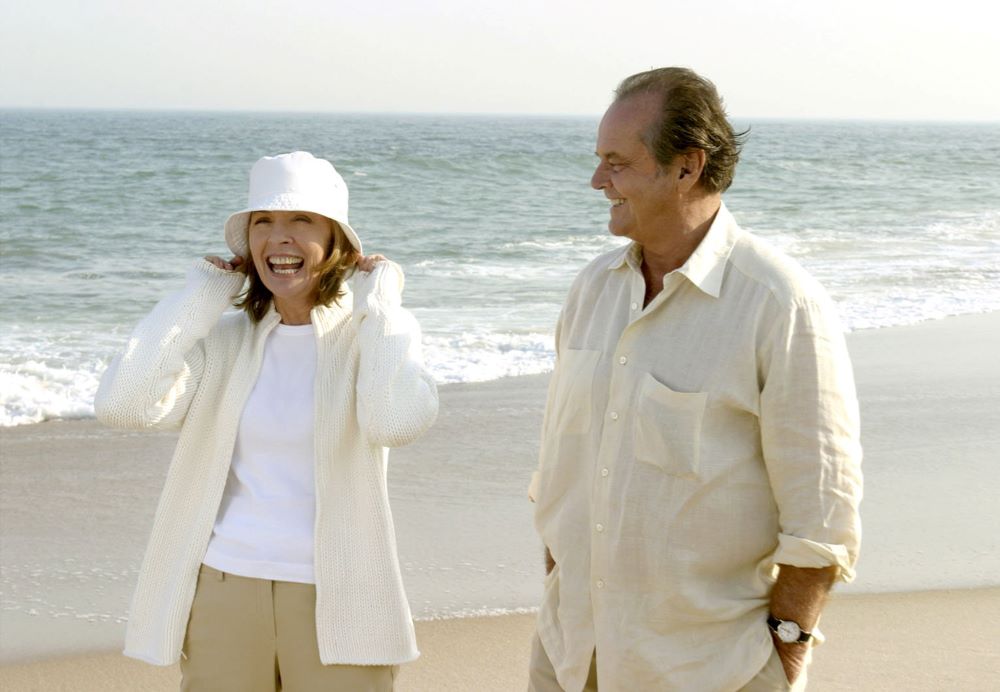
Diane Keaton and Jack Nicholson star in a scene from the 2003 movie "Something's Gotta Give." Keaton died Oct. 11 at age 79. (CNS/Columbia Pictures)

Diane Keaton is getting her posthumous flowers. New York City's Film at Lincoln Center is running a showcase of the late actor's filmography Feb. 13-19 that "celebrates a paradigm-shifting performer whose contributions to the art and craft of screen acting cemented her legacy as an auteur in the truest sense of the word."
The weeklong series, "Looking for Ms. Keaton," includes many of the movies considered to be the best work of the actor, who died of pneumonia Oct. 11 at age 79. Slated among box office hits like "The Godfather" and "Annie Hall" is a lesser known offering that Keaton just might have considered her most important.
In her 1987 documentary "Heaven," (the only nonfiction film she directed) Keaton posed the same question to a diverse series of people including children, a Black church congregant, a skeptic, the boxing promoter Don King and many others: "What is heaven?"
There are people who answer quickly and those who hesitate; people who go into elaborate philosophical dissertations and those who erupt into quick snippets brimming with wisdom. Keaton doesn't elevate the most articulate response, diminish anyone's view or look for consensus. She merely listens.
Again and again, [Diane] Keaton gravitated toward playing women who stood at the intersection of belief and reality, who felt the tremor when certainty faltered but always leapt into the possible rapture of the unknown.
I watched "Heaven" for the first time shortly after Keaton's unexpected death and was struck by the audacity of this major Hollywood star, at the height of her power, who had chosen to make a documentary centering mortality as common ground. This is a documentary without experts, title cards, or even a final word; it's just human beings facing the same uncertainty.
"Are you afraid to die?" she asked in one question that serves as a chapter marker in her film oeuvre. In "Marvin's Room" (1996), the question hums beneath every scene. Bessie is terminally ill, and Keaton plays her without spectacle. She organizes paperwork, tends to her father (Hume Cronyn) and reconciles with her sister (Meryl Streep). The film never gives Bessie a grand theological speech; it lets her work of caring for her loved ones become a stand-in for belief. If heaven exists in "Marvin's Room," it's in the way Bessie remains present while knowing she is leaving. "Marvin's Room" came nearly a decade after "Heaven." Keaton circled the questions in her documentary throughout her long career.
"Is there love in heaven?" she asked in "Heaven." In "The Godfather" (1972), Keaton's character, Kay Adams, believes love can coexist with power. When she asks Michael (Al Pacino) near the end of the film, "Is it true?" and he says no, she is desperate to accept it. The door closes in her face as men kiss his hand and call him Don Corleone. Although that image has become shorthand for betrayal, what Keaton plays is more subtle than heartbreak — it's the moment when belief fractures. If love survives in that world, it does so outside the room where this dark power consolidates. In "The Godfather Part III" (1990) Kay carries the weight of that recognition, as we see how her relationship has aged along with her illusion.
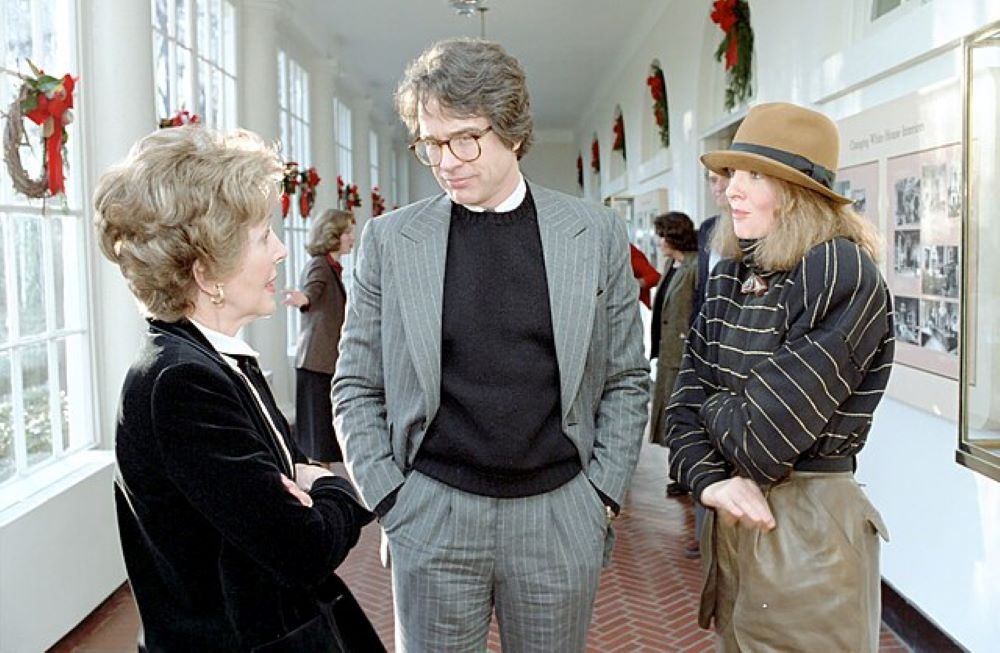
Diane Keaton, right, speaks with Nancy Reagan and Warren Beatty at a screening for "Reds" in the Family Theater of The White House in 1981. Keaton plays Louise Bryant, a writer who left her marriage and life in Portland, Ore., to join John Reed, a radical journalist and activist portrayed by Beatty, in Greenwich Village. (Wikimedia Commons/White House Photographic Collection)
"Can heaven be here on earth?" asked Keaton in "Heaven," and her work in "Father of the Bride" (1991) answers that question without naming it. The film revolves around rituals — a wedding, a family gathering, a father letting go — and Keaton's presence as Nina Banks grounds the chaos. She plays motherhood as steadiness and silent work instead of maudlin sentimentality. There is something sacred in the ordinariness of the scenes where we see her talk to her daughter, engage with wedding plans and manage her husband's (Steve Martin) reluctance to let their daughter leave the nest. If heaven is anywhere, it might be in those rooms filled with people who love each other imperfectly.
The question "Is there sex in heaven?" seems to invite mischief in Keaton's documentary, but in "Something's Gotta Give" (2003), it becomes urgent. Erica Barry, Keaton's character, confronts aging and desire without apology. When she tells Harry (Jack Nicholson), her unexpected love interest, "The truth doesn't have versions," she is naming the difference between intimacy and convenience, and how desire does not evaporate with age but takes different forms while remaining embodied, vulnerable, dangerous. When she later admits, "I let someone in, and I had the time of my life," she delivers it with the wisdom that comes from knowing experience always costs something.
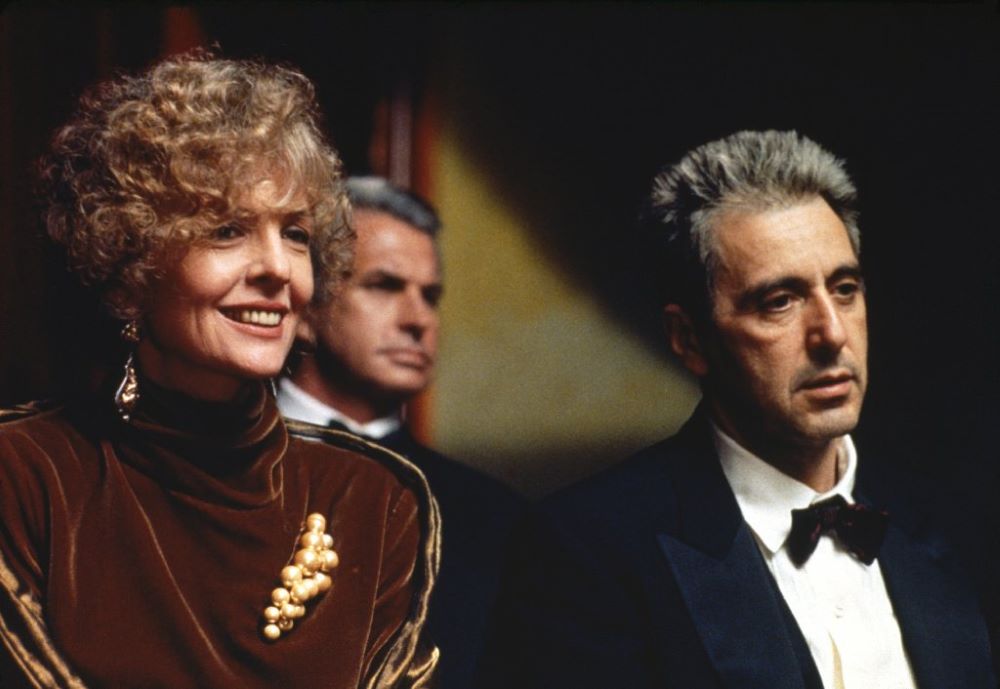
Diane Keaton and Al Pacino star in a scene from 1990's "The Godfather Part III" in a recut version, "The Godfather Coda: The Death of Michael Corleone," from director and co-writer Francis Ford Coppola. (CNS/Paramount)
In "Annie Hall" (1977), for which she won the Oscar for best actress, Annie (Keaton) absorbs Alvy's (Woody Allen) anxieties about the expanding universe and keeps living anyway. The famous moment when she splits in two during sex, her consciousness detaching and watching while her body stays put, captures how easily presence can slip. Love requires attention, which in itself can sometimes be as fragile as faith. Although Annie never asks "Do you believe in heaven?" the entire film explored such questions.
As a documentary, "Heaven" never attempts proof or an ultimate answer; instead of searching beyond the boundary of her universe, Keaton turns to cinema itself. The documentary includes fragments from throughout film history: the lush Black paradise of "Cabin in the Sky" (1943), radiant and stylized; Renée Falconetti's face in "The Passion of Joan of Arc" (1929), her eyes lifted in rapture towards the heavens. These are not arguments, but attempts to use cinema as language for imagining what cannot be verified. Light falling on a face becomes as persuasive as theology.
Advertisement
Seeing Keaton's work gathered now, all in one place and in the span of one week, the throughline feels unmistakable.
And there's more. In "Reds" (1981), she navigated ideology and intimacy; in "Interiors" (1978), she sat with familial collapse and emotional inheritance; in "Baby Boom" (1987), she reimagined vocation. Again and again, Keaton gravitated toward playing women who stood at the intersection of belief and reality, who felt the tremor when certainty faltered but always leapt into the possible rapture of the unknown.
Hearing Keaton ask people if they are afraid to die lands differently now. "Heaven" never resolves the inquiry; it lets it stand without flattening the differences between a preacher and a teenager, both equally expert in the imperfect science of being alive. We also never know where Keaton stands, although in 1987 she confessed, "I was primarily interested in religion because I wanted to go to heaven." Maybe that was always enough.