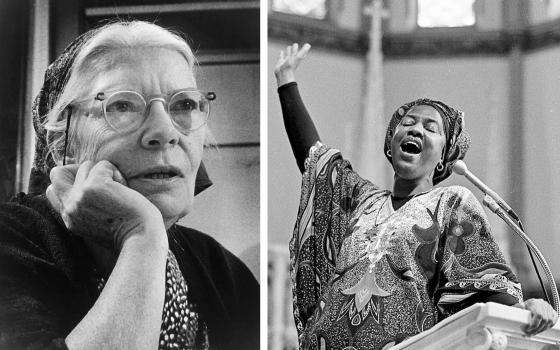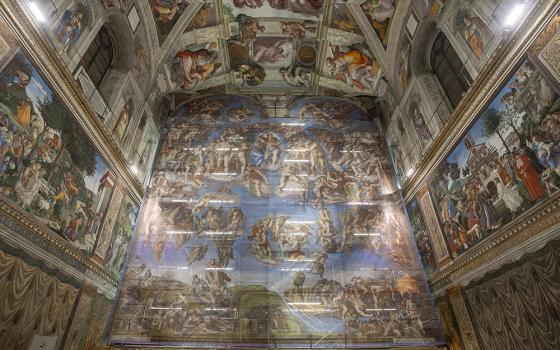

Panels from Saint Catherine, Anna Meyer's debut graphic novel; Jim McDermott writes that the novel "is a poignant examination of 'salvation-and-damnation' thinking and the demons it implants within us. It's also a funny and tender portrait of life in your 20s, and the liberating power of friendship." (Macmillan)

by Jim McDermott
"Am I going to hell?"
Some might joke about the question, but the fear of eternal damnation continues to impact many Catholics, practicing and nonpracticing alike. In her debut graphic novel Saint Catherine, Anna Meyer explores the implications of this complicated topic.
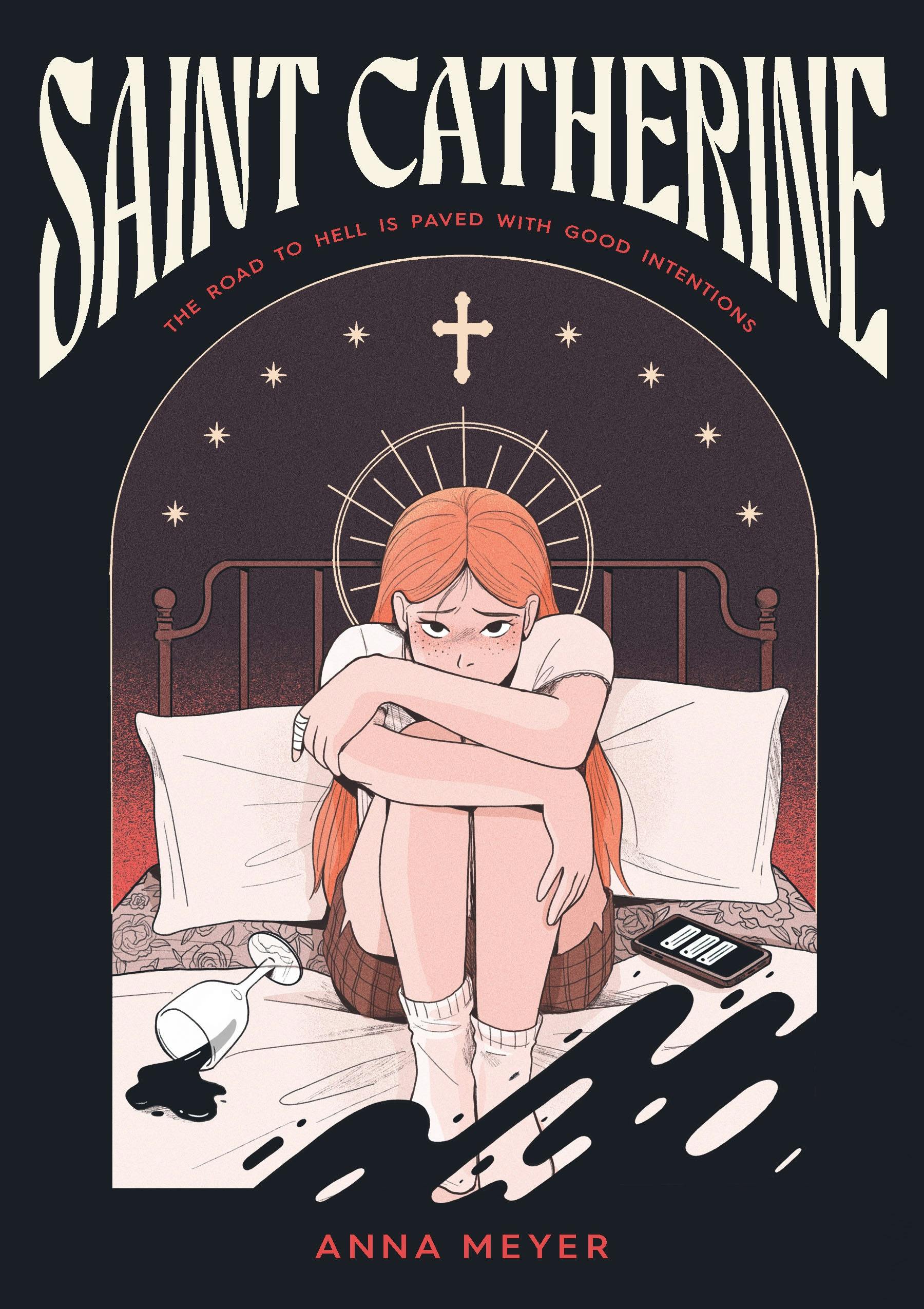
Recent college grad Cat lives in New York City and has never missed Sunday Mass — but not because she is devoted to her faith. Rather, decades of instruction have left her afraid of what will happen if she doesn't go. It turns out she's right to be afraid: After she misses Mass to spend time with her boyfriend, Cat finds herself seemingly haunted by a demon.
Crisply drawn and wonderfully plotted, Saint Catherine is a poignant examination of "salvation-and-damnation" thinking and the demons it implants within us. It's also a funny and tender portrait of life in your 20s, and the liberating power of friendship.
NCR recently spoke to Meyer over Zoom about the work. The conversation has been edited for length and clarity.
NCR: How much of St. Catherine comes from your own experience?
Meyer: It is a fictional story, but there's a lot of my own truth in it. I grew up in a strict Catholic household. We joked that we were "the Catholic kids" in the Catholic school; that's how important it was to my parents. I took pride in my religious conviction. [But eventually] I realized it was causing me to have obsessive thought patterns, and this real fear of eternal damnation. I found myself falling into the same patterns as Cat.
Cat's demon takes different forms: a cute one-eyed Casper the Ghost; thick swirling smoke; a looming gravestone. How did you come up with these?
There's something great about this flat, inky black shape. Especially since a lot of the art is muted and a little airier, it creates a lot of contrast and fun ways to show Catherine's emotions. Catherine is a bit of a scaredy cat, so the fact that they're kind of cute and not that scary is funny to me.
Its one eye represents the paranoia of the story, the idea of something omniscient that can always see what you're doing, always know what you're thinking; seeing what is happening, what has happened, what will happen — which is representative of how I was raised to believe religion operated.
There are confessional scenes in the book where priests either don't appreciate or actively diminish Cat's experience. What was your own experience of going to confession or talking to people about the scruples you were having?
Everyone's experience is different, but the Catholicism I was raised in was rigid and kind of cold. Very strict.
When I was in kindergarten, I stole a toy horse from a friend's house, and it turned into "The Tell-Tale Heart." As soon as it was in my home I couldn't enjoy it, I felt so guilty. The next time I went to my friend's house, I slipped it back. But I still felt this guilt because I never told her. I knew, as soon as I can go to confession, this is what I'm going to confess. And I did; I did talk about that, and the priest was very cold. I felt so bad.
In my life I have experienced priests and religious people who are warmer. The faith some of my close friends grew up in was much more focused on community, giving back, service, volunteering. That wasn't the focus in my family. It was more doing things exactly the way the doctrine tells us to do it.
Advertisement
There are moments where Cat tries to draw strength from reading about St. Catherine of Siena. At first she's this icon of purity and faith; but at the end of her life St. Catherine was overwhelmed by a sense of her own sinfulness. And Cat reflects, "She did everything right, and it still wasn't enough."
St. Catherine of Siena actually is one of my patron saints. My middle name is Catherine. So I always knew about her, but I did a deep dive into her story for this. I found it to be really sad and tragic.
I know a lot of people love Catherine of Siena, she's a doctor of the church, I think she's one of the only female saints who are. But she was so by the book, and really intense, incredibly scrupulous. Toward the end of her life it felt like there was a lot of pain and a lot of feeling that she never measured up. There were long periods of time when she wasn't eating. You look at that and you wonder how much is some sort of mental illness, and how much is a hyperfixation on being the best you can be for this faith. I found it tragic in a lot of ways.
There are so many stories of saints where we ignore or romanticize what are obvious signs of psychological distress. The church raises them up, but those are not experiences to aspire to.
They were suffering. Within a lot of Catholicism, suffering is seen as a very noble thing: If you suffer in this lifetime, and if you are suffering for the right reasons, for the faith or this moral code, you'll be rewarded in the end. For people that have more obsessive thought patterns, this can be really harmful and dangerous.
While Catherine clearly struggles with that within herself, her mother is also constantly reinforcing that way of thinking.
I wanted to bring a lot of nuance to the mother. I wanted to show the path that you could fall down when you become so obsessed with doing everything the right way in regards to a certain doctrine, how it can sometimes even unknowingly rob you of some of your humanity. You're not looking to the person in front of you, you're not even looking to your own feelings, you're looking to some sort of higher power or doctrine to make the answers for you.
Catherine's mother loves her a lot. She wants what's best for her kids. If she sees Catherine going down the wrong path, in her mind it's like, "You're going to hell, you're going to suffer forever, and I'll never see you again." You can see how the stakes for that are so high.
In the end, it's Cat's friends and her experiences of beauty in the world that free her.
There's a line at the end, "You tried, and you cared, and you listened." That's the balance. The mother really cares about Catherine, and she's trying really hard, but she's not listening. That's what's missing. For me, having friends that care about you, that listen to you and try to show up for you, what's better than that?
I wonder how you might advise priests and others in the church about dealing with people who have scruples. How can fellow Catholics best be of help to them?
Allowing people to express those feelings — the moments of doubt and also moments of extreme fixation — and just being able to have a conversation with them. What I've experienced in the past is a lot of extremes from priests, sort of "This is the way that it is. We can't talk about those feelings, I'm going to tell you exactly how it is and how to feel." What we need instead is "It's okay to be a little messy and a little human sometimes. It's part of life."