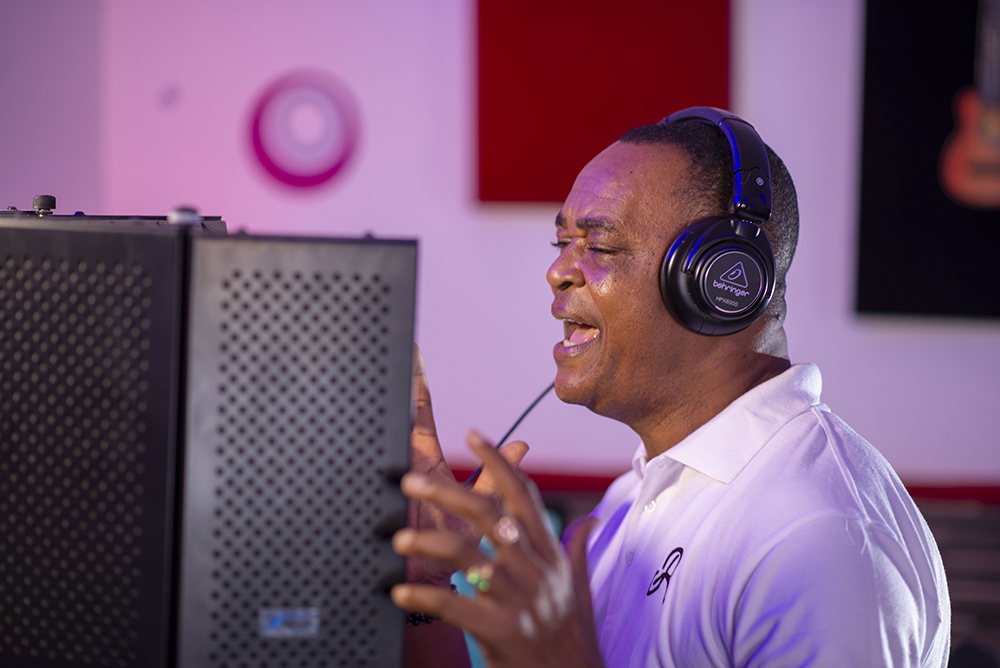
Musician and composer Jude Nnam records his song "Ndi Nna" in a studio in this undated photo. (Courtesy of Jude Nnam)

by Michael Aromolaran
When Jude Nnam wrote his first Mass in 1992, it was under the subconscious influence of a boyhood experience. In the mid-1970s, Nnam and two friends visited an Assemblies of God church in Enugu, the city in southeastern Nigeria where Nnam was born and raised.* The trio was impressed by the mode of service: the drum-heavy worship style of the Pentecostal church was different from the more meditative style that the boys were used to at the local parish, St. Paul's Catholic Church.
The next Sunday, when Nnam noticed his friends' absence at Mass and asked why, they said they had gone to the Assemblies of God church: "We went there to dance. The Catholic Church is boring."
So, when Nnam wrote his first Mass in Igbo, it was subconsciously to make people dance, to keep people from leaving the church. He was only 27 and a student at the University of Nigeria, Nsukka, where he was studying for a music diploma, and where he would earn the nickname "Ancestor" because he often behaved older than his years. It took only three days to write the set of compositions, and he titled it "Missa Ifunanya," which translates to "Mass of Love."
"I lost two of my friends to Pentecostalism," Nnam told National Catholic Reporter on a Zoom call, speaking in the same slow, measured tenor used in his music videos on YouTube. "When that happened, I said to myself, 'Why not make the church lively?' I was too young to actually understand what I was thinking about. When I wrote 'Missa Ifunanya' and my other works, what I told myself as a boy seemed to be present. I just wasn't aware of it."
With more than 2,000 original pieces to his name, Nnam is widely considered as the most influential Nigerian composer of Catholic liturgical music. In a career spanning four decades, he has composed songs in several languages, including English, French, Swahili, Spanish, Zulu, Chinese and various Nigerian languages, particularly Igbo, the composer's native tongue. It is often said that you cannot attend Mass in Nigeria without hearing a Jude Nnam composition, an ubiquity Nnam combines with a knack for catchy, soulful tunes and for blending African musical traditions with Western influences.
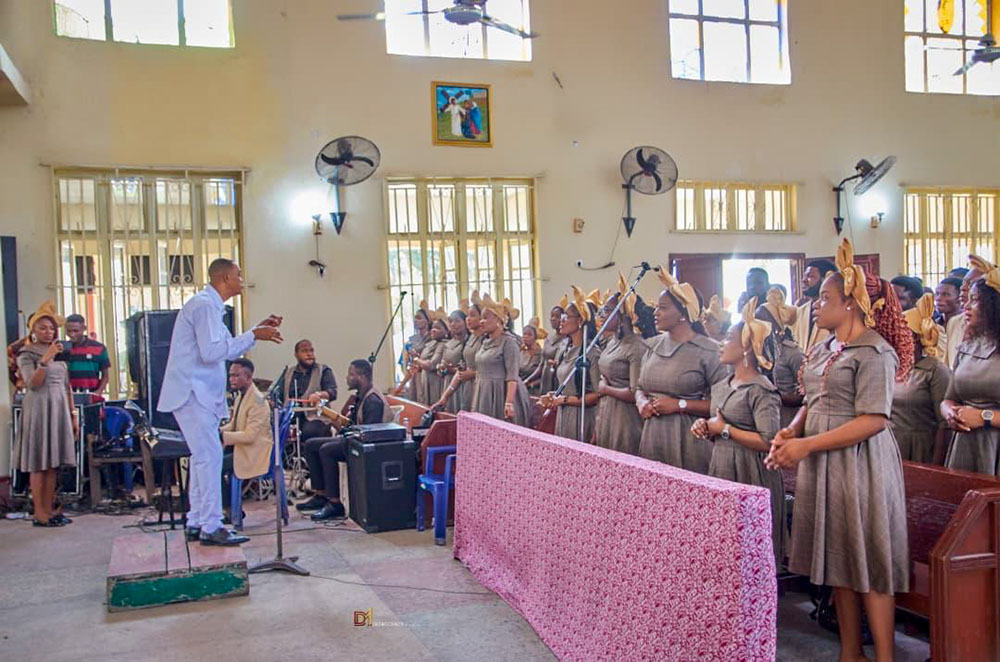
Musician and composer Jude Nnam conducts the St. Cecilia Choir of Mater Misericordiae Catholic Church in Port Harcourt, Nigeria. (Courtesy of Jude Nnam)
"There is no doubt he is the greatest. Even Yamaha confirmed this," said composer Ifeanyichukwu Eze, referring to the ambassadorship deal that the keyboard manufacturer sealed with Nnam in 2017.
When "Missa Ifunanya" came out, Nnam had already established himself as a serious musical talent. He had written hundreds of pieces and traveled widely to train choirs in Nigeria, visiting churches in Imo, Anambra, Jos, Makurdi and Lagos. "Chineke Gbaghara," his first piece, which he wrote at 18, had become a Mass staple.
But "Missa Ifunanya" was different, not just from Nnam's previous works but also from a lot of liturgical music at the time. It came with qualities that would define Nnam's oeuvre, such as the use of Igbo tonal inflections, breaking from many Igbo songs at the time that followed rhythmic patterns of Gregorian chants. "Missa" also borrowed from traditional and contemporary Igbo musical traditions such as highlife. But most importantly, it was danceable, an innovation that concert pianist and poet Echezonachukwu Nduka described as "Dancing the Mass."
"Nnam set some sections to danceable rhythms accompanied by instruments," Nduka said. "He even went as far as using digital instrumentation in electronic keyboards to drive home the point of dance and movement. Before this practice, it wasn't the norm."
Choirs quickly adopted "Missa," performing the songs every Sunday. Congregations across southeastern Nigeria loved it, falling particularly in love with its rendition of the Gloria titled "Otito Diri Chineke." And Nnam's stature as a composer swelled.
But then, dissenting voices started to emerge. Some priests thought the songs in "Missa Ifunanya" contravened church guidelines for sacred music, that it did not fulfill the requirement of solemnity.
"Priests said, 'This is unacceptable,' that it was too punchy, that it was wrong to make people dance in the church and that it sounded like something from the world, like highlife," said Nnam. "It wasn't an official opposition. The church didn't come out as a group to oppose it. It was some priests who opposed it. There were many priests who liked it."
Nnam took the criticisms in stride. "I have been brought up to respect priests," he said. "So when they criticized the work, I would simply keep quiet and say, 'No problem.' "
A Facebook post by Nnam from 2018, suggests some of the criticisms cut deeper than the composer let on. "I was terribly disappointed that the church which was supposed to encourage me was busy discouraging me and making sure I was pulled completely down to the floor. But with the encouragement of some priests like Fr. Tobechukwu Nnamani, Fr. Tony Igweagu, Fr. John Bosco Igboka and many others, I picked up the courage to move on," the post said.
A tumultuous childhood
Two years after Jude Nnam was born in 1965 in Enugu state, the Nigerian Civil War broke out. As Nigerian federal forces dropped bombs on Biafran territories and thousands of Igbo children died of starvation due to the Nigerian government's blockade strategy, Nnam and his younger brother, along with hundreds of other Igbo children, were airlifted to Gabon with the Red Cross' help.
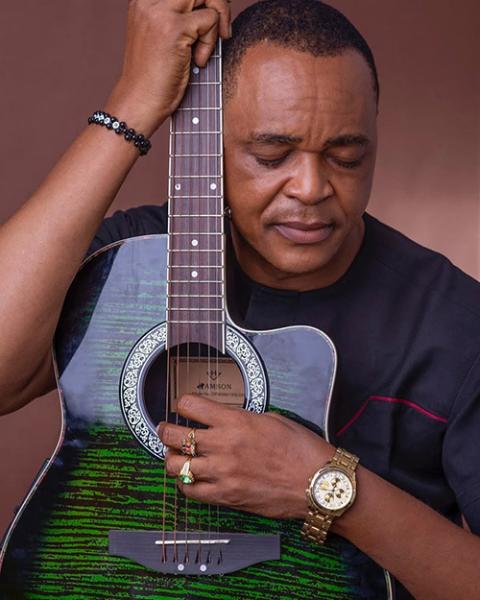
Jude Nnam (Courtesy of Jude Nnam)
By the time the war ended in 1970 and Nnam returned the next year to a war-riven Enugu, his older sister had died.** His father would die the year after Nnam's return. And a documentation error would see Nnam's brother lost in Gabon, never to be seen or heard from again. For Nnam, or Chika as he was then called, the culmination of these losses was a crippling sense of loneliness.
This feeling of isolation was compounded by treatment received from peers. "I had a reputation for always telling the truth, so mothers loved me and would often use me as an example to their children," said Nnam. "But it also made their children hate me. They would always exclude me from playing football with them."
But when Nnam stepped into St. Paul's Catholic Church in Enugu Town one afternoon, he was received with a form of kindness like nothing he had ever experienced. He soon became more involved with the church, signing up to be an altar server. It was while serving at Mass as a 9-year-old that he heard a rendition of Paulinus Umeh's "Kpadoro Onwe Gi Aku N'eluigwe," an offertory song that moved him to tears and made him want to join the choir.
With neither radio nor a record player at home, Nnam's encounter with music had come from snatches heard as he walked past record stores playing popular music — highlife songs by the Oriental Brothers and Celestine Ukwu. But Nnam displayed a natural talent that surprised even him: During a choir rehearsal, his perfect recall of all the vocal parts for Lucien Deiss' "All the Earth, Proclaim the Lord" was all the convincing the St. Paul's choir needed to admit the 9-year-old into their fold.
As a chorister, Nnam was particularly curious about composers, often asking questions about authorship. His questions could not always be answered: Scripts were handwritten at the time and names of composers were often lost during transcription. But some of the pieces that Nnam was first introduced to included those by Ikoli Harcourt Whyte, Felix Nwuba, the Rev. David Okongwu and Sam Ojukwu.
"I noticed most of the songs used in church then were composed by non-Catholics, especially Igbo songs," Nnam said. "Whyte was Methodist. Nwuba was Anglican. Okongwu and Ojukwu were also Anglicans. There were not many Catholic composers at the time, and in fact this is one of the reasons I went into composition. There were the likes of Dorothy Ipere and Betsy Ofoegbu, though. But most of the composers weren't even making liturgical music. The songs lacked deep Catholic dogma and teaching. That's why they couldn't survive, because a priest could criticize a song at Mass and the song would die off."
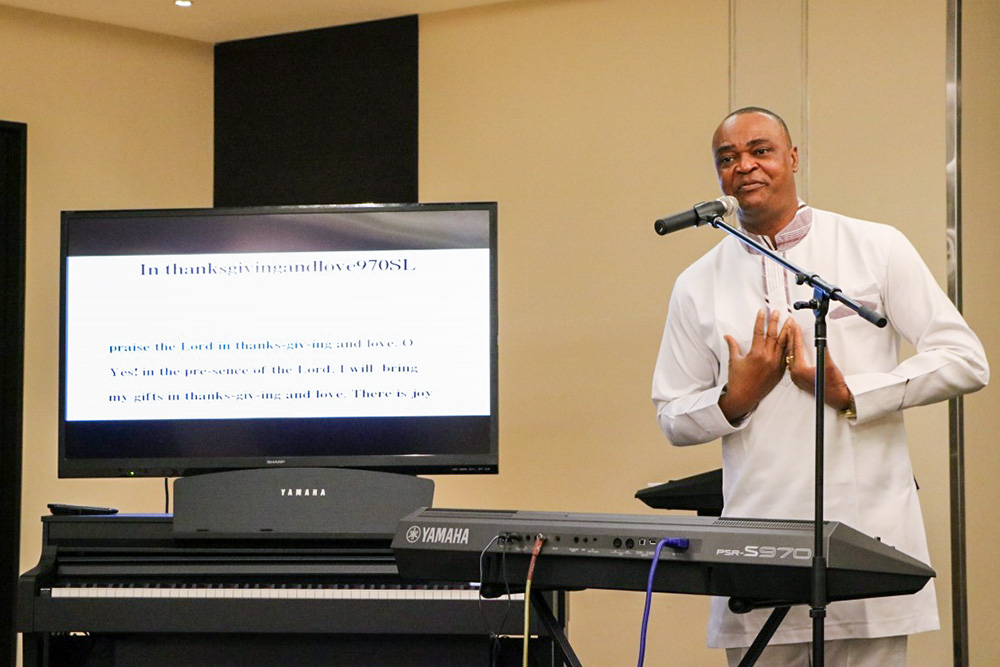
Musician and composer Jude Nnam performs his popular offertory song "Thanksgiving and Love" in this undated photo. (Courtesy of Jude Nnam)
Foundations of new liturgical music
The paucity of Catholic compositions in the 1970s, particularly in native languages, was because the adaptation of liturgy to local culture was still a new development, barely a decade old.
Since the first sustained Catholic mission kicked off in Nigeria in the 19th century, missionaries saw Indigenous traditions as "rustic artefacts of a heathen culture," according to Catholic priest and religion scholar Benedict Agbo. This suspicion ensured that native tongues and musical practices were disbarred from liturgical use.
But with the Second Vatican Council ending in 1965 and allowing for inculturation, local flavor started to enter the church. Indigenous musical instruments such as the ogene, the ekwe and the sekere were incorporated into liturgy, providing a percussive counterbalance to the staid air of Gregorian chants. And with composers such as Msgr. Cyril Ezenduka, compositions started to use the tonalities of different Nigerian languages.
It was mostly priests and seminarians composing in the period immediately after Vatican II, and they had little to no formal musical training. But subsequent years brought about a class of university-trained Catholic composers, made possible by the founding of music departments in Nigerian universities, with the first founded in Nsukka, in 1960. These school-trained composers, who blended Igbo compositional idioms with Western harmonic techniques, include Nnam, Ipere, Richard Okafor, Joe Onyekwelu, Fr. Emmanuel Umezinwa and Sr. Cordis Achikeh.
Advertisement
At secondary school, Nnam met a man he says changed his life: the school's music teacher, Matthew Onyeabor. Onyeabor would give Nnam an exhaustive musical education, introducing him to composers such as George Frideric Handel, and teaching him how to play multiple instruments, including drums, the flute and recorder, the keyboard and guitar.
"He became everything music to me," Nnam said, his tone reverent. "He laid the foundations I stand on today. He taught me the rudiments of composition, how to write music."
It was in secondary school Nnam wrote his first set of compositions, which he called "total rubbish," a description he also applied to works written in his early 20s. Seeking mastery, he turned toward Handel, Dan Agu, Ojukwu, Okongwu and works of other composers he had always admired. This sort of magpie sampling of various sources would form the basis of his creativity.
"The composers gave me confidence. I would put their works side by side and try to find out what makes them work differently," Nnam said. "Then I tried to incorporate them into my works to create something unique. That's why none of my songs sound alike. I may borrow an idea, but I would infuse something that is original. By the time it comes out, you won't be able to recognize the source."
When Nnam sits to compose a song, which depending on the kind of song could take anywhere from a few days to a couple of weeks, he conducts research to ensure adherence to Catholic theology. He also tries to infuse the work with rhythmic features he hopes would appeal to the youth population, whose declining engagement with the church has been amply observed. For songs in foreign languages, he relies on translators from embassies, and is particular about the songs reflecting their respective cultures.
"I try to find out what kind of music they use in their culture and see how I can follow the pattern, so that it works when they want to accompany it with their local music and instruments. I try not to alienate people from their kind of music," Nnam said.
After seeing choirs perform his pieces wrongly, Nnam decided in 1999 to make studio albums to serve as reference points. "It was also to keep the music alive," he said.
It may also have been to preempt copyright infringement. In 2021, Nnam would file a lawsuit against record label Five Star Music and Nigerian brothers Kcee and E-Money, alleging they had used his music without permission in their popular "Cultural Praise" album released the same year. The case, which remains in contention, points to the danger of copyright violations facing liturgical composers, whose works are often taken as common patrimony rather than products of sole authorship.
Totaling 12, Nnam's albums feature some of his most popular works, including "Kosisochukwu," "Abinci Alheri," "Take and Sanctify," "In Thanksgiving and Love" and "Do You Believe," which opens with highlife's trademark two-finger guitar pluckings. The albums embody qualities associated with Nnam's work: simple, repetitive melodies, an upbeat tempo, highlife stylings and a simplicity that makes his songs easily learnable, contributing to their popularity.
"His harmony is unique and beautiful. He can take a straightforward melodic line and turn it into a masterpiece," said Abel Obaje, the national coordinator of the Forum for the Inculturation of Liturgical Music. "Ordinarily, it would sound too plain, but then he brings in harmony, polyphonic and contrapuntal kinds of harmony — polyphony, especially."
For Agbo, Nnam's compositions are unique in their use of African musical elements such as call and response. "They also use ostinato refrains, a mixture of popular and folk music airs, and a modern compositional technique we can simply describe as minimalism. Examples are the songs 'Naranu m rie' and 'Olisa,' " Agbo said.
Nnam doesn't know exactly when the criticisms stopped, but he has not faced any significant opposition since "Missa Ifunanya." Both the passing of time and Nnam's ubiquity seem to have vindicated him, turning some of his fiercest critics into fans. "Some of the people who didn't like 'Missa Ifunanya' now like it. At Mass, they would be the ones to intone it," Nnam said.
'His music resonates widely'
Nnam sits on a lush pile of accomplishments. He is the music director of the Abuja Archdiocese, and has been the music director for the Christian Association of Nigeria since 2021, where he trains an interdenominational choir and accommodates various musical styles. He is also the music director of the National Catholic Liturgical Music Council, helping to enforce high standards in the composition of sacred music.
He has judged music competitions, and written tons of church and secular music: school and church anthems, carols, cantatas and jingles, including one for popular presidential candidate Peter Obi in the 2023 Nigerian election. In 2001, when he was only 36, Nnam was knighted by the Order of the Knights of St. Mulumba for his contributions to the church. And many of his songs have traveled well beyond Nigeria and the Catholic Church, soundtracking churches of different denominations across the continent.
Out of all these achievements, Nnam is particularly fond of the time he trained and conducted a 1,000-member choir at a papal Mass in Abuja, when Pope John Paul II visited Nigeria in 1998 to beatify Cistercian monk Michael Iwene Tansi. It almost never happened: Days before the papal Mass, choirmasters of the Abuja Archdiocese orchestrated a coup that nearly sidelined Nnam but for the intervention of the archbishop of Abuja, now Cardinal John Onaiyekan.
"Nnam's compositions helped shape a distinctly Nigerian and African Catholic sound, one that is authentically African yet fully faithful to liturgical norms," said influencer Schonstatt Fr. Ugochukwu Ugwoke. "His music resonates widely because it is deeply relatable. Jude Nnam composes from real human experience — our joys, struggles, celebrations, and prayers, oftentimes using his own real-life experiences. He raised the standard for liturgical music in Nigeria and inspired a new generation of church composers and choir directors."
One composer who has been greatly influenced by Nnam is Ifeanyichukwu Eze, who decided to join the choir after encountering Nnam's work in 1989 at St. Joseph's Catholic Church in Nsukka. Such is Nnam's influence that Eze's "Into Your Sanctuary," a popular entrance hymn, is often misattributed to Nnam.
"I studied a lot of Dr. Jude's works to learn his styles. I once dedicated an amateur piece to him titled 'Feed Me, Lord,' " Eze said. "People mistaking my works for his has made my works get to places I never thought they would get to, like the Vatican."
When Nnam performed on stage in Lagos in December at Unusual Praise, a gospel concert founded by Divine Mercy Catholic Church, Lekki, it was because his team convinced him of its merits. Many of the people who know and love Nnam's songs do not know who composed it, a common case with liturgical composers, whose works are usually experienced in contexts divorced from their creators.
"It doesn't bother me but lately it's started to bother my managers," Nnam said. "They said they would like to put a face to the music. That's why you find me attending events like this. Normally I don't do that. And my managers make sure I now sing only my songs."
His performance at Unusual Praise also doubled as a celebration of sorts: He turned 60 on Nov. 10, and the performance coincided with the one-year anniversary of Nnam's freedom from captivity, after he was abducted on Nov. 14, 2024 in Anambra. Nnam described muttering lines of Psalm 23 as he was bundled into the back of a car and blindfolded. The unusual kindness of one of his captors, who brought him a mosquito net and slipped a few naira notes into his pocket, seemed like proof of divine intervention.
Nnam sees God as the overarching theme of both his life and career. "God number one, God number two, God number three," he said. "When I tell people, they say it's humility. But it's not humility. It's the truth. Na God dey run am for me. He is the one who encourages me when I have challenges. I'm not the most intelligent, but God chose to use me for his work. Why is it that any song I write goes viral, and yet people are writing hundreds of songs daily? Even if I dropped dead now, I would be grateful because I never thought I would get here."
But there is still work to be done, he said.
"We don't have songs covering a lot of areas in liturgical music. I'm trying my best to see if before I die it would be possible to cover the parts of liturgical music that are still open," Nnam said.
"A lot of people are concentrating on just one area. But in my studies, I've seen there are a lot of areas we've not touched, like songs dedicated to church memorials. I pray God gives me strength."
*This sentence has been edited to correct the location of Nnam's birthplace.
**This sentence has been edited to correct the number of sisters who died.