

Idris Elba as POTUS in Kathryn Bigelow’s "A House of Dynamite." (Netflix/Eros Hoagland)

Released at a moment when world leaders once again rattle their nuclear sabers — Russia testing "doomsday" weapons and the U.S. renewing talk of testing its nuke systems — Kathryn Bigelow's latest film, "A House of Dynamite," detonates more than a plot. It's a cinematic alarm bell ringing in a world that has drifted back toward the edge of annihilation. Premiering on Netflix on October 24, 2025, the film has been hailed by nuclear policy experts as "the most realistic depiction ever" of a nuclear crisis and condemned by others as unbearable to watch. Bigelow's refusal to deliver a tidy ending ensures that viewers leave unsettled, even haunted, by what they've seen.
At the heart of the film lies a chilling exchange between two officials in the White House Situation Room. "This is insanity!" one shouts. "No, sir. This is reality," comes the reply. In that brief dialogue, Bigelow and screenwriter Noah Oppenheim distill their thesis: humanity lives inside a house built of explosives, mistaking our unbroken streak of survival for safety.
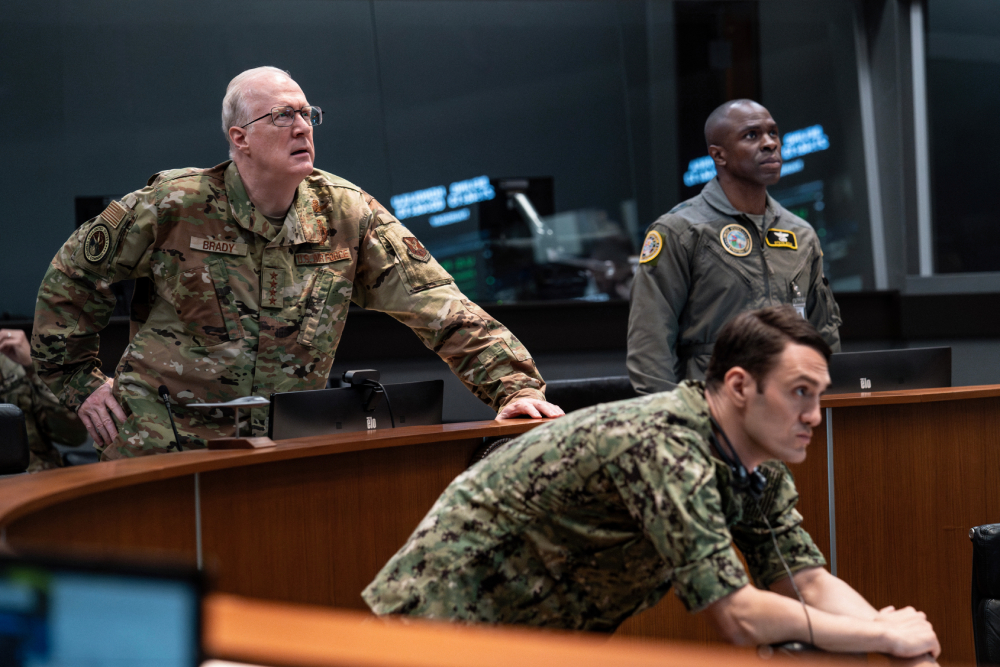
Kathryn Bigelow's new film, "A House of Dynamite," follows 18 minutes in the White House Situation Room in a race to determine who is responsible for a missile that has been launched at the United States, and how to respond. (Netflix/Eros Hoagland)
A masterclass in procedural realism
Rather than dwell on spectacle, Bigelow anchors the story in 18 minutes; the time between the detection and impact of a single, unattributed intercontinental ballistic missile headed for Chicago. The narrative unfolds through three interlocking perspectives: the White House, Strategic Command in Nebraska and the president, played with taut restraint by Idris Elba. The clock never stops ticking.
The realism is harrowing. Sets were modeled on actual command centers; consultants included former nuclear officers and policy veterans. Oppenheim calls the script "a work of journalism in cinematic form." By focusing on process rather than aftermath, Bigelow rejects Hollywood comfort. There are no mushroom clouds, no post-apocalyptic wastelands; only the claustrophobia of decision-making, the grinding protocols of annihilation. What unfolds is not fiction; it's a mirror of procedures that still govern our world tonight.
The human factor
Unlike the caricatures of Dr. Strangelove, Bigelow's characters are competent, conscientious — and powerless. The President prays, argues and tries to call his family. The tension isn't between good and evil but between reason and momentum. The system itself is the villain.
The tyranny of time
The true antagonist is the clock. Eighteen minutes allow no time for verification, diplomacy or reflection. Procedure overtakes prudence. Humanity barrels forward toward extinction because no one dares to pause.
The folly of missile defense
When America's $50 billion Ground-based Midcourse Defense system proves unreliable, a general erupts: "So it's a f---ing coin toss? That's what fifty billion buys us?" The line lands because it's true; experts say hitting a missile with an interceptor is like "hitting a bullet with a bullet." Each failure exposes not only political peril but spiritual blindness, a collective refusal to see what we've made of God's creation.

Rebecca Ferguson as Captain Olivia Walker. "A House of Dynamite" has been hailed by nuclear policy experts as "the most realistic depiction ever" of a nuclear crisis. (Netflix/Eros Hoagland)
The divisive ending as moral imperative
When the countdown reaches zero, the screen cuts to black. We never learn who launched the missile, whether it detonated, or if retaliation followed. Many viewers were furious. They wanted closure. But Bigelow and Oppenheim insist the ambiguity is the point. "The explosion we're interested in," Bigelow said, "is the conversation afterward."
The film's stylistic repetition feels like a moral echo chamber. It's disorienting, deliberately so. The movie doesn't end because the danger hasn't ended. We are still living in that unresolved second.
Anti-nuclear activists have seized upon "A House of Dynamite" as an urgent teaching tool. In policy circles, it's already being screened alongside seminars on the "new nuclear era," an age when the post–Cold War consensus on disarmament has collapsed. Viewers are reminded of real-world flashpoints: The New START Treaty that limits U.S. and Russian warheads will expire February 5, 2026; both nations keep missiles on hair-trigger alert, leaving mere minutes to decide on launch; and a U.S. president still has the sole authority to order a strike (a power many now call undemocratic and morally indefensible).
The moral alarm bell
Bigelow's film arrives amid grim headlines: renewed weapons testing, trillion-dollar modernization programs and rhetoric that normalizes the unthinkable. Earlier this year, The Bulletin of the Atomic Scientists set its Doomsday Clock to 89 seconds before midnight — the closest in history. "A House of Dynamite" shows what that number looks like.
The film's moral question is ancient: Can any society claim to revere life while maintaining weapons designed to erase it? Watching Elba's president stare at the launch codes, whispering a prayer for his children, one feels the absurdity of entrusting planetary survival to a single exhausted human being. This is not governance; it is moral abdication, a roulette game with creation itself.
The insanity that is our reality
Bigelow's title becomes a metaphor. Every policy paper, every budget line, every "deterrent upgrade" adds another stick of dynamite to the foundation. The madness lies not in villains but in ordinary professionals executing their duties inside a perfectly legal system. The architecture of annihilation endures through bureaucracy and denial.
Oppenheim's dialogue bristles with factual allusions — false alarms, psychological tolls and the routines of control. The camera lingers on faces more than machines. When an aide mutters, "We're all hostages of our own technology," the line lands as prayer and confession. What Bigelow captures, perhaps without intending it, is the theology of idolatry: the worship of control, the sacrament of fear.
Advertisement
Glimmers of hope
Still, despair is not the only possible response. The film's companion discussion panels, streamable on Netflix, feature experts who remind viewers that change is possible. History offers precedents: South Africa dismantled its six warheads; Kazakhstan surrendered its inherited arsenal; global stockpiles have fallen from 70,000 to about 12,000 today.
"We built the system," Bigelow said. "We can decide to stop building it." That is as much a theological statement as a political one.
Faith communities are reclaiming this ground. The Vatican's growing rejection of the "just war" doctrine and endorsement of the U.N. Treaty on the Prohibition of Nuclear Weapons mark a profound moral shift. Catholic leaders now describe deterrence itself as "an illusion of security." "A House of Dynamite" translates that teaching into visceral experience. In rejecting deterrence, the church calls faith itself to be disarmed.
The question of survival
Watching "A House of Dynamite," one feels both dread and clarity. It strips away abstraction and leaves us naked before the question of survival. Are we content to live indefinitely inside this house of dynamite, hoping the fuse never catches? Or will we finally dismantle it, plank by plank, warhead by warhead?
Bigelow offers no answers, only silence and light. The fuse is lit. Yet conscience is still a hand that can reach out and snuff the flame.
"A House of Dynamite" is not entertainment. It is a revelation. It shows us the insanity that has become our reality and challenges us, before it's too late, to choose sanity instead.