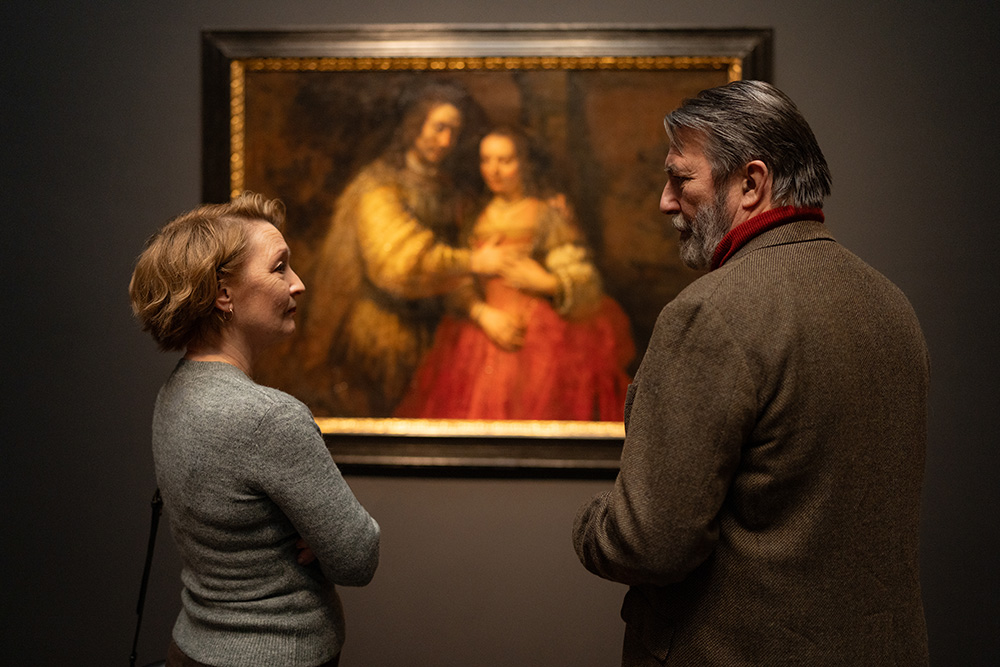
In a scene from the movie "Midwinter Break," Stella (Lesley Manville) and Gerry (Ciarán Hinds) survey "The Jewish Bride," a Rembrandt painting of Isaac and Rebecca that hangs in the Rijksmuseum, and see two separate but equally plausible meanings based on the circumstances of their own lives. (Focus Features/Mark de Blok)

by Elizabeth Hamilton
"Do you think we'll ever get away?" the aging Gerry asks his wife, Stella, in the penultimate line of "Midwinter Break." The two stand shoulder to shoulder in front of a floor-to-ceiling window in the dark terminal of Amsterdam Airport Schiphol, watching the morning star rise through a flurry of snowflakes. On the surface, Gerry could be talking about their flight out of Amsterdam, long delayed due to the inclement weather. More likely, he's referencing the past, and the coping mechanisms he and Stella have developed over decades of marriage for dealing with painful memories they cannot escape. Will they ever?
"Midwinter Break," based on the novel of the same title by Bernard MacLaverty, is a quiet film about a long-held marriage, a film that unspools through drawn-out scenes of ordinary life. Stella and Gerry, played with astonishing emotional range by Lesley Manville and Ciarán Hinds, are originally from Belfast but emigrated to Glasgow shortly after Stella, then heavily pregnant, was injured in a firefight during the Troubles in Northern Ireland.
Decades later, they've raised their son and completed modest careers in teaching (her) and architecture (him). Now, they live comfortably as retired, empty nesters in their Glasgow flat. Or do they?
When Stella plans a spontaneous trip to Amsterdam at the start of the New Year, we begin to see that under the surface of their peaceful domesticity lie unspoken grievances. Stella is a devout Catholic; Gerry is secular. He makes little comments about her faith, seemingly not meant in harm, but these remarks add up over time and set Stella on edge.
She, in turn, digs at him for not understanding anything "spiritual." Gerry drinks. A lot. Stella pretends she doesn't see, but of course she does.
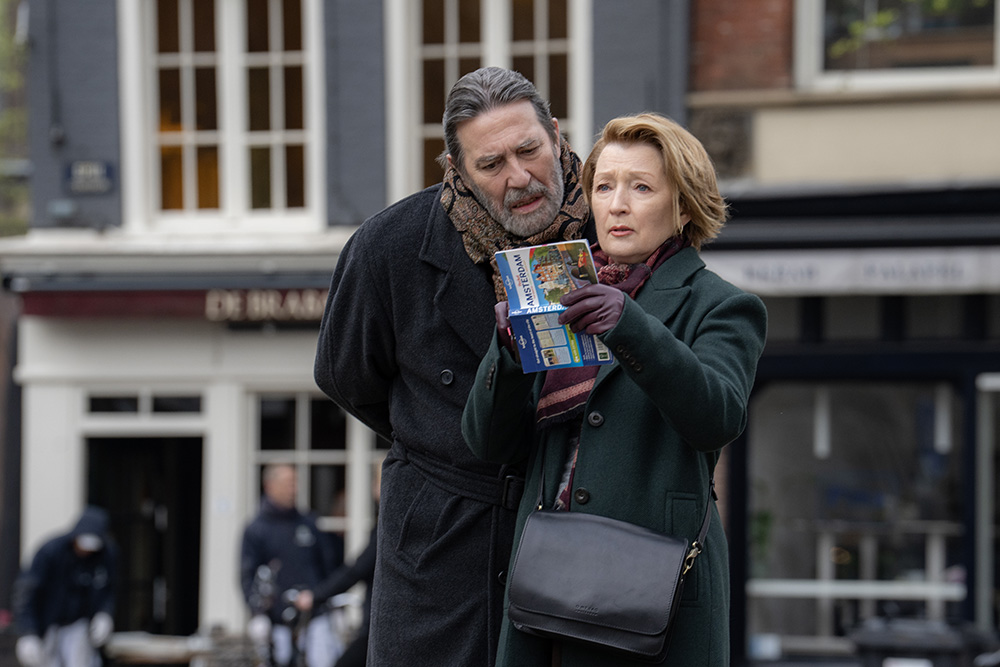
Ciarán Hinds as Gerry and Lesley Manville as Stella in the movie "Midwinter Break." On a spontaneous trip to Amsterdam, long unspoken grievances create tension in a seemingly peaceful marriage. At the root of the trouble are questions of God and faith. (Focus Features/Mark de Blok)
Theirs is an intimate, intertwined relationship. She keeps track of his heart medicine. He passes her his reading glasses. She ties his scarf. He takes her hand when they cross a busy street. As they visit the various tourist sites throughout Amsterdam — the Rijksmuseum, the Anne Frank House, the occasional Irish pub — we see the full range of feelings that exist between them, from frustration to affection, miscommunication to acceptance. It's a realistic picture of what marriage often looks like and asks, what might keep a couple married after so many years?
At the heart of the distance growing between them is the catastrophic event that happened to Stella in Belfast all those years ago. After she was shot, while bleeding out on the sidewalk, she promised she would devote her life to God — if only God would save her baby. She and her baby did, in fact, survive, and she looks back on this moment as miraculous.
Gerry, on the other hand, doesn't see anything miraculous about it. In a touching scene where he speaks with a young Irish bartender, he calls what happened "the end of human decency in the name of religion." Not only did the Troubles injure his wife and force his family into exile, he also lost out on a prestigious architectural career.
These days, he drinks to make himself feel better about the loss — or, as he puts it, to hate himself a little bit less than he does while sober.
Stella, for her part, tortures herself with the belief that she failed to make good on her promise to devote herself to God. Thus, the same event means totally different things to these two people, and the stories they've told themselves about what happened have slowly, over the years, ground them down.
Advertisement
Which begs the question: Which version of events, if either, is true? In a telling scene, Stella and Gerry survey a Rembrandt painting of Isaac and Rebecca that hangs in the Rijksmuseum. Known as "The Jewish Bride," the painting depicts the young biblical couple dressed in golden finery, Isaac embracing her lightly, Rebecca holding her belly. Gerry says he can tell how much Isaac cherishes her.
After a pause, Stella wonders why Rebecca is protecting her stomach. They seem to be seeing two separate but equally plausible meanings in the same image, drawing differing conclusions based on the circumstances of their own lives.
Later, Stella visits the Begijnhof, a cluster of historic buildings surrounding a grassy courtyard, once home to a religious community of women who practiced their Catholic faith in secret. She inquires about how to join the community, hoping to live a more devout life in her latter years — and thereby uphold her promise to God — only to discover that the religious component of the Begijnhof ended decades earlier. Here again, we have an instance of Stella seeing a half-version of reality based on her own fears and desires, surprised to discover that a reality different from her own exists.
How, then, do these two reconcile their differences and find themselves once more in the same story? Not through changing each other's minds, as one might suspect, but through a version of that ancient Christian practice: confession. Stuck in the Amsterdam terminal — a place symbolic of transition, from middle to old age, from despair to freedom, from exile to home — the two finally open up to each other, each sharing their versions of the truth.
On the surface, it may seem as if nothing has changed. But confession brings healing in part through the release of burdens. By confessing their truths in vulnerability, Stella and Gerry are able to see each other anew. A closeness is restored, even if we are left wondering whether that will be enough to save their marriage.
But the morning star symbolizes the arrival of new beginnings. It may not be possible for these two to escape their pasts but, like all of us, they still might transform them. As Stella says, taking Gerry's hand, "We can only hope."