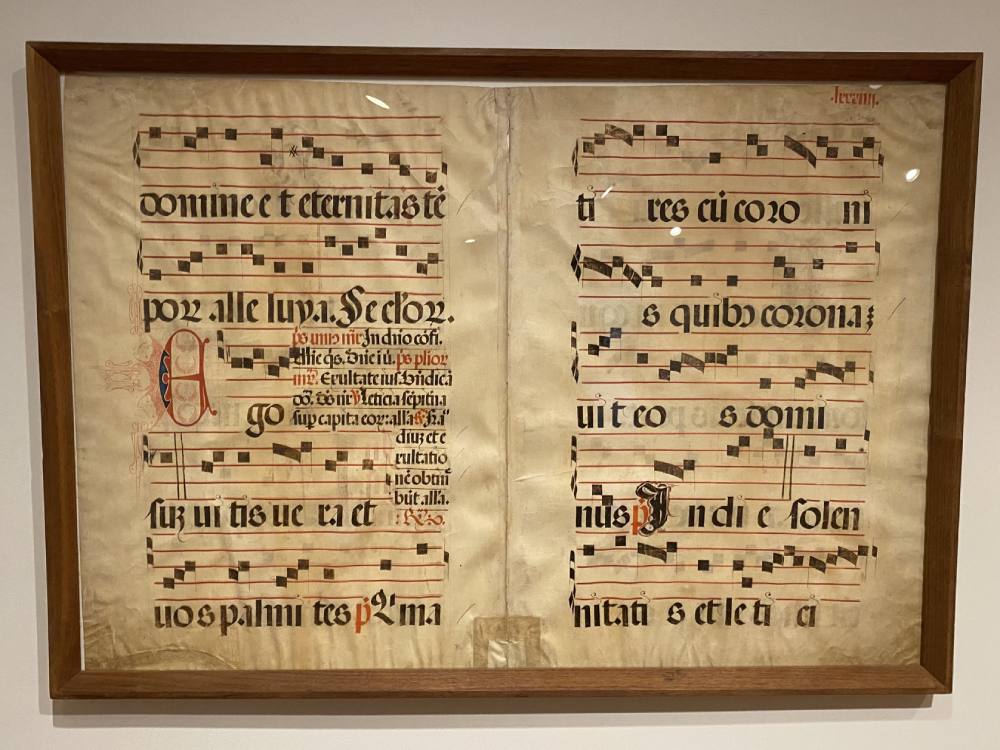
"Bifolio from a Choir Book," Spanish, 1400-1450. (Michael Centore)

by Michael Centore
When does the physical act of writing cross over into art? When does the artistic process cross over into prayer?
I found myself contemplating these questions as I toured "Painted Pages: Illuminated Manuscripts 13th-18th Centuries," an exhibition currently on view at the art museum of the University of St. Joseph in West Hartford, Connecticut through Dec. 13.
"Painted Pages" brings together a selection of manuscript leaves from medieval Europe as well as later examples of Hebrew, Arabic and Persian texts. The exhibit was organized by the Reading Public Museum in Pennsylvania, which holds a trove of manuscripts from the legendary collection of Reading native Otto F. Ege.
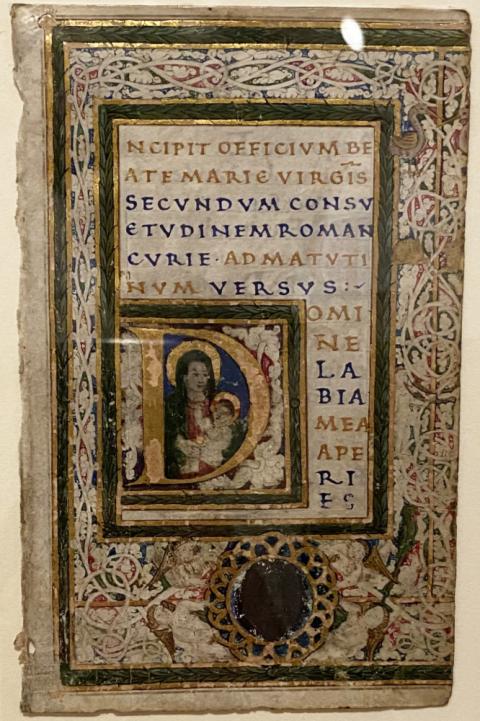
"Leaf from a Book of Hours," Flemish, c. 1480-1490. (Michael Centore)
Though the exhibit is small by museum standards, it is exceptionally well-curated. The sheer variety of texts represented is itself a revelation, as the curators incorporate pages from breviaries, lectionaries, missals and choir books. Diverse forms of script, from the compressed angularity of Gothic characters to the semi-cursive lettre bâtarde, show how writing systems evolved in response to both copyists’ and readers’ needs.
The longer I looked at these letter forms, the more I began to perceive their kinetic energy as they march across the parchment. This was evident from the first piece in the show, a leaf from a 14th-century psalter where initials illuminated in red, gold and blue tumble down the lefthand margin to note the opening of each verse.
The sense of motion carried over into the liturgical music manuscripts, including bifolios from Spanish and Italian choir books and a leaf from an Italian antiphonal. Here the neumes, or square-shaped notes, climb up and down the ladder of the staff to direct the melody of the chanted words below. Seeing the calligraphic, poetic and musical elements work together felt like a way of condensing the multisensory experience of the Mass onto a single page.
There are also several examples of what specialists refer to as "historiated initials," letters whose openings contain figurative or narrative scenes. In a leaf from a 15th-century Flemish book of hours, a tiny image of the Virgin and Child is ensconced within the D of the line, "Domine labia mea aperies" ("O Lord, open my lips"). The image establishes a prayerful connection to the word — and Word — of God itself. One can envision a medieval reader pausing to meditate on the Incarnation and how it affected their pronunciation of the divine name.
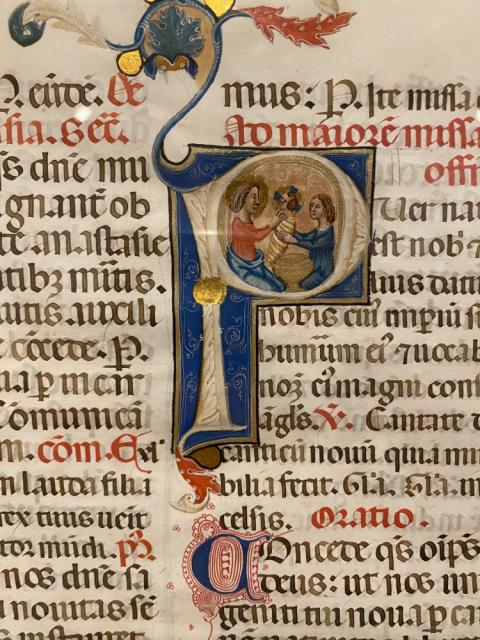
Detail from "Leaf from a Dominican Missal," Italian (Perugia), c. 1353. (Michael Centore)
A similar historiated initial appears in a leaf from an Italian Dominican missal. Mary and her attendant hold the Christ Child, whose gilt halo is striated by three bands of blue. The precision achieved within such a small space is astounding. When I discovered that the text of the leaf details instructions for the celebration of the Christmas Mass, the image acquired an even deeper relevance.
Another Dominican-related object is a leaf from a miniature Latin Vulgate Bible dating to the mid-13th century. Dominican friars were the most prominent copyists of the Vulgate at the time. Learning about their use of skins and quills to create these treasured tomes was a reminder that the printed page, like an icon, emerges from creation: the Bible and the book of nature are read as complementary volumes.
That interplay of the orthographical and the theological reaches another level in an ink-on-paper illustration of the Kabbalistic "Tree of Life," produced by members of the Jewish diaspora in Cochin, India. Here the circles of the sefirot, nodes depicting the attributes of God, are ringed with green embossing that sparkles in the light. The mystical tree is flanked on both sides by diagrammatic representations of the Hebrew alphabet, showing the inner relationship between letter forms and the creative work of God that is prevalent in Kabbalistic thought.
Advertisement
Like so many works in the show, a 17th-century leaf from a Koran copied in Arabic script obliterates any distinction between calligraphy and visual art. The beautiful symmetry of the composition, with bands of larger characters on the top and bottom framing a field of smaller characters within, conveys intention and balance. But it is the third band bisecting the text that captivates the eye. Illuminated with gold leaf and a deep blue pool of lapis lazuli, I could almost feel the coolness of the color transmuted through the page.
As I made a final pass through the galleries, I considered another boundary these assembled manuscripts blurred: that between the devotional and the utilitarian object. I thought of the page from a miniscule breviary likely used by a traveling cleric, or the leaf from a lectern Bible to be read in a monastery refectory, and I imagined these texts as entering the flow of daily life. The anonymous scribes who created them expressed a true gift of the artistic vocation: to beautify someone’s experience of prayer.