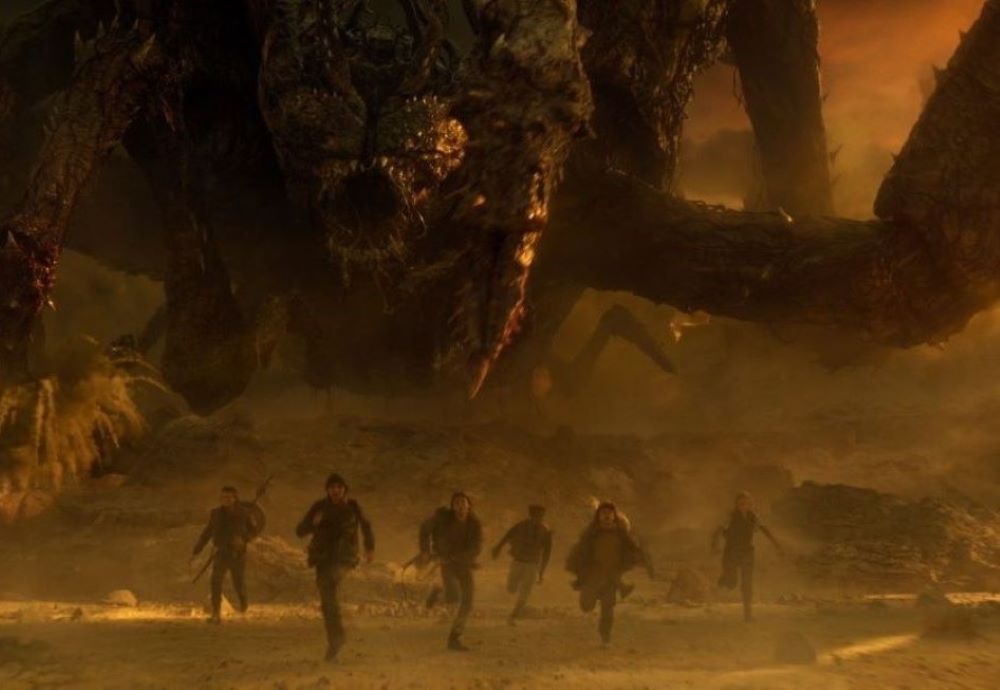
In "Stranger Things," an ancient, sinister being called the "Mind Flayer" has terrifying intentions for the world. The five-season Netflix series by Duffer Brothers recently released its final episode. (Netflix)

by Rebecca Bratten Weiss
"Stranger Things" has come to an end. Set in the 1980s and centered on a group of nerdy kids battling monsters from an alternate dimension, the Duffer Brothers' critically acclaimed Netflix series, has acquired a cult following for its writing, acting and production. It's also beloved for its meticulous rendering of the 1980s and its many nods to the decade's culture. The show's retro soundtrack introduced millions of Gen Zers to the joys of Metallica and Kate Bush.
Despite leaning heavily into nostalgia, the five-season show isn't escapist. Following C.S. Lewis' belief that fairy tales employ the fantastic to convey profound realities, "Stranger Things" is a fairy tale for our age. The '80s may be "once upon a time," but the era's bigotry, brutality and paranoia never really went away. The show's themes of government overreach and the exploitation of women are pressingly relevant.
Other critically acclaimed shows from the era of prestige TV, including "The Sopranos," "Game of Thrones" and "Breaking Bad," focus on morally ambiguous protagonists in convoluted situations of their own making. When neoliberalism was dominant, such ambiguity felt like a sophisticated and necessary critique of societal structures. But as the United States tumbles from neoliberalism to fascism, ambiguity begins to feel compromised. The rich texture of "Stranger Things" could lend itself to an entire book, but in the era of MAGA, I want to focus on the story as an uncompromising good-versus-evil narrative.
The show takes place in the fictional Hawkins, Indiana, an unpretentious municipality that looks like thousands of other midwestern towns but happens to have a government research facility nearby. The town's believability, as well as the authentic cultural touchstones like friendship bracelets, boomboxes and the mall, build out a realism that satisfies another of Lewis' requirements for fairy tales: They must start with the commonplace, before introducing the fantastic.
Belief here is not about leaps of faith but about the courage to trust one's observations and intuitions, and to trust those who have earned it.
At the start of the show a boy, Will (Noah Schnapp), is abducted while cycling home after a D&D game. At the same time a girl with telekinetic powers (Millie Bobby Brown) escapes from the lab and is rescued by Will's friend Mike (Finn Wolfhard), who calls her "Eleven," or "El," after the number tattooed on her wrist.
The kids quickly realize that Hawkins is being invaded by sinister creatures from an alternate dimension, which they name the "Upside Down." Over the course of the show, the events grow increasingly terrifying, but the town's residents come up with explanations that are easier to live with, such as cult activity (alluding to the "Satanic Panic") or earthquakes. No one wants to believe what's right in front of their eyes.
The theme of belief bookends the show. In the first season, Will's mother Joyce (Winona Ryder) insists he's alive even when everyone thinks she's crazy. Belief here is not about leaps of faith but about the courage to trust one's observations and intuitions, and to trust those who have earned it. As Mike teaches El, when she's learning the ropes of human society: "Friends don't lie."
Early on, the kids learn that the lab is doing experiments (inspired by the CIA's infamous MK-Ultra mind control program) intended to create an army of telekinetic humans for the Cold War. Since El is one of their most powerful test subjects, they want her back. The kids also figure out that the monsters are a hive mind controlled by a powerful being, once a telekinetic test subject in the lab, who inadvertently created the Upside Down when he went rogue. This creature, whom the kids call "Vecna" (Jamie Campbell Bower), operates in tandem with an ancient, sinister being they call the "Mind Flayer," and has terrifying intentions for the world.
The kids get the names for the other monsters from D&D lore, and the game functions as a framing device for their adventures. This framing — and the power they assert to name their enemies — gives them agency, allowing them to reimagine themselves not as victims but as heroes.
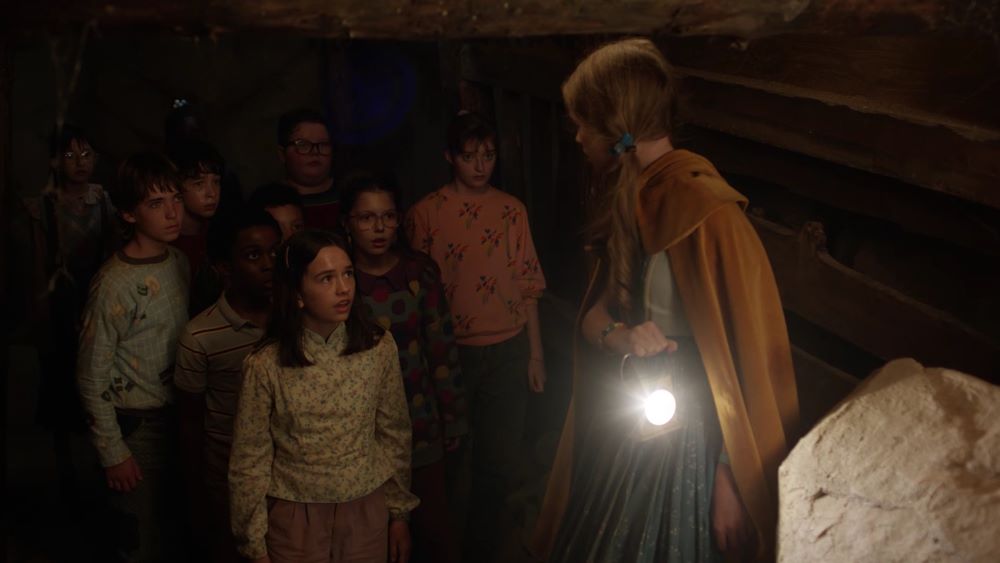
Starring in "Stranger Things" are, from left, Carson Minniear as Thomas, Anthony Jenkins as Joshua, Eden Stephens as Debbie Miller, Jake Connelly as Derek Turnbow, Calista Craig as Mary, Olive Abercrombie as Valerie, and Nell Fisher as Holly Wheeler. The Netflix series has completed its fifth and final season. (Netflix)
By the final season, the little kids have become high schoolers. Mike and El are dating. Other characters are navigating romances and complicated friendships. Will, scarred from the trauma of his kidnapping, has realized that he is gay and attracted to Mike. The story's foregrounding of perennial human concerns keeps the conflicts relatable, no matter the exceptional circumstances.
As critic Justina Walford writes, "Stranger Things" succeeds "because it applies 1980s storytelling rules — small towns, real stakes, sacrifice and practical horror — to modern television. The result is a series that feels authentic rather than exploitative." It also helps that the writers don't make the characters behave stupidly or unbelievably to create cheap plot twists.
Though the protagonists are a diverse group in terms of age, gender, sexuality, race, economic class, ability and body type, authenticity is essential for all of them. This means something deeper than "just being yourself." It means acting out of a moral center, through your unique gifts. This is highlighted in the final season when Will learns to accept his sexuality and is then free, at a crucial moment, to tap into telekinetic powers of his own. Of course, most of the characters don't have psychic powers, but they have other gifts, like computer coding, sharpshooting and playing epic guitar riffs.
Since Vecna was originally a human child, he is theoretically redeemable. In the final confrontation, Will offers him a chance at redemption, reminding him that he, too, is a victim of the Mind Flayer. Vecna rejects this, claiming he freely chose to be an agent of the Mind Flayer, and is no mere vessel. So, no conversion for Vecna. El fights and injures him. Then Joyce hacks his head off with an axe.
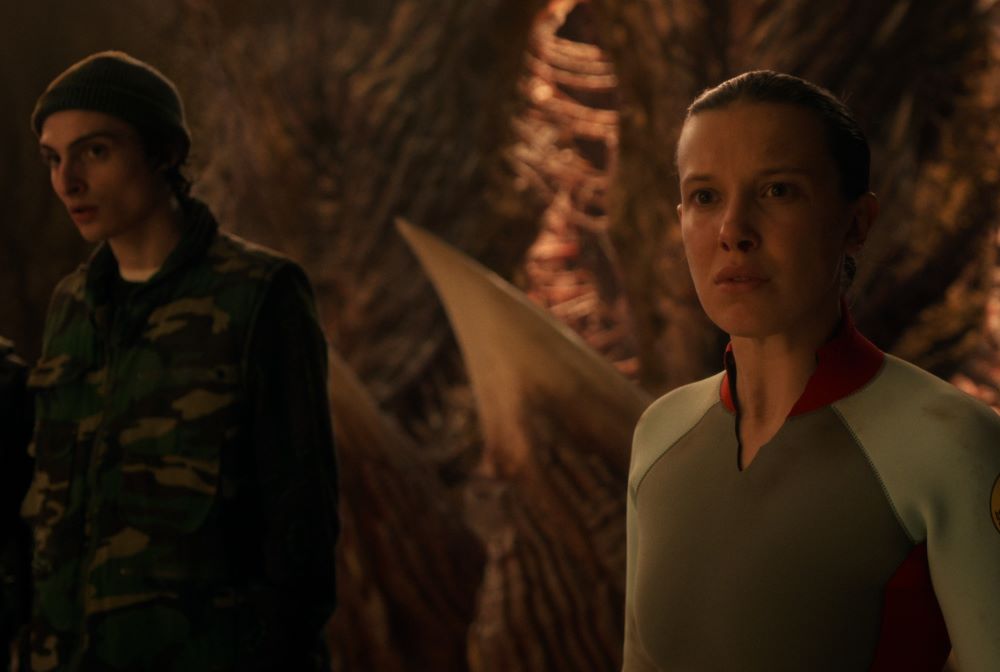
Finn Wolfhar, left, portrays Mike Wheeler and Millie Bobby Brown portrays Eleven in "Stranger Things: Season 5." The series is set in the 1980s and centers on a group of nerdy kids battling monsters from an alternate dimension. (Netflix)
There's still the military to contend with, though. And the stakes are higher now, because Season Five revealed that the government hasn't just been abducting psychic kids. It's been abducting pregnant women, too, and injecting them with the blood of psychics. So far, this experiment has succeeded only in killing the women.
Knowing that the government will never stop pursuing her, and that if they capture her they will use her blood in this way, El makes her own decision. She sacrifices herself in an explosion intended to close the Upside Down forever.
The last 40 minutes of the finale are dedicated to giving the main characters their wrap-ups. While some viewers felt that this dragged, I think the show earned the right to linger. But the final moments are dedicated, once again, to D&D.
"It felt right to go full circle," Ross Duffer said about the ending. "This is about this group of characters saying goodbye to their childhood. That basement, specifically the Dungeons & Dragons game, represents their childhoods [and it's] how we first met them as an audience. To say goodbye to it, you have to play one last time."
In their last game, Mike uses D&D to suggest an alternate ending for El. What if she isn't really dead, but tricked them with an illusion, to keep them safe, and then escaped, and is happy and free somewhere? This is what he chooses to believe. The others choose to believe it, too.
And that's the end of their game, and their childhood.
Advertisement
I don't know that the Duffer Brothers intended the scene to allude to the Christian tradition, but it was striking that "Stranger Things" closed with a tight-knit group remembering their friend who sacrificed herself to save them. As each of the four boys, now young men, put their D&D books on the shelf, it reminded me of the Gospels. Four books; four storytellers. "Stranger Things" closes with a reminder of how stories give us the framework we need to go on resisting evil.
To allude to G. K. Chesterton's famous quote on fairy tales, we already know that monsters exist. We are reminded of it daily, as we wake up to the latest stories of brutality and violence. "Stranger Things" reassures us that the monsters can be beaten, though this may demand great sacrifice. We will not emerge unscathed. But the alternative, giving up, would be infinitely worse.