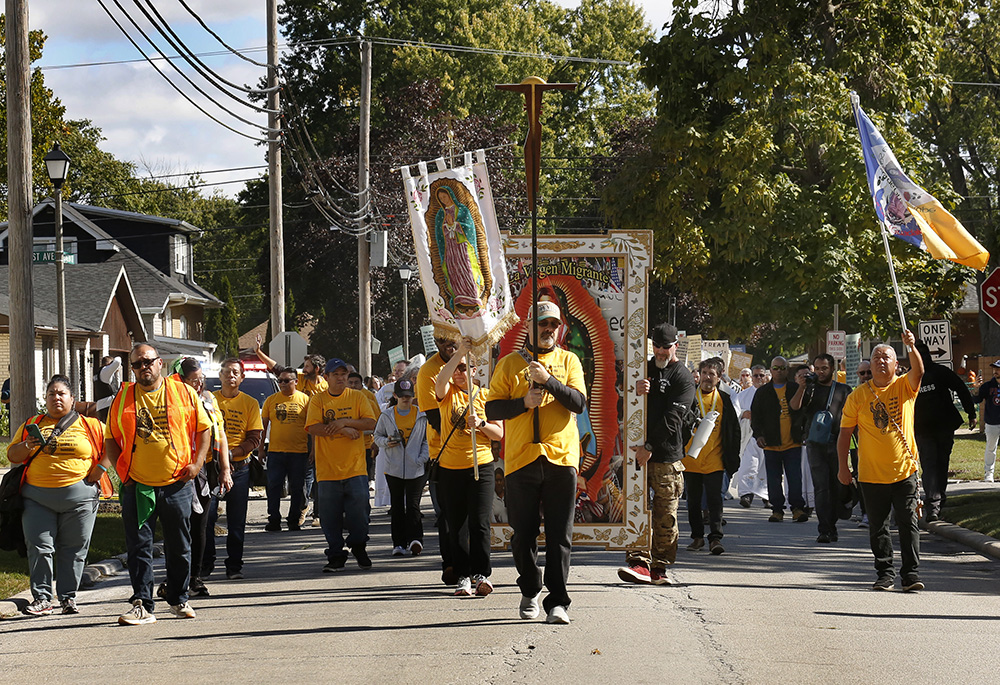
Immigrant activists make their way down Lexington St. on the way to the U.S. Immigration and Customs Enforcement facility in Broadview, Oct. 11 in Chicago. Hundreds followed the Eucharist from St. Eulalia Parish in Maywood to the Broadview facility operated by the Department of Homeland Security. The group hoped to give Communion to detainees at the center but were denied access. (Chicago Catholic/Karen Callaway)

A group of Catholics who marched to a Chicago immigration processing center three days ago and were prevented from giving Communion to detainees said they are not about to back down.
Organizers said their movement is only gaining momentum — planning new trainings, legal action and more "holy protests" to challenge what they call the erosion of faith and human rights under federal immigration enforcement.
"I'm obviously disappointed that they would not allow us into offering holy Communion to those who are being detained there," said Fr. Larry Dowling, one of the priests who took part in the march Oct. 11.
"Until the last three, four months, we have been able to do that and they've allowed us to do that, but under the current administration, all of that has stopped. They don't want anyone going in there, seeing the horrible conditions inside and offering any support to these people that they are detaining," he said.
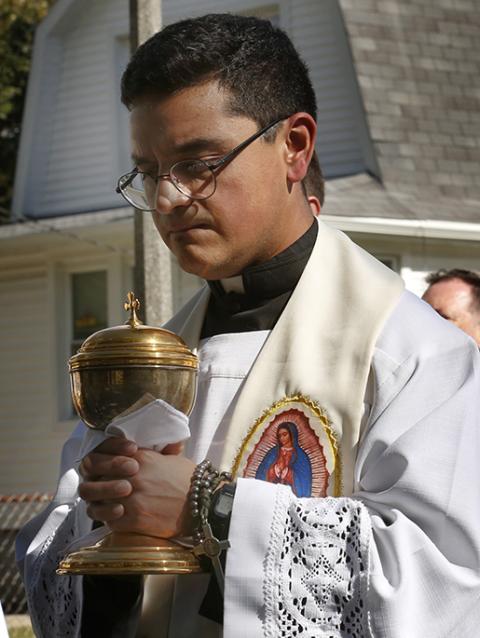
Fr. Cristian Enrique Garcia Nuno carries the Eucharist during the procession Oct. 11 in Chicago. (Chicago Catholic/Karen Callaway)
Dowling, a retired priest from the Archdiocese of Chicago, told NCR that he and other clergy members are considering legal action to assert their right to minister to detainees in an immigrant processing area that some of the protesters say is also used as a detention center.
"I think we are going to pursue a lawsuit, to claim our rights as clergy and religious to be able to minister to anyone in these facilities," he said. "We're going to continue to push back in any way that we can peacefully to fight for what is right."
While the group walked less than 2 miles to the U.S. Immigration and Customs Enforcement processing center in Broadview from St. Eulalia Parish in Maywood, they carried banners of the Virgin Mary, sang hymns in English and Spanish and prayed the rosary.
Their hope was simple and sacred: to bring holy Communion to the men and women detained inside.
But at the gates, that hope was met with silence and a locked door.
Illinois State Police officers, standing in for ICE, relayed the group's request. After a long wait, a phone call came back: No. No reason was given.
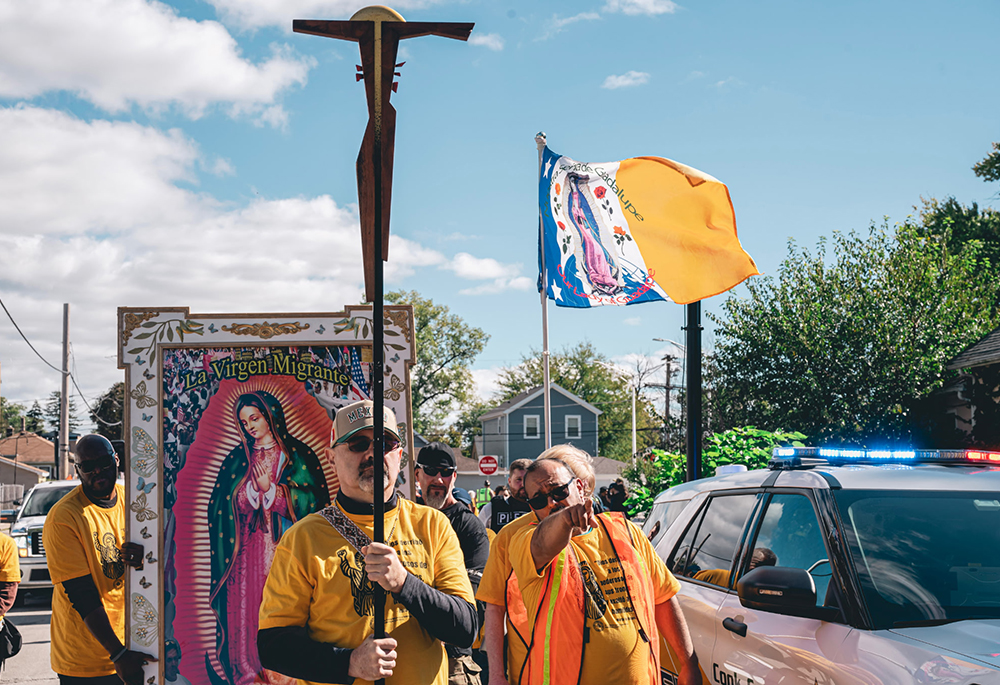
About 1,000 Catholic activists march Saturday, Oct. 11 in Chicago to bring Communion to detainees at the Broadview ICE processing center. (Courtesy of Coalition for Spirituality and Public Leadership)
NCR reached out to ICE and the Illinois Police Department Oct. 13 for comments about the denial to allow the group to distribute Communion to detainees and to describe conditions of detainees in the ICE center. No immediate response was given from ICE before publication.
A spokesperson for the Illinois State Police said the department relayed to ICE personnel the group's request and after it was denied "that information was in turn respectfully provided back to those making the request." The spokesperson also said the state police "does not have any authority over detainees or the ICE facility in Broadview."
After the denial was announced, the leaders turned to prayer. Felician Sr. Jeremy Midura, a member of the delegation that led the march, addressed the group of about 1,000 who had gathered outside the detention center, her voice steady as she relayed that the doors would remain closed. In that moment, the crowd did what they had come to do: They prayed, they sang and they broke bread together on the pavement.
"After the sister shared the report, we provided Communion outside of the detention center," said Michael N. Okińczyc-Cruz, the group's executive director Coalition for Spiritual and Public Leadership (CSPL), a Chicago-based network of parishes, universities and religious orders involved in faith-based community organizing.
The coalition, which organized the demostration, has been at the forefront of nonviolent faith-based protest in the Chicago area, and the Broadview procession was, by far, its largest, Okińczyc-Cruz said.
"They may have denied the body of Christ in physical form, but we extended a prayer of spiritual communion to them. We communicated to our members that the struggle does not end, that we have to continue to organize and work together," he said.
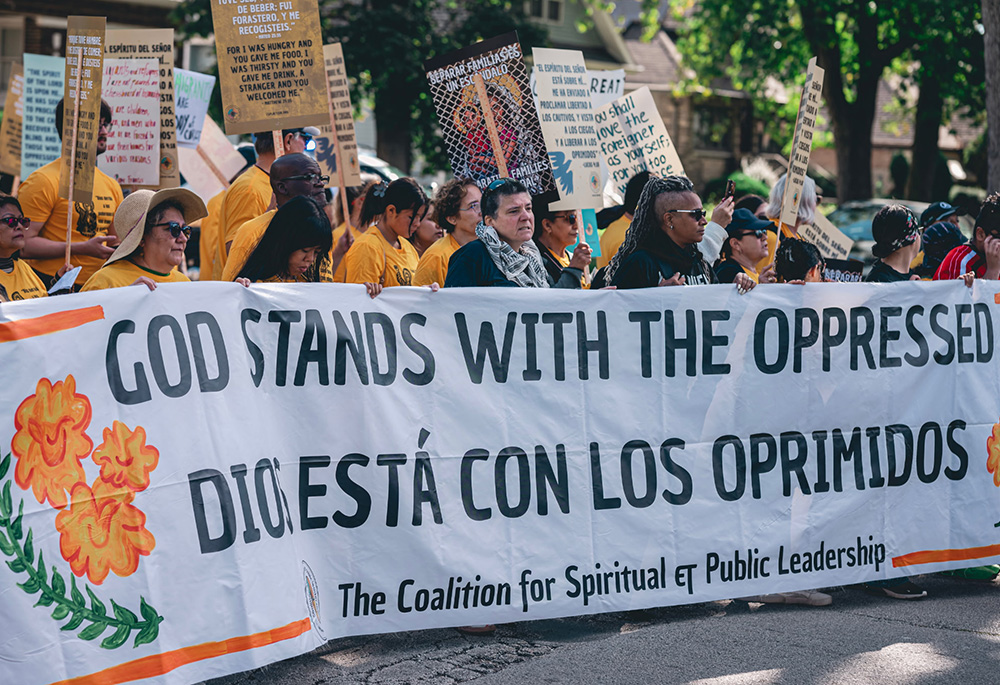
About 1,000 activists march on Saturday, Oct. 11 in Chicago to bring Communion to detainees at the ICE processing center in Broadview. (Courtesy of Coalition for Spirituality and Public Leadership)
On Sept. 13, the group also organized a misa popular — a people's Mass attended by more than 300 Catholics outside the Great Lakes Naval Station in North Chicago to protest the site's use as a staging ground for ICE operations. Okińczyc-Cruz said these Masses echo historic acts of faith-led resistance in Latin America and Poland — from the misas populares of El Salvador denouncing military repression to the Masses celebrated outside the Lenin Shipyard during Poland's Solidarity movement.
"ICE denied not only our religious freedom," said Okińczyc-Cruz, "but [it] was going against laws that allow for ministers to enter in to provide Communion and religious services."
He and Dowling described Saturday's gathering not as a one-time protest, but as part of a broader spiritual resistance to what they call a deepening climate of fear.
Advertisement
Okińczyc-Cruz said local Catholic families have reported "up to 150 people being crammed into a room together at a time in the detention center, that they're not being fed properly, that they have no room to sleep, no place to bathe." He added that many detainees are Catholic parishioners, including relatives of coalition members.
"We know people on the inside," he said. "We know many, many, many of them are Catholic, and so we want to be witnesses to this and bring the body of Christ, Communion, into the detention center."
For Dowling, the peaceful presence of the crowd was itself a message. "If you go to protests out there, they're always standing on the top of the building, people outside, ICE people watching, but there was no one there," he said.
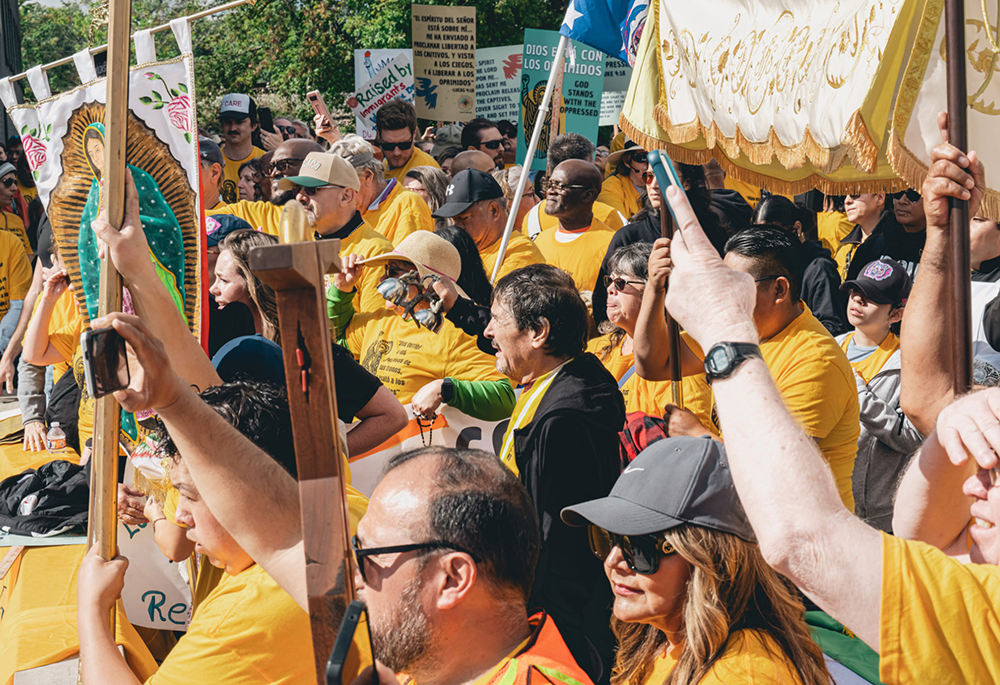
About 1,000 Catholic activists march Saturday, Oct. 11 in Chicago to bring Communion to detainees at the Broadview ICE processing center. (Courtesy of Coalition for Spirituality and Public Leadership)
The coalition's next steps, Okińczyc-Cruz said, include expanding training programs such as "Know Your Faith, Know Your Rights" — a curriculum combining legal education with theological formation to help parish communities organize and stay resilient. "We must rely upon our God and our faith to be resilient people, to be prayerful people, to be nonviolent people in the face of authoritarianism and violence," he said.
Jesuit Fr. David Inczauskis, a doctoral student at Loyola University Chicago who serves on the coalition's clergy council, echoed that the next phase will join prayer with policy. The leaders also want to ensure that the fervor of Saturday's procession (Oct. 11) leads to concrete change.
"We recognize that there has been a great moment of passion associated with this past Saturday," he said, adding that the next step would involve legal changes in the state of Illinois "that we might be able to support in order to curtail ICE's presence at certain locations."
Linking liturgy to legislation, he said, is part of seeing the Mass as a mission.
The priest also said possible legal action for being denied access to the detention center remains under discernment, but he thinks it is something the group should consider and said the coalition's clergy council plans to meet next week to consider it.
"This is obviously a time of despair and people are losing hope," Dowling said. "But I think we need to realize that God is in the midst of it all.
"That's my hope, my desire, my prayer, is that people will open their eyes and hearts and actually see this as fellow human beings who are just like them in a lot of ways, and who deserve that same dignity that we would all ask," he said.