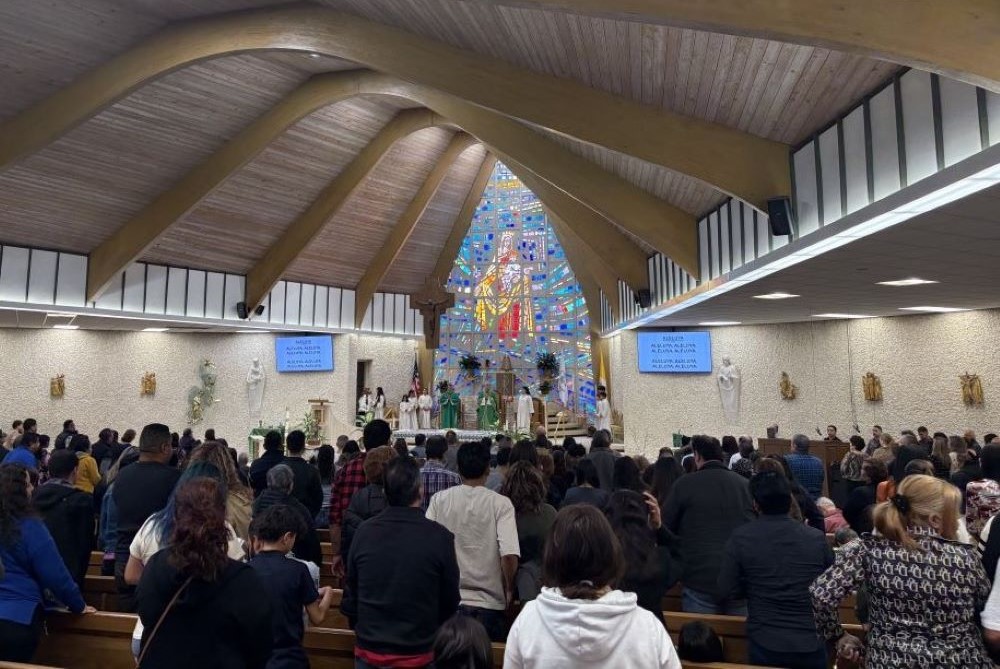
Congregants attend a Sunday afternoon Mass at Our Lady of Mount Carmel Parish in Melrose Park, a Chicago suburb, on Oct. 26. The service typically attracts more than 2,000 people, primarily Central American Hispanic immigrants, with people spilling outside the sanctuary and in the side chapel. (NCR photo/Camillo Barone)

Inside the offices of Our Lady of Mount Carmel parish in Melrose Park, west of Chicago, a small group of parishioners gathered with Scalabrinian Fr. Leandro Fossá, the pastor, on a cold late October Sunday afternoon.
The conversations here have changed in recent weeks. Where they once centered on baptisms, quinceañeras and parish parties, they now turn to immigration checks, missing relatives and how to prepare legal papers in case of deportation.
For many in this working-class suburb, the death of Silverio Villegas González marked a turning point. Villegas, an undocumented Mexican immigrant father of two, was fatally shot by Immigration and Custom Enforcement agents on Sept. 12 after a traffic stop that ended with his car pinned under a truck.
For people in Melrose Park's Mexican community, his death made real a fear that had already been spreading quietly.
'If we shut down, then people will have nowhere to go to meet the Lord and to find courage.'
—Scalabrinian Fr. Leandro Fossá
One of the women in the parish office on Oct. 26, who asked not to be named, was Villegas' girlfriend. In an interview with the National Catholic Reporter she said she met Villegas as a child in Michoacán and they found each other again years later in Chicago. "We built a life together," she said. "He worked; he took care of us. He was a good person."
Recalling the morning she learned Villegas had been shot, she said: "He didn't answer my call. I saw the videos on social media and I knew it was him. I still can't believe it."
Her 13-year-old daughter, who sat beside her, said Villegas treated her as his own daughter. "He always asked if we were OK, if we needed anything. When I graduate, I'll keep his promises."
The days following Villegas' death, Our Lady of Mount Carmel parish hosted a novena prayer and a memorial Mass for him; Chicago Auxiliary Bishop José María Garcia-Maldonado presided.
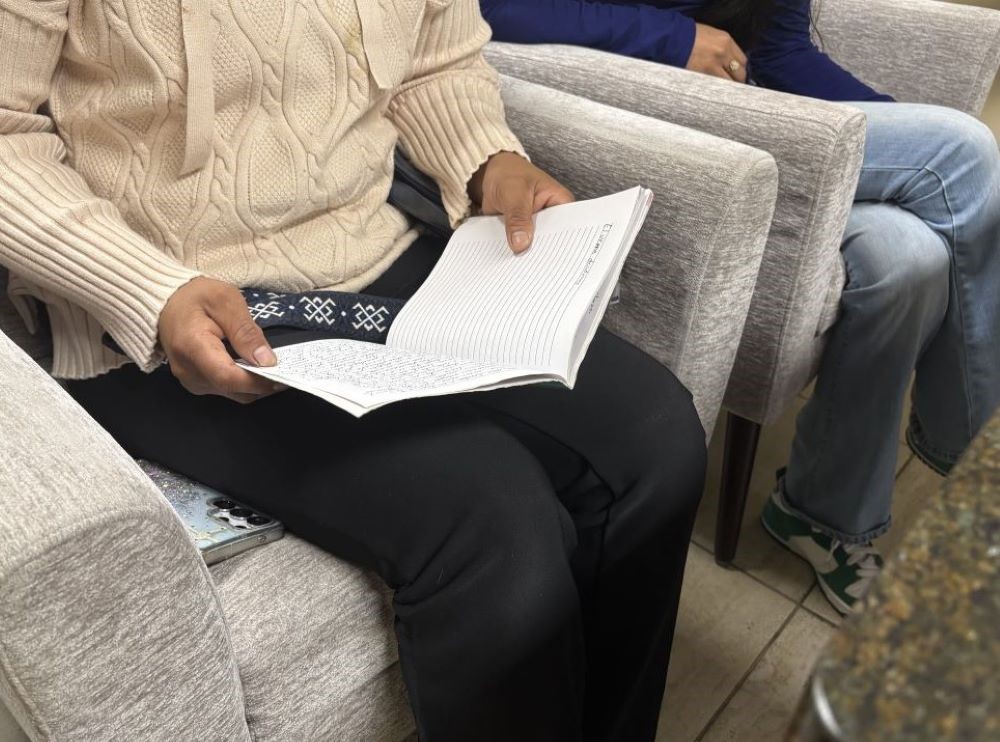
Mexican immigrants share their stories in the office of Scalabrinian Fr. Leandro Fossa, pastor at Our Lady of Mount Carmel Parish, a Chicago suburb, Oct. 26. Some say the church is the only place they feel safe now. (NCR photo/Camillo Barone)
Villegas' girlfriend said she no longer feels safe leaving home.
The women who spoke to NCR asked to remain anonymous to protect their identities and ensure confidentiality.
"I used to go to work or church safely. Now I'm afraid every time I go out," the girlfriend said. "The parish has been helping us with food and prayers."
Next to her was a parish volunteer, another undocumented woman who helps coordinate outreach and translation. She's been in the U.S. for about 30 years working different jobs and now spends much of her time connecting families to resources.
"This situation took me out of my comfort zone," she said. "Before this, I was doing the things I liked to do and basically just working. This country gave me great opportunities, even if I've been undocumented."
She helps lead "Know Your Rights" workshops, where immigrants learn how to respond if approached by immigration officers. "I remind people they have the right to remain silent, to ask for a lawyer. Even if you're undocumented, you still have rights," she said.
Living in quiet vigilance
Another mother, also undocumented, said she came to the U.S. in 2004, 18, alone and pregnant, hoping for a life that felt steadier than the one she left in Mexico. In the 21 years since, she has worked wherever she could — a printing factory first, then cleaning apartments and houses, later babysitting. Church became her anchor. It was the place, she said, that helped her face the harder parts of her life.
Two years ago, she confronted another kind of fear when she reported that her stepfather's father had abused her daughter. The man was eventually deported.
Today, she said many neighbors no longer attend Mass or send their children to school. Even simple errands feel dangerous.
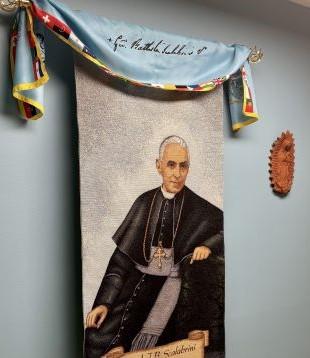
An icon of St. Giovanni Battista Scalabrini, the founder of the Scalabrinian order and "Father of Migrants," hangs in Scalabrinian Fr. Leandro Fossá's office, at Our Lady of Mount Carmel Parish. (NCR photo/Camillo Barone)
Her own family lives in a kind of quiet vigilance. Her husband is a legal resident, her daughters are citizens, but she is not. She is in the process of applying for a green card, a step that brings both hope and anxiety.
In late October, that fear became real. Two of her brothers were detained at a Home Depot while buying materials for work. ICE trucks boxed them in, she said, and agents ordered them out of their vehicle. Later, a stranger called her cousin to say he had found the truck still running in the parking lot. He turned it off, hid the keys, and waited until the family could collect it.
Her brothers were transferred to a detention center in Texas, she said. Since then, calls have been brief and uncertain. Their wives cry most days, she said. The children ask when their fathers will come home. She tries to keep her voice steady when she talks about them, but her words tighten.
"They are not criminals, only men who went to work that morning," she said, crying.
Her 20-year-old daughter was born in the U.S. and works at a clothing store. After work, she joins the parish's young adult group, a circle of first-generation Americans who gather to pray and talk about the most recent news.
The daughter knows that citizenship doesn't shield her from worry. Her family's future still feels uncertain, and each sighting of an ICE vehicle brings anxiety, she said.
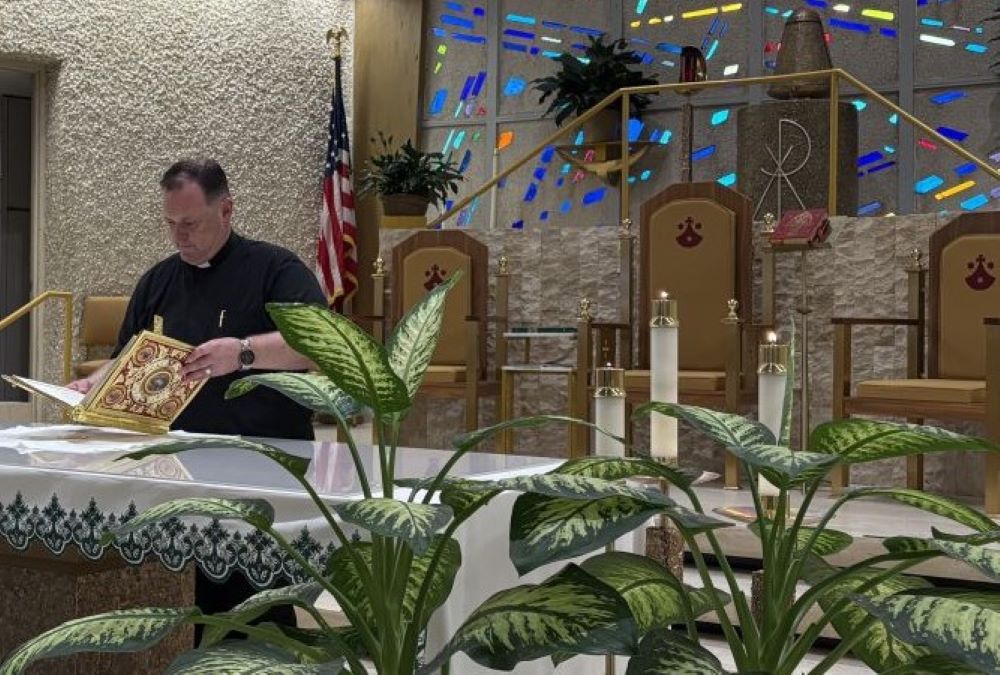
Scalabrinian Fr. Leandro Fossá, is pastor at Our Lady of Mount Carmel Parish in Melrose Park, a Chicago suburb. Parishioners support each other amid the immigration crackdown and help each other learn about their legal rights. (NCR photo/Camillo Barone)
"I haven't encountered ICE directly, but there was one day where on my way to work I saw them two lanes next to me," she said. "My body felt heavy, it was like this weird feeling. Because I thought, if my mom was in my position right now what would've happened?"
"She could've gotten nervous and scared and then next thing you know ICE could get suspicious and pull her over."
When her uncles were detained in October, she received the call before her shift. She went to work anyway, trying to focus on customers while her thoughts circled back to her family. Prayer became her only refuge, she said.
The only place that feels safe
When Fossá talks about his parish, Our Lady of Mount Carmel, he describes it as a community determined to resist fear. "We decided from day one not to shut down any ministry, because we do not live in fear — we have faith," he told NCR.
"If we shut down, then people will have nowhere to go to meet the Lord and to find courage."
That conviction has kept his parish alive and full, even as immigration raids and political tensions have reshaped the lives of the overwhelming majority of his parishioners. "We have more people attending our ministries and we have weekends with even more people in church," he said.
"We have created opportunities for people to come to Holy Hour and pray for migrants and refugees, to pray for Donald Trump, to pray for ICE, to pray for reconciliation."
Advertisement
"Some are coming to church because they feel that this is the only place where they could go and feel safe," Fossá said. "We did not stop it, because they feel that here they could come and participate and they feel that ICE will not take their peace away."
Beyond the liturgy, the parish's mission has taken on an urgent, concrete form. In recent weeks, the church hall has transformed into a hub of quiet resistance, where folding tables are stacked with legal papers instead of potluck dishes. Fossá said the parish recently assisted more than 300 families, working with lawyers and notaries to ensure their property and guardianship rights are protected.
The goal is vital: If a parent is detained by immigration authorities, their assets remain safe and they have a plan for who will care for their children. In a time when uncertainty shadows even daily routines, the parish has become one of the few places where families can prepare, pray and breathe freely.
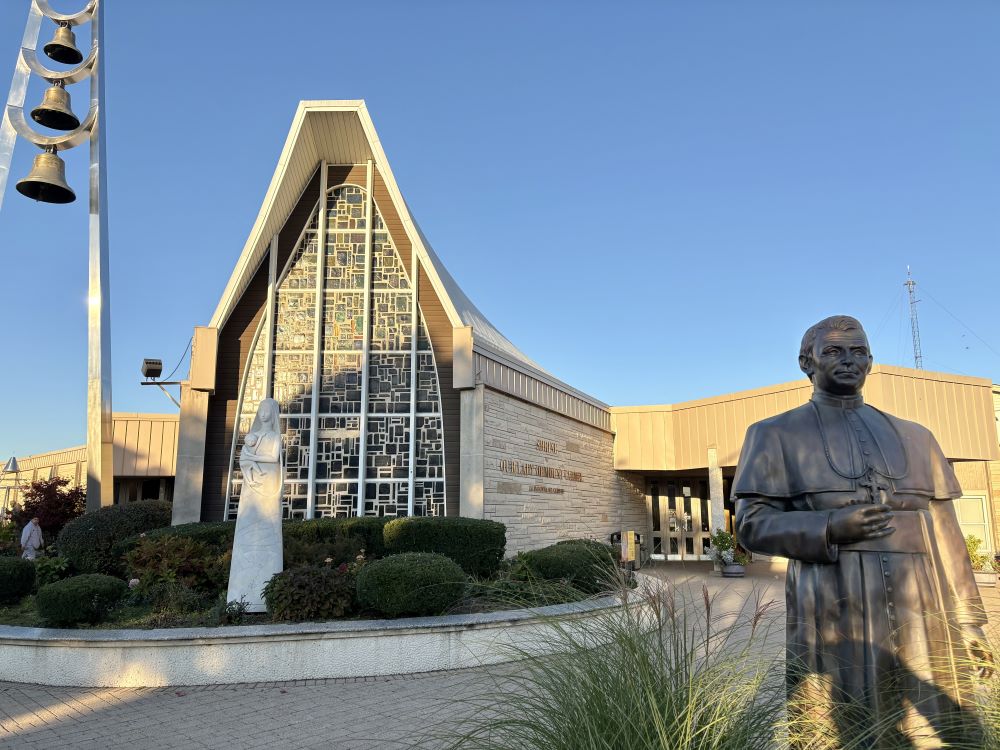
Our Lady of Mount Carmel Parish in Melrose Park, a Chicago suburb (NCR photo/Camillo Barone)
This blend of prayer and protection captures the essence of the Scalabrinian mission, said Scalabrinian Fr. Giovanni Bizzotto, who is superior provincial of the order's Province of West North American and Central America.
Bizzotto, who oversees 19 parishes and migrant shelters in Mexico, Guatemala and El Salvador, said that USAID cuts have left humanitarian agencies "without funds," forcing shelters in Central America to struggle as migrants are stranded and homeless. Yet despite what he called "a pretty dark reality," he said that "it is by doing good and behaving well that we have to overcome this evil situation."
As the afternoon ended, the women at the parish gathered their belongings. The woman who lost her boyfriend thanked the priests quietly, and she and her daughter hugged both of them tight.
Outside, the bells of Mount Carmel signaled evening Mass. Despite the fear of leaving their homes, more than 2,000 people gradually packed the church and started singing.