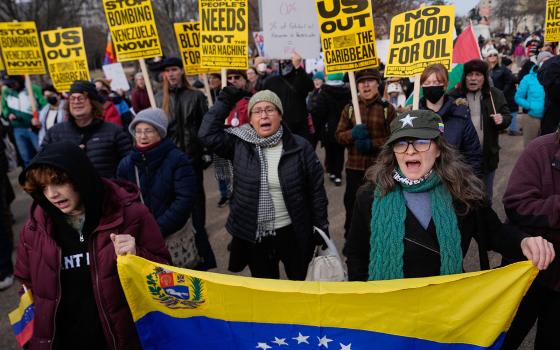
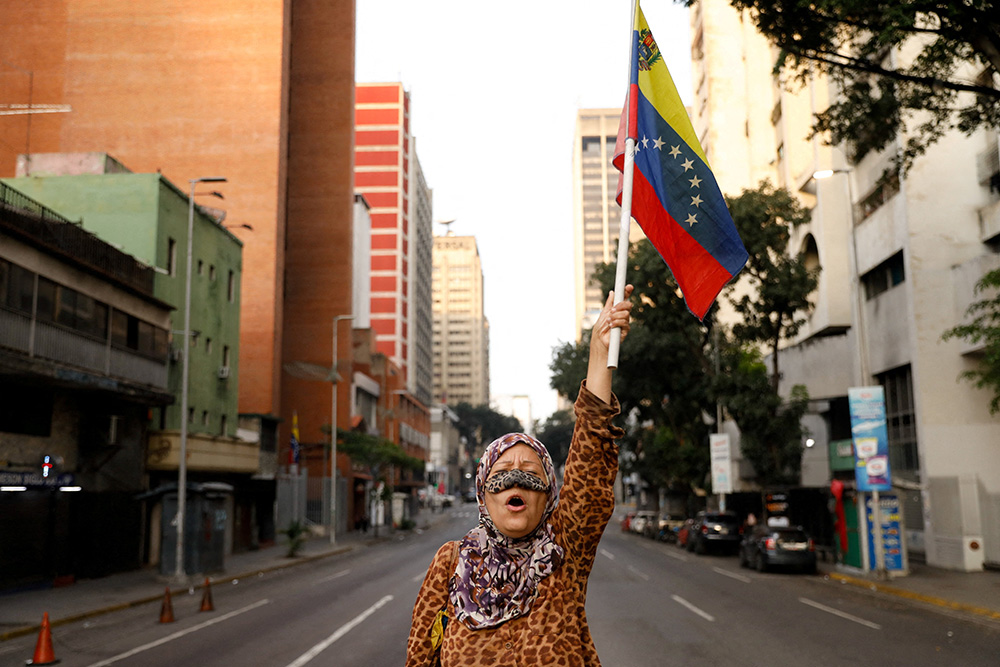
A supporter of Venezuelan President Nicolás Maduro holds a flag of Venezuela on a street near Miraflores Palace in Caracas, Jan. 3, 2026, after U.S. President Donald Trump said the U.S. has struck Venezuela and captured Maduro. (OSV News/Reuters/Leonardo Fernandez Viloria)
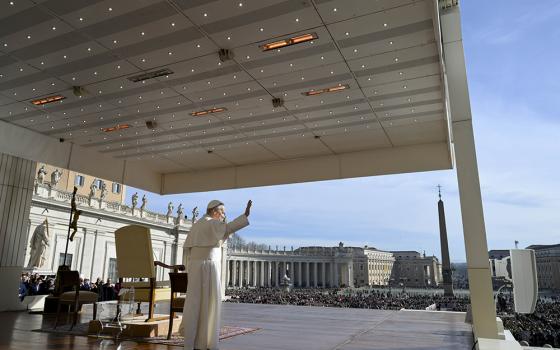
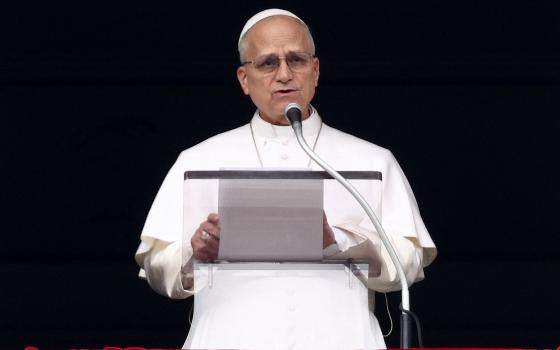
Pope Leo XIV closed his Angelus prayer address Sunday Jan. 4 with an appeal for Venezuela to remain independent.
"I follow the developments in Venezuela with a heart full of concern," the pope said from the window of the Apostolic Palace, speaking to thousands of rain-soaked pilgrims under umbrellas in St. Peter's Square. "The good of the beloved Venezuelan people must prevail over every other consideration and lead to overcoming violence and embarking on paths of justice and peace."
The pope urged respect for the country's sovereignty, the rule of law enshrined in its constitution and the human and civil rights of all citizens, with "special attention to the poor who are suffering due to the difficult economic situation."
He said he was praying — and invited the faithful to pray with him — entrusting Venezuela to Our Lady of Coromoto, the country's patroness, as well as to Sts. José Gregorio Hernández and Carmen Rendiles, figures deeply woven into Venezuela's historical Catholic identity.
The pope's comments came the day after Venezuela entered one of the most volatile moments in its modern history. A Jan. 3 U.S. strike on Caracas killed at least 40 people, including civilians and soldiers, according to Venezuelan officials.
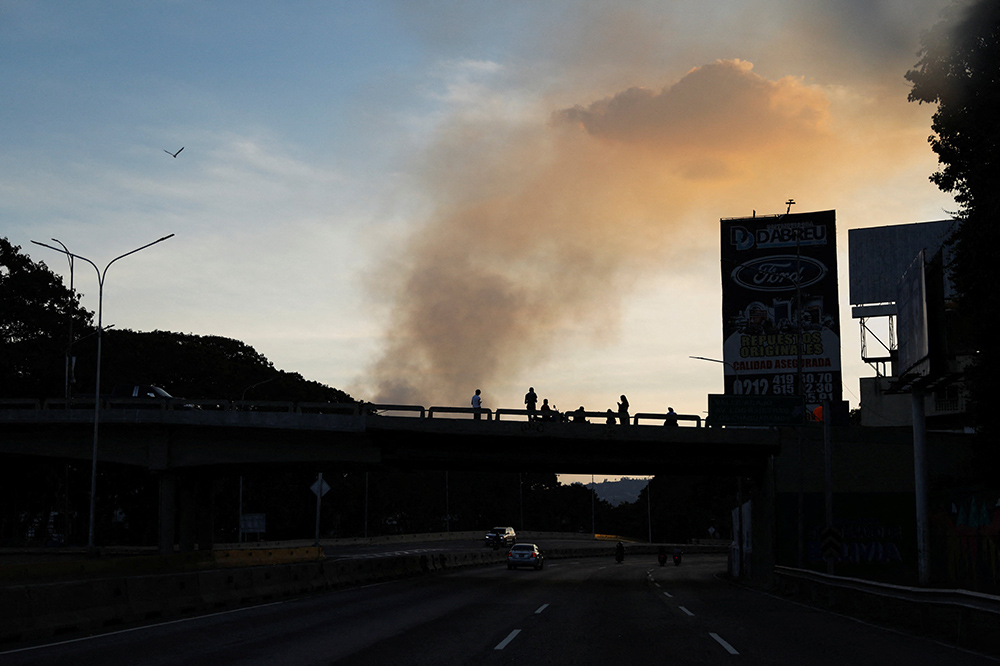
People on a bridge are silhouetted as smoke rises near Fort Tiuna, after U.S. President Donald Trump said the U.S. struck Venezuela and captured its President Nicolás Maduro, in Caracas, Venezuela, Jan. 3, 2026. (OSV News/Reuters/Leonardo Fernandez Viloria)
Hours later, after Venezuela's President Nicolás Maduro and his wife, Cilia Flores, were captured and flown out of the country, a federal indictment in New York charged them and senior allies with narco-terrorism and drug trafficking. Washington signaled it was prepared to use further force, while Venezuelan opposition leaders demanded immediate recognition of a new president.
Venezuelan influence runs deep within the upper ranks of the Holy See, where some of the Vatican's most sensitive diplomatic and administrative roles are held by figures with close ties to the country. Among them is Venezuela-born Archbishop Edgar Peña Parra, one of the most powerful officials in the Roman Curia, who serves as substitute for general affairs in the Secretariat of State, effectively overseeing the Vatican's day-to-day operations and internal coordination.
Peña Parra is second only to Cardinal Pietro Parolin, the Vatican secretary of state, an Italian whose familiarity with Venezuela dates back to his tenure as apostolic nuncio in Caracas from 2009 to 2013. Several Vatican diplomats also were born and raised in Venezuela.
According to U.S. officials, the raid in Venezuela targeted strategic sites in the capital. No American service members were killed, though a helicopter was struck and several soldiers were injured. Venezuelan authorities said the dead included both civilians and members of the armed forces, deepening fears of a broader conflict in a country already scarred by years of economic collapse, mass emigration and political repression.
Advertisement
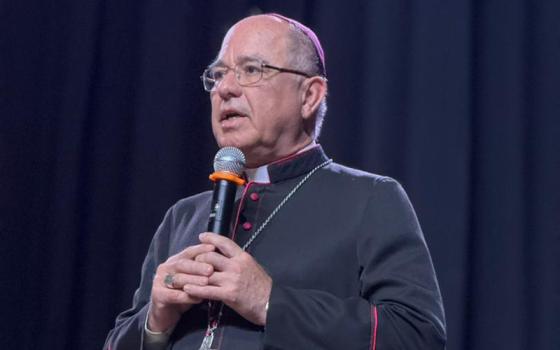
In a statement sent to the National Catholic Reporter on the night of Jan. 3 as the crisis deepened, Valencia Archbishop Jesús González de Zárate, president of the Venezuelan Episcopal Conference, urged the country to turn to prayer amid uncertainty and loss.
"In light of the events our country is experiencing today, let us ask God to grant all Venezuelans serenity, wisdom and strength," he said, expressing solidarity with those injured and with the families of those who lost loved ones. He called on the faithful to persevere in prayer for national unity at a moment of profound tension.
The archbishop also appealed for a clear rejection of violence and a renewed commitment to peace, both in public life and in personal conduct.
"We call on the people of God to live more intensely in hope and fervent prayer for peace in our hearts and in society, rejecting any kind of violence," González said. He urged Venezuelans to keep their "hands open to encounter and mutual aid," stressing that decisions taken in the coming days must be guided solely by the well-being of the people.
In a separate email sent to NCR early on Jan. 3, González underscored how fluid the situation remained. "Events are still unfolding, and we do not yet have a comprehensive view to assess them adequately," he wrote, noting that the Venezuelan bishops had been in contact with one another and with their priests since 2 a.m., when the U.S. military operation unfolded.
As facts continued to emerge, he said, the Venezuelan church's immediate response was to remain united in prayer for the Venezuelan people.
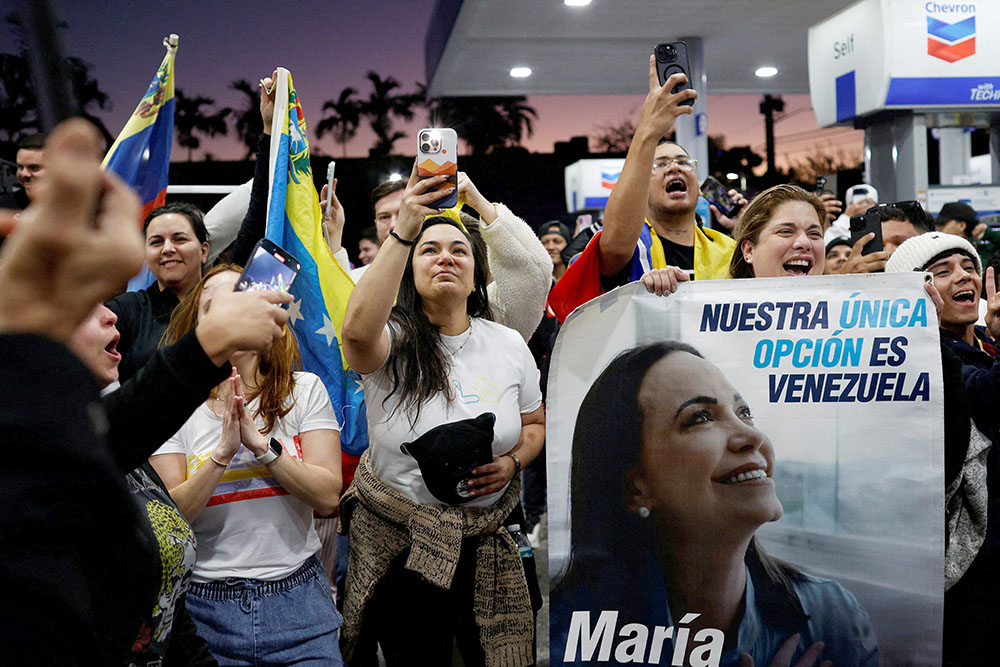
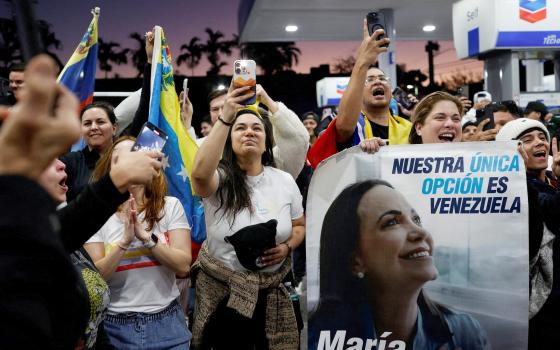
A woman holds a banner depicting Venezuelan opposition leader and Nobel Peace Prize laureate Maria Corina Machado, as people react in Miami Jan. 3, 2026, to the news that U.S. forces struck Venezuela and captured its president, Nicolás Maduro. (OSV News/Reuters/Marco Bello)
At a news conference Jan. 3, U.S. President Donald Trump declined to rule out a deeper military role in the South American country. He said he was not afraid of putting "boots on the ground" but suggested that further escalation might be avoided if Venezuela's interim leadership, headed by Maduro's Vice President Delcy Rodríguez, complied with U.S. demands.
Trump also made clear that Venezuela's oil wealth loomed large in Washington's calculations. Calling the country's vast state-controlled reserves "our oil," he said the United States would "run the country right" and open the sector to American companies, denouncing the nationalization policies of previous governments.
Reactions to the U.S. action were swift and polarized, with protesters and supporters gathering in cities around the world. In the U.S., groups in Chicago and Washington, D.C., denounced the U.S. military action, while Venezuelan migrants in New York celebrated Maduro's removal from power.
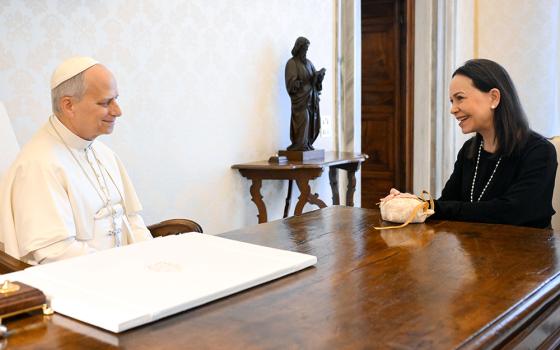
María Corina Machado, the Venezuelan opposition leader and recent Nobel Peace Prize laureate, called for the immediate international recognition of her ally Edmundo González as president. Trump, however, dismissed her, saying she lacked the "respect" required to govern.
The National Catholic Reporter's Rome Bureau is made possible in part by the generosity of Joan and Bob McGrath.