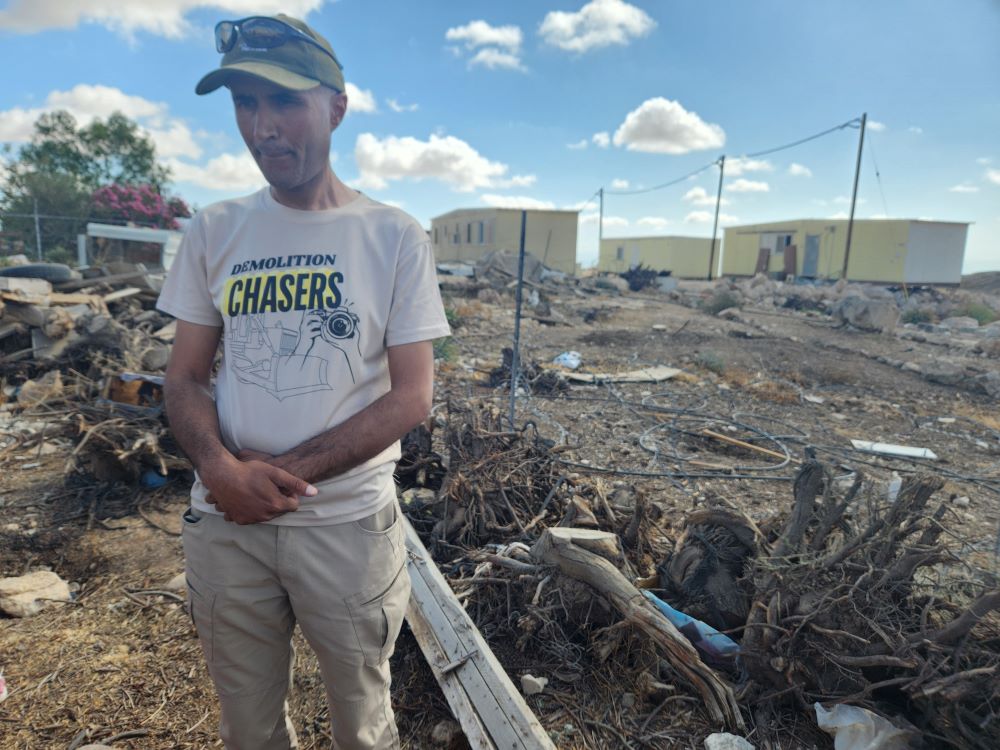
Eid Hathaleen is a cousin of Awdah Hathaleen, an Umm al-Khair resident and peace activist shot and killed by an Israeli settler in July. His T-shirt signifies continued resistance by Umm al-Khair residents to planned house demolitions announced by the Israeli government. (NCR photo/Chris Herlinger)

The Palestinian community of Umm al-Khair was once a peaceful place, where Bedouin families eked out a living as goat and sheep herders roaming the rugged windswept highlands that offer panoramic views of the South Hebron Hills.
The grazing continues. But Umm al-Khair's tranquility has been shattered in recent years, if not decades, by violence and anxiety — anxiety that Umm al-Khair's residents, who are members of the Bedouin Jahalin tribe, attribute to their neighbors, Israeli settlers living in the abutting community of Carmel.
Equally important: Israeli government policies that have resulted in bulldozing dozens of homes, with at least a dozen more threatened with demolition in the coming weeks.
And yet that is not the worst of it.
In July, Umm al-Khair resident Awdah Hathaleen, a teacher, peace activist and sometime videographer, was shot and killed by an Israeli settler as he tried to record a settler attack — an attack that resulted in his own death. The alleged killer, Yinon Levi, has not been charged but is known for assaults against Palestinians in the West Bank, NPR reported. President Donald Trump lifted U.S. sanctions against Levi in January, but European Union sanctions against Levi for human rights violations remain in place, NPR said.
The murder of Hathaleen, who was involved in the Oscar-winning documentary "No Other Land," has drawn international attention to the village's plight — and also to larger questions about the ongoing Israeli military occupation in the West Bank, which has continued and even intensified in the midst of the war in Gaza.
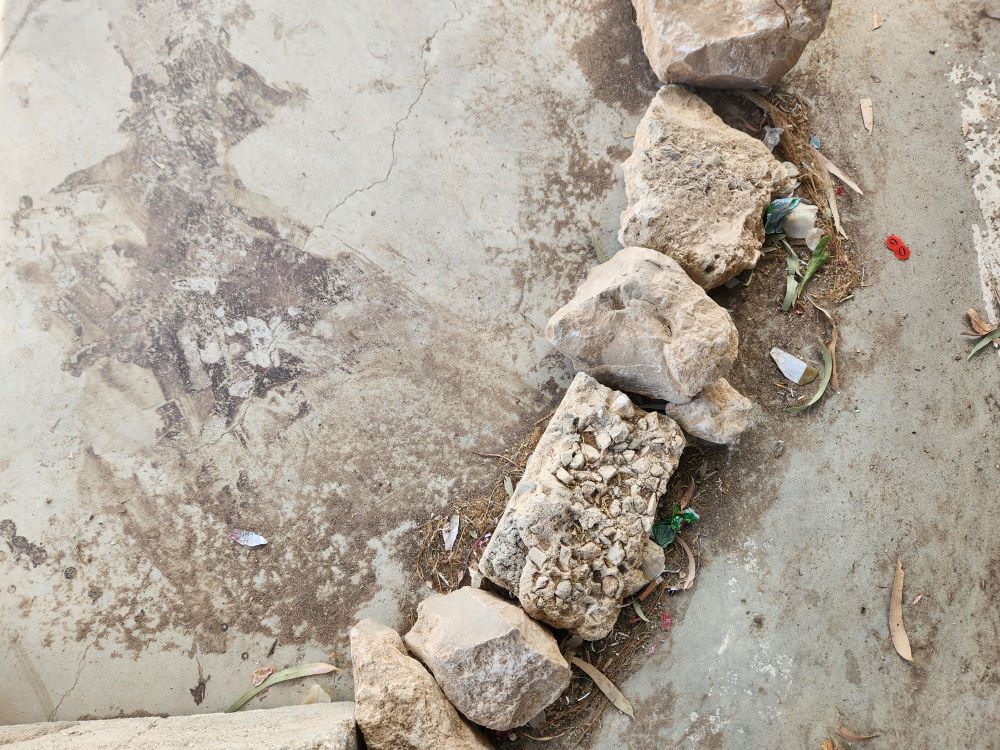
A small monument to Awdah Hathaleen stands on shared community space in the West Bank village of Umm al-Khair. The spot where he was shot in the chest is circled by stones, the young man's blood stains still visible. (NCR photo/Chris Herlinger)
For Palestinians living in the West Bank, and not just in Umm al-Khair, the occupation is seen and experienced as brutal — sowing confusion, assaulting dignity, marked by intimidation and fear. It is a source of continued anger that has, nonetheless, not stopped Palestinians from hoping and working for a better future, be it in cultural, political, nongovernmental and educational spaces.
To the Israeli government, and to many Israelis, the continued military occupation has been deemed necessary for Israel's security, particularly after the brutal assault, killings and abductions of Israeli citizens on Oct. 7, 2023.
Given two desperate narratives, a more hopeful moment seems distant. A fragile Gaza ceasefire is barely holding; the West Bank is led by an aging Palestinian leadership; and a right-wing Israeli government, accused of committing genocide in Gaza, even by Israeli human right groups, has declared it will never recognize a Palestinian state.
A major source of controversy and tension is the issue of Israeli settlements — Israeli communities formed on occupied land which make the formation of a contiguous Palestinian nearly impossible.
'Here I was born. Here I grew up. Here I will die.'
—Fr. Jack-Nobel Abed
The BBC reported earlier this year that such settlements "are widely seen as illegal under international law, though Israel disputes this." In May, the Israeli government announced plans for 22 new settlements in the West Bank.
Concurrent with the settlement expansion is an uptick in violence against Palestinian communities. Earlier this month Israel's president, Isaac Herzog, whose position is largely ceremonial, condemned a string of recent settler attacks, violence that he said "crosses a red line" and must be stopped, the Associated Press reported. Herzog was joined in his condemnation by two high-ranking Israeli military officials.
The Catholic Church has weighed in, too.
In an October pastoral message delivered as the Gaza ceasefire was being finalized, Cardinal Pierbattista Pizzaballa, the Latin patriarchate of Jerusalem, noted the extreme suffering in Gaza, of "repeated massacres of civilians, starvation, repeated displacement, limited access to hospitals and medical care."
But Pizzaballa also noted the challenges and suffering of West Bank Palestinians, many of whom live in villages "which are increasingly surrounded and suffocated by settler attacks, without sufficient protection from the security authorities."
While praising the end to the war in Gaza, the cardinal was also careful to stress "the cessation of hostilities is only the first, necessary and indispensable, step on a treacherous path," adding, "The end of war does not necessarily mark the beginning of peace."
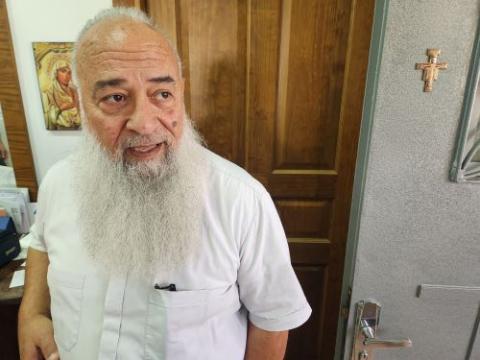
Fr. Jack-Nobel Abed is a Greek Melkite Catholic priest in Taybeh, a Christian enclave on the West Bank. (NCR photo/Chris Herlinger)
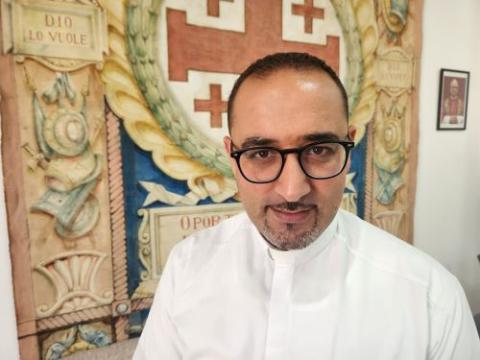
Fr. Bashar Fawadleh is a parish priest of Christ the Redeemer Catholic Church in Taybeh, a Christian enclave on the West Bank. (NCR photo/Chris Herlinger)
Fellow clerics in the West Bank share the cardinal's message of hope, leavened by caution and worry.
"We live today and hope tomorrow will bring peace, serenity and brotherhood. But how will it come?" Fr. Jack-Nobel Abed, a Greek Melkite Catholic priest in Taybeh, said in a recent interview with a group of visiting journalists and scholars, most from the United States. Taybeh is the last predominately Christian conclave in the West Bank.
"We don't live in safety," Fr. Bashar Fawadleh, a parish priest of Christ the Redeemer Catholic Church in Taybeh, said not only of immediate worries, but the overall life of Palestinians.
Fawadleh, who is also the general director of an online Catholic radio station in Taybeh, says that he and other clerics have to raise their voices publicly about the occupation "and tell the truth about the situation facing Palestinians."
"Our problem is not with the Israelis," he said about Israeli civilians. "It is with the occupation."
Bedouins are targets because of their land holdings
The occupation has multiple layers, as the case of Umm al-Khair demonstrates.
The first Israeli settlers arrived there in 1981, and Umm al-Khair's residents recalled that some kind of coexistence, perhaps uneasy, seemed possible. But through the years, some of the settlers residing in Carmel have become more aggressive in provoking their Palestinian neighbors, who live on lean land where water is scarce, and in shanty-like conditions, with no indoor plumbing or electricity.
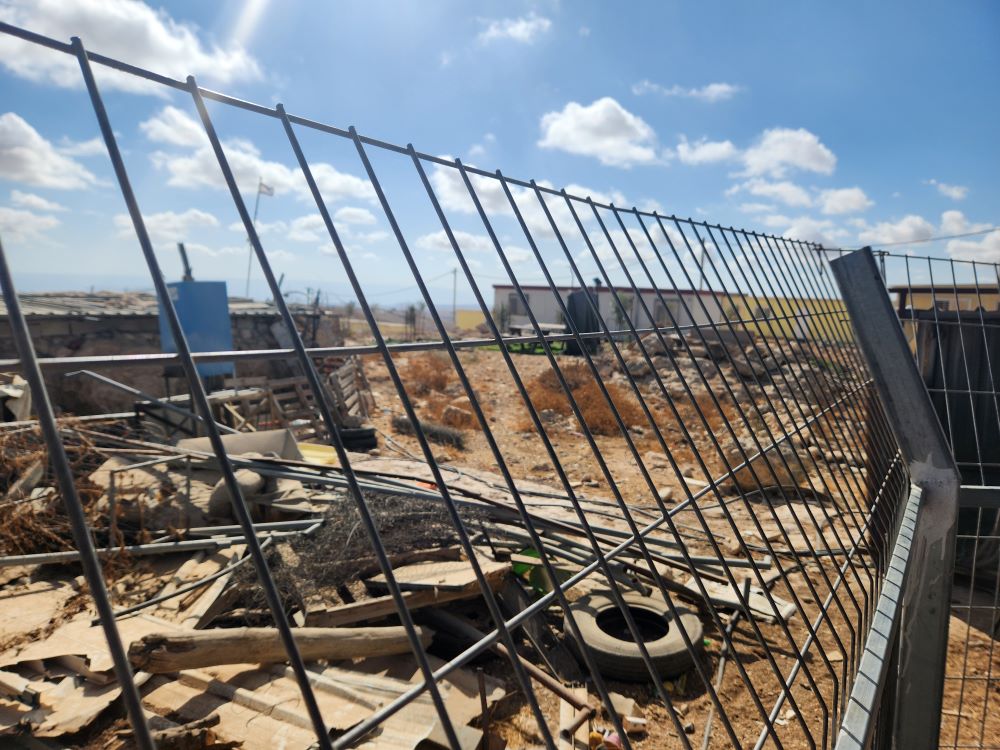
A chain-link fence stands between Israeli settler property and the property of the Bedouin village of Umm al-Khair in the Israeli-occupied West Bank. (NCR photo/Chris Herlinger)
But settler taunts and vandalism are common, borne from the settlers' belief that the land is theirs — and in this they have been supported by the Israeli government which wants to drive the Palestinians from the community through a policy of house demolitions and support for settler expansion.
While the settlers say their right to the land is based on biblical history and that they are often the victims of Palestinian violence, a Nov. 6 report by the United Nations' humanitarian arm, OHCA, said that the highest number of settler attacks since 2006 against Palestinian communities — more than 260 — occurred in October.
The attacks came during the olive harvest season, the U.N. noted, adding that the violence overall during the season was the highest level in recent years — some 150 attacks in 77 villages. That resulted, the U.N. said, in injuries to more than 140 Palestinians and the vandalism of more than 4,200 trees and saplings.
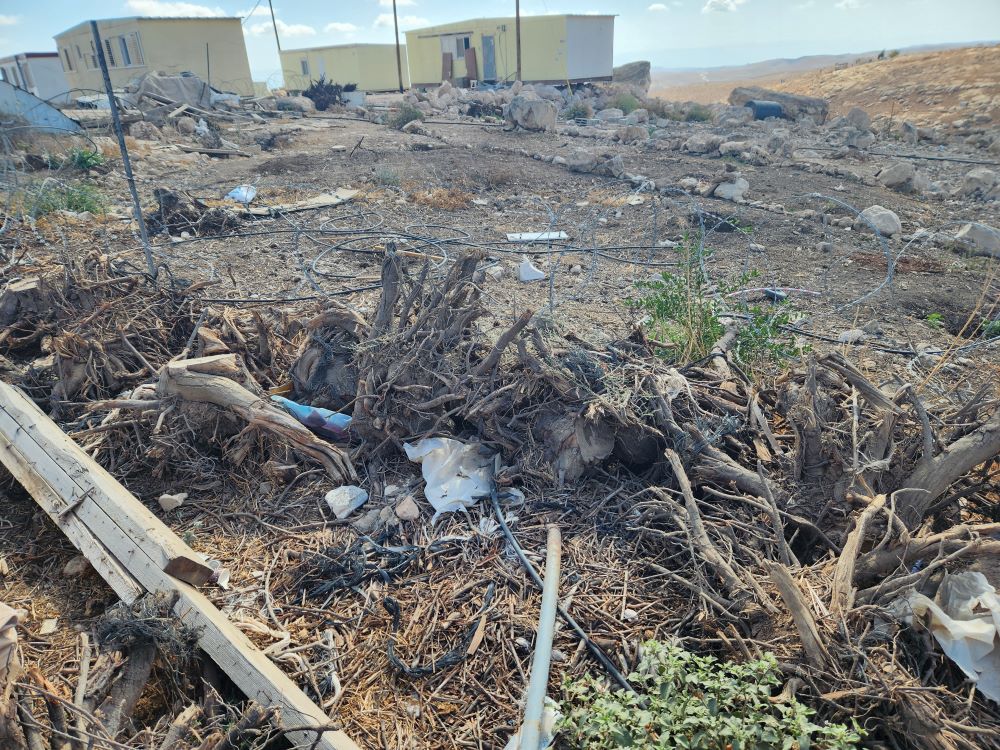
Burnt and destroyed trees and vegetation are an example of destruction of property on the perimeters of the Bedouin village Umm al-Khair by neighboring Israeli settlers. A Nov. 6 U.N. report said that more than 260 settler attacks against Palestinian communities occurred in October. (NCR photo/Chris Herlinger)
Why are the Bedouins — who are among the most vulnerable communities in the military-occupied territories — particular targets?
Largely because their land is precious, said Jeff Halper, an American-born Israeli anthropologist, author and peace activist who grew up in Minnesota and directs the Israeli Committee Against House Demolitions. Halper and Issa Amro, a Palestinian peace activist, were nominated this year for a Nobel Peace Prize.
Bedouins own large plots of land, Halper said, land that can accommodate settler expansion under a policy of "Judaization."
Like other Israeli peace activists, Halper believes the depiction of a "conflict" between Israelis and Palestinians misses a key point — that there is not a symmetry between vulnerable communities like the Bedouins and the government-backed settlers. The police and army are protectors of the Israeli settlers and not the Palestinian communities, he argues.
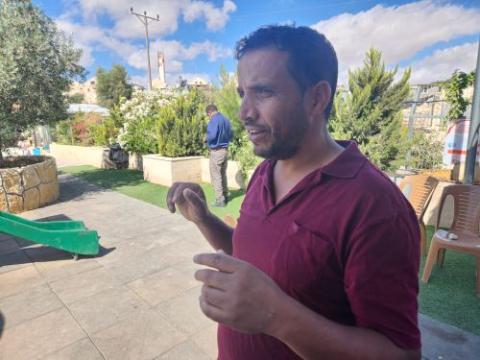
Aziz Hathalen's brother, teacher and peace activist Awdah Hathaleen, was shot and killed by an Israeli settler in July. (NCR photo/Chris Herlinger)
The house demolitions are proof of that, and point to a deeper historical legacy, Halper said.
"House demolition is the essence of the 'settler colonial' movement," Halper said. Defenders of Israel say that is an unfair characterization, but critics say it is the basis for control of Palestinian areas. Put another way, Halper argues, the settlers really represent the beliefs and intent of the Israeli government.
"The settlers are the Israeli government," he said.
There is no real protection for vulnerable Palestinian communities, Halper and others say, though Umm al-Khair has had a constant flow of Israeli and foreign visitors, and recently the community held a news conference on the possible demolitions that attracted global attention.
"We have a strong relationship with friends in Israel and throughout the world," said Hathaleen's cousin Eid Hathaleen. Such friends have a commitment to the community that runs counter to those who characterize the villagers as "those terrorists" and "those Arabs," he said.
One group allied with residents of Umm al-Khair is the Israeli-based Mothers Against Violence Israel, founded in 2020.
Ketty Bar, founder and director of the group, told NCR the group is composed of Israeli mothers who have built "a continuous and intimate relationship of solidarity and mutual care" with Palestinian mothers in Umm al-Khair and in surrounding communities.
She said that for the Israeli mothers, visiting Umm al-Khair is not an act of charity but an act of conscience.
"We believe that as Jewish citizens of Israel, it is our moral duty to stand beside Palestinian communities living under occupation — to listen, to witness, and to nurture trust and safety where the state has failed to do so."
Bar added: "Over the past years we have developed continuous, intimate contact with the families there — supporting them materially and emotionally, helping document abuses, and ensuring their voices are not silenced."
Concurrent with this, the office of Democratic Rep. Jamie Raskin of Maryland said Nov. 6 he and four other members of the U.S. House of Representatives, joined by more than 100 other House members, had called on Israeli Prime Minister Benjamin Netanyahu to "immediately halt" the Israeli government's demolition orders for Umm Al-Kheir.
Still, past demolitions have had an effect. There are now perhaps 300 residents in Umm al-Khair — close-knit, all bound by kin, family and blood — but that is roughly half the population about a decade ago.
It has been hard-going, relatives of Hathaleen, the slain activist, told the visiting journalists recently. But they said they have legal title to the land and will defend, nonviolently, their right to stay where they are. The residents of Umm al-Khair have been there since 1948, when their families — like some other 700,000 Palestinians — were uprooted and displaced when the state of Israel was created, in an event the Palestinians call the Nakba, an Arabic word for "catastrophe."
"These people always want to come here and put their fingers in your eye," Aziz Hathalen, brother of the slain activist, said of his settler neighbors. "All I want is a quiet night's sleep for me and my children."
Concerns about inequalities under the law
Aside from the particular and considerable challenges that Umm al-Khair itself faces are the overarching injustices all Palestinians face — such as inequality under the law. If a settler kills a Palestinian it is not seen as a crime, Hathaleen argues. But, he adds, if a Palestinian kills a settler it is likely that a settler would be killed by the police.
In a 2022 report, the Association for Civil Rights in Israel, an Israeli human rights group, said of the West Bank that there are two systems of law "applied in a single territory: one — a civilian legal system for Israeli citizens; and the second — a military court system for Palestinian residents. The result: institutionalized discrimination."
There are also the cultural challenges — as in a whole people being labeled terrorists. "We're not related to Hamas in any way," Aziz Hathaleen said of the association many in Israel and Western countries make.
To underline that, Aziz, his brother Khalil and cousin Eid remember that Awdah Hathaleen was a kind and peaceful man, firmly committed to the principles of nonviolence. He was appalled by the violence of Oct. 7, 2023, they said. But for the residents of Umm al-Khair, the tragedy of that day became an excuse for revenge to tarnish all Palestinians as a "violent people" who support Hamas — and in the West Bank use it as justification for expanded land takeovers.
A poignant reminder of the tragedy befalling the West Bank generally but to Umm al-Khair in particular is a small monument to Awdah Hathaleen on shared community space. The spot where he was shot in the chest is circled by stones, the young man's blood stains still visible.
"This is the blood of peace," said Eid Hathaleen.
Advertisement
Other scars are visible elsewhere on the West Bank. Arson resumed recently in Taybeh, the Christian enclave. Last year arsonists set fire to trees and brush surrounding the remains of the Church of St. George, a Byzantine structure dating from the 4th century CE.
Recently, extremist settlers set cars ablaze, while Taybeh's farmers have feared the kind of attacks on olive tree harvesting that the United Nations has noted in recent weeks.
But fear — whether in Taybeh or Umm al-Khair — is no match against the resolve to stay and protect land and heritage, kin and pride.
Fr. Jack-Nobel Abed in Taybeh, speaking in a church common room filled with photographs and sacred objects, as well as a large Arabic-language Bible laying open on a wide carved armchair upholstered in red velvet, says he has a right to stay in his hometown.
"Here I was born," he said. "Here I grew up. Here I will die."
Asked on an October morning with the sun brightly falling on South Hebron Hills if it might be better, just pragmatically, to leave Umm al-Khair, Aziz Hathaleen was emphatic.
"No," he said, recalling the experience of Palestinians uprooted in 1948 and more recently in Gaza. "This is my land. I would prefer to die here rather than live as a refugee."
Editor's note: GSR international correspondent Chris Herlinger recently visited the West Bank as a member of a delegation of journalists and scholars sponsored by the Jerusalem-based Sabeel Ecumenical Liberation Theology Center. That visit was augmented by additional reporting in Israel and the West Bank.