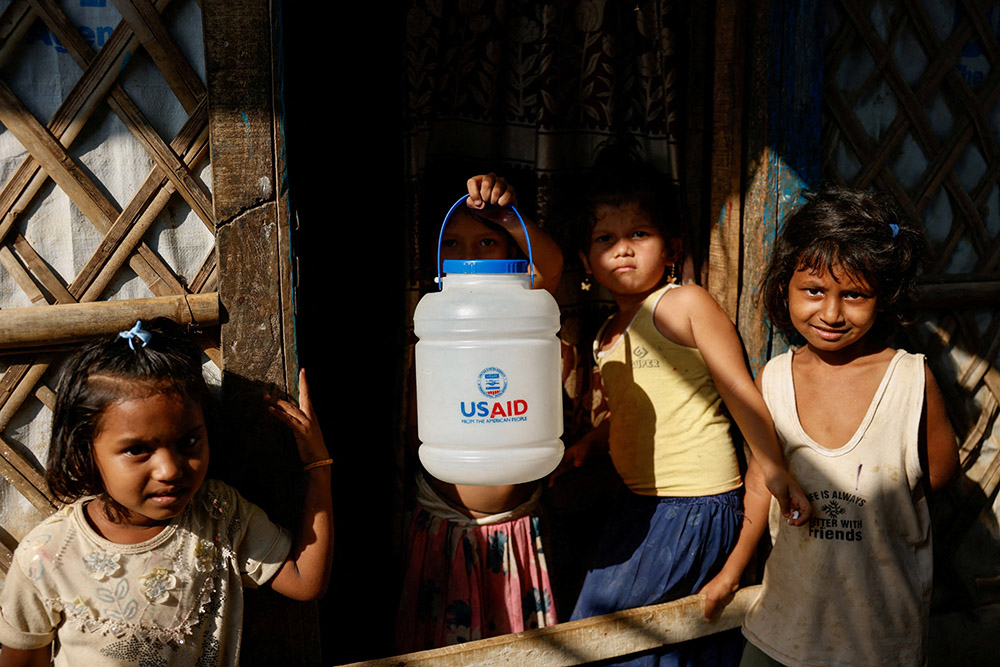
A Rohingya refugee girl holds a jar with U.S. Agency for International Development logo imprinted, at the refugee camp in Cox's Bazar, Bangladesh, March 16, 2025. The Trump administration moved March 28 to formally close USAID and fold remaining functions into the State Department. (OSV News/Reuters/Mohammad Ponir Hossain)

As humanitarian crises have escalated around the globe in 2025, foreign assistance has fallen.
The biggest cuts have come in the United States, where President Donald Trump gutted the country's spending on international aid and shuttered the U.S. Agency for International Development, or USAID.
The U.S. was the largest global source of foreign aid and a key funder of development organizations like Catholic Relief Services, the U.S. bishops' overseas aid group and the country's chapter representative in Caritas Internationalis — the church's global aid and development network and the world's second-largest humanitarian aid network. It is active in more than 200 countries and territories.
But the U.S. was not alone in cutting funding for international development. Governments in the United Kingdom, Germany, Netherlands and France have also scaled back aid in recent years, though to lesser degrees. Overall, global financing for development is on track to fall to $161 billion in 2026, from a peak of $223 billion in 2023, according to a September briefing from the Human Rights Funders Network.
"I talk about the golden age of aid being over," Alistair Dutton, Caritas secretary general, told National Catholic Reporter in October at the "Raising Hope for Climate Justice" conference outside Rome. "We're not going to see that money coming back."
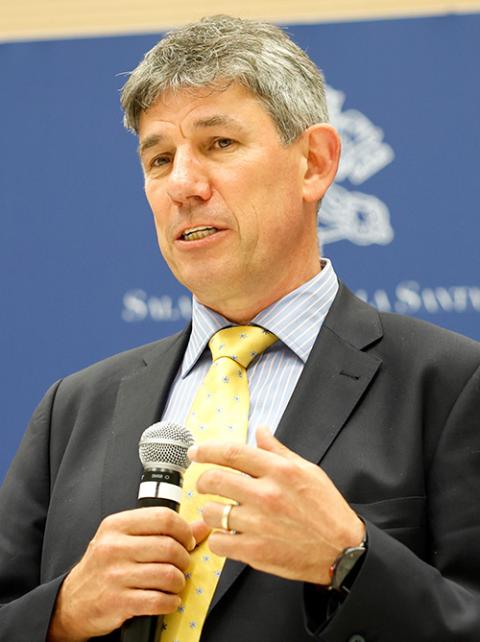
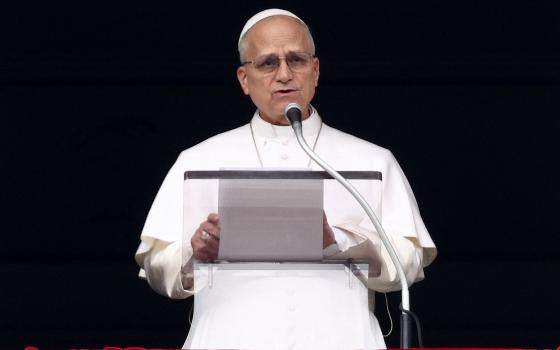
Alistair Dutton, secretary-general of Caritas Internationalis, speaks during a news conference at the Vatican May 16, 2023. (CNS/Lola Gomez)
The pullback in foreign assistance has serious ramifications for people facing war and hunger, as well as those on the front lines of weather-related disasters worsened by climate change.
A report from the United Nations in late October concluded that governments will likely fall short of their goal to double by 2025 public financing, to $40 billion, to help developing countries adapt to climate impacts — like more extreme storms and flooding, longer heat waves and droughts and rising seas. The report cited declining international aid in the U.S. and elsewhere. Meanwhile, costs alone of adapting to climate change are estimated to reach $365 billion annually by 2035.
The state of international climate funding — for adaptation, as well as mitigation and loss and damage — will be a major topic throughout COP30, the U.N. climate conference, in Belém, Brazil, Nov. 10-21.
For Caritas and its country chapters, the situation presents the difficult challenge to find new ways to assist the world's poorest communities, all while threats from climate change grow and financing diminishes. That has real-life ramifications, Dutton said — not just in what projects, aid and interventions Caritas can deliver, but on human lives and livelihoods.
"We will see millions of people die as a result of these cuts," he said, repeating comments he made earlier this year. "Loss of health care, loss of basic services, loss of clean water, loss of agriculture, and therefore the crops to feed their families."
"The harm that's being done will have very long-term consequences."
This interview has been edited for length and clarity.
EarthBeat: Under the Trump administration, the U.S. has slashed significantly foreign aid spending, which has severely impacted Catholic Relief Services, including its climate and environmental initiatives. Has the loss of U.S. foreign aid affected other parts of the Caritas network?
Dutton: Yes, absolutely. But it's not just U.S. foreign aid.
The highest spending in overseas development systems was in 2023, that was $223 billion. Already this year, $80 billion has been canceled, and 75% of that is the U.S. aid cuts, but the remaining 25% is from [mainly] European governments. And we are seeing that hurt the poorest people dreadfully.
Advertisement
I have made other statements, and we will see millions of people die as a result of these cuts. Loss of health care, loss of basic services, loss of clean water, loss of agriculture, and therefore the crops to feed their families.
So we will see it in the most macro terms within our Caritas members. CRS is obviously our largest international member, and so they have been very badly affected by the money that they have lost. But members in Latin America also lost direct funding from USAID and are suffering dreadfully from the cuts that they have had directly on their income not coming through Catholic Relief Services.
And then through the projects that USAID was funding through the U.N. system — in the week after the announcement [was] made back in January, Caritas Bangladesh had to stop all its services within the Rohingya camps and lay off 450 staff who were providing shelter and food and care of various different kinds throughout those refugee camps. And we're seeing that in refugee camps in Lebanon, Syria and Jordan. So we are seeing this worldwide.
And the difficulty is the first thing you see is only ever the tip of the iceberg and what we will see in terms of long-term deaths, what we will see in terms of reverses in the gains of development, in terms of loss of health systems, loss of agricultural gains, we're going to see hundreds of millions suffering badly as a result of this and millions dying.
How is Caritas responding to this pullback on funds, whether from the U.S. or other national governments?
I think the first thing you do is you double down and you try to maximize whatever available income there is. But being quite honest, with the amount of money that has disappeared, we're not going to be able to replace that. So I talk about the golden age of aid being over. We're not going to see that money coming back.
For the Catholic Church, it will remain in all of the countries where it is, and Caritas is absolutely fundamental to the mission of the church and the work of each of the bishops' conferences. We, Caritas, will remain present, but what we will see are far lower international flows of financial assistance, and so we are going to have less available to it. So I think we're probably moving into a time of solidarity, rather than the kind of golden age where aid was plenty.
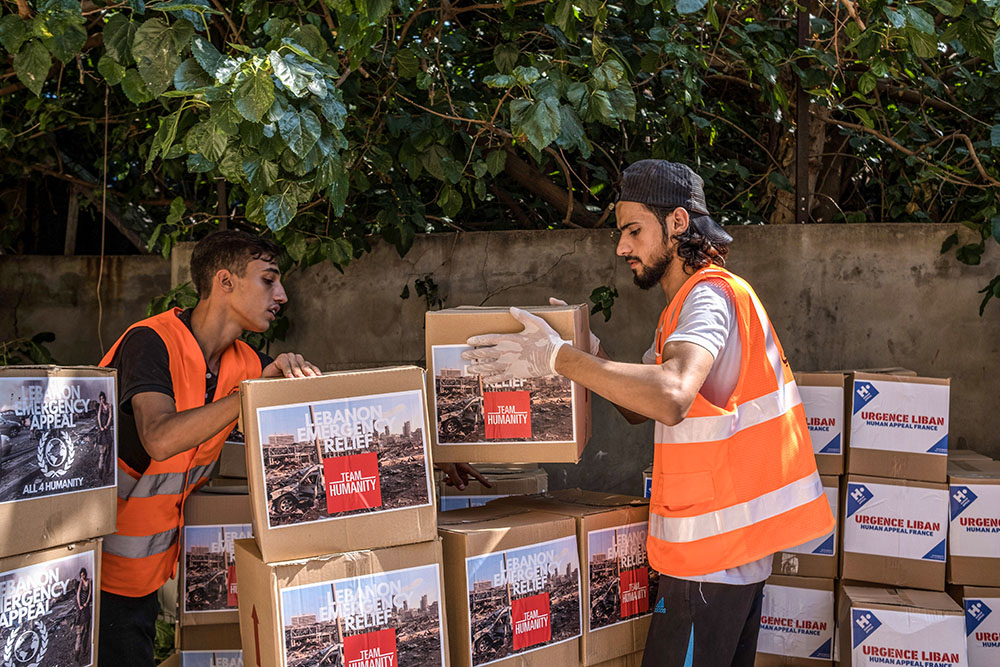
Workers with Caritas Lebanon, in partnership with Catholic Relief Services, are pictured in an undated photo distributing food and hygiene kits to people who were affected by an Aug. 4, 2020, blast in Beirut's port area. (OSV News/Stefanie Glinski for Catholic Relief Services)
It doesn't sound like there are expectations that international aid levels might grow or rebound should new leaders be elected in the next two, four, six years?
There are some notable countries at the moment that stand out as maintaining or even increasing their aid spend, which is fabulous. But the amount that's being wiped off, once that money's been reallocated in government, making it free again becomes very, very difficult.
So if there were a change of administration in the U.S., if there's a change of administration in many of the European countries, it's not going to be as simple as just turning the tap back on. The money's gone elsewhere, or it's been given back in tax cuts, and then you've got to persuade people in the country that they [have] to pay more [taxes] again. Well, we know how difficult that debate is. So the harm that's being done will have very long-term consequences.
We know that there are several [countries] now that lose more every year in loss and damage to climate emergencies than they ever got in aid. So there's the harm of climate shocks, there's the aid cuts, tariffs that are being imposed.
And then on top of that, many countries are in debt distress, or right on the edge of debt distress. And [roughly 60 countries in 2021] have paid $33 billion in debt payments, but they've only received $20 billion in climate finance. ... The amount of money they're having to spend on servicing their national debt is absolutely crippling, and they spend more on debt than they can spend on health care, roads, infrastructure, education, all of those things that are fundamental to the development of countries.
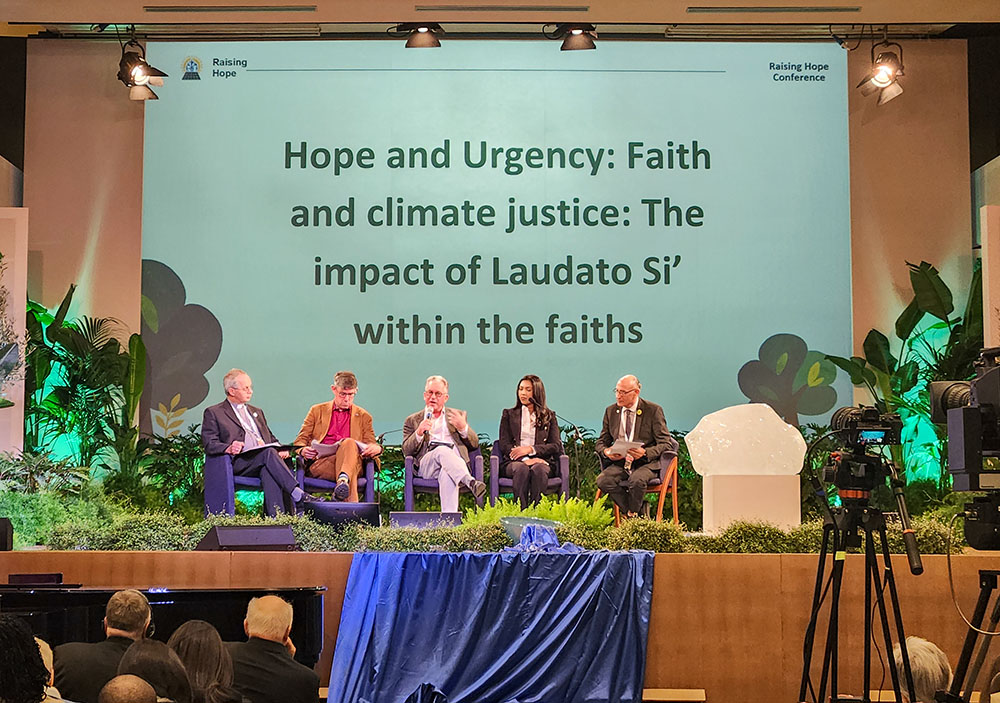
Caritas Internationalis secretary-general Alistair Dutton, second from left, takes part in a panel discussion Oct. 2, 2025, during the "Raising Hope for Climate Justice" conference in Castel Gandolfo, Italy. The three-day event commemorated the 10-year anniversary of Pope Francis' encyclical "Laudato Si', on Care for Our Common Home." (NCR photo/Brian Roewe)
And so Caritas this year, together with Pope Leo XIV, have a campaign about turning debt into hope and how we work with the international system to reframe debt in a way that works for the poorest countries and doesn't sacrifice them to the greed of the rich and powerful.
Have countries shown openness to some kind of debt relief, possibly tied to environmental commitments, as Pope Francis and Pope Leo have urged as part of this Jubilee Year?
It depends what we mean by debt relief, I think. And it's a much more complicated discussion now than it was at the Jubilee at the turn of the millennium when we were talking about debt cancellation.
We have to be aware that if you cancel debt you're a bad debtor, so then you can't borrow again, so you cripple countries longer term. We're engaging much more in conversations about how you restructure debt, how you look at the interest rates that are being paid, how you look at perhaps debt swaps or different ways of using debt. The "how" of how we do it is very different. There's lots of conversation going on about that.
One thing that's very different this time is that most of the national debt is held with private lenders rather than states. So in 2000, it was states who were forgiving debt. Now it's private lenders who don't have the same mechanisms to convene them, and we are working hard to try to get legislation that binds private lenders into the same conditions as state lenders.