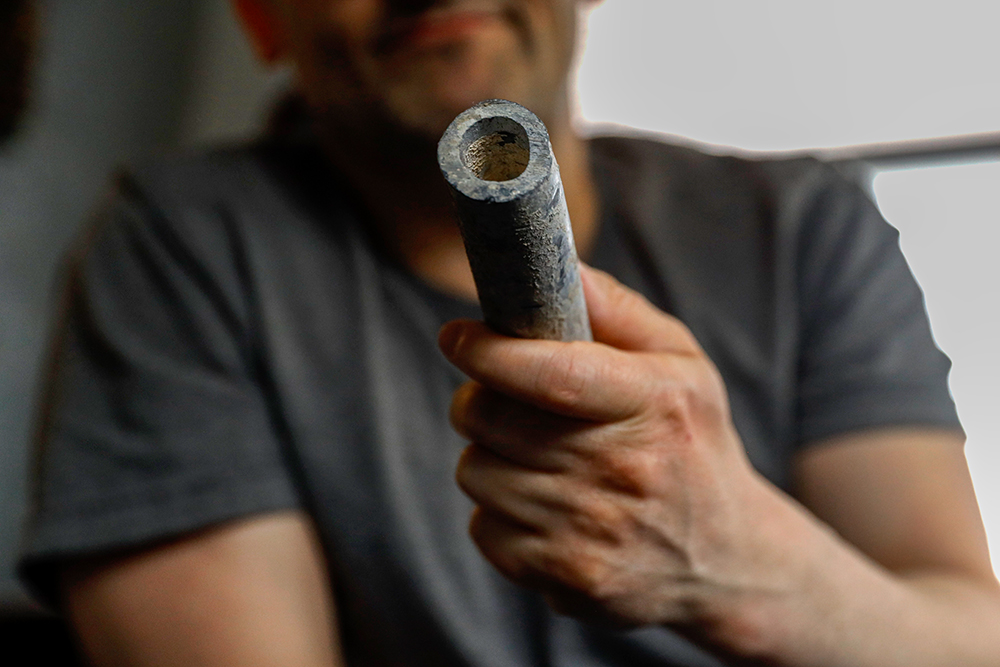
Troy Hernandez, an environmental justice activist with Pilsen Environmental Rights and Reform Organization shows a piece of lead pipe obtained from his residence during his home renovation, April 9, 2021, in Chicago's Pilsen neighborhood. (AP/Shafkat Anowar)

A coalition of Chicago Christian leaders is calling for swift removal of lead water pipes in Illinois, a state that ranks atop the nation in the toxic infrastructure that poses a danger to public health.
Ecumenism Metro Chicago, comprising 14 Christian denominations in the Windy City, called on federal and state lawmakers to "make every effort to replace all the lead water pipes in Illinois as quickly as possible."
The letter was issued Jan. 24 during an ecumenical prayer service at St. Gregory the Illuminator Armenian Apostolic Church in Chicago as part of the Week of Prayer for Christian Unity. The Christian leaders, which includes the Roman Catholic Archdiocese of Chicago, also urged the Trump administration to reenter the Paris Agreement on climate change, from which the president has withdrawn the country for a second time.
Auxiliary Bishop Mark Bartosic signed both environmental statements on behalf of the Chicago Archdiocese.
"In the words of our late Holy Father Francis, we must see that in creation 'Everything is connected' if we are to effectively 'listen both to the cry of the earth and the cry of the poor,' " Bartosic, citing Pope Francis' 2015 encyclical, "Laudato Si', on Care for Our Common Home," said in a statement. "Things go very wrong when we overlook essential points of connection between us."
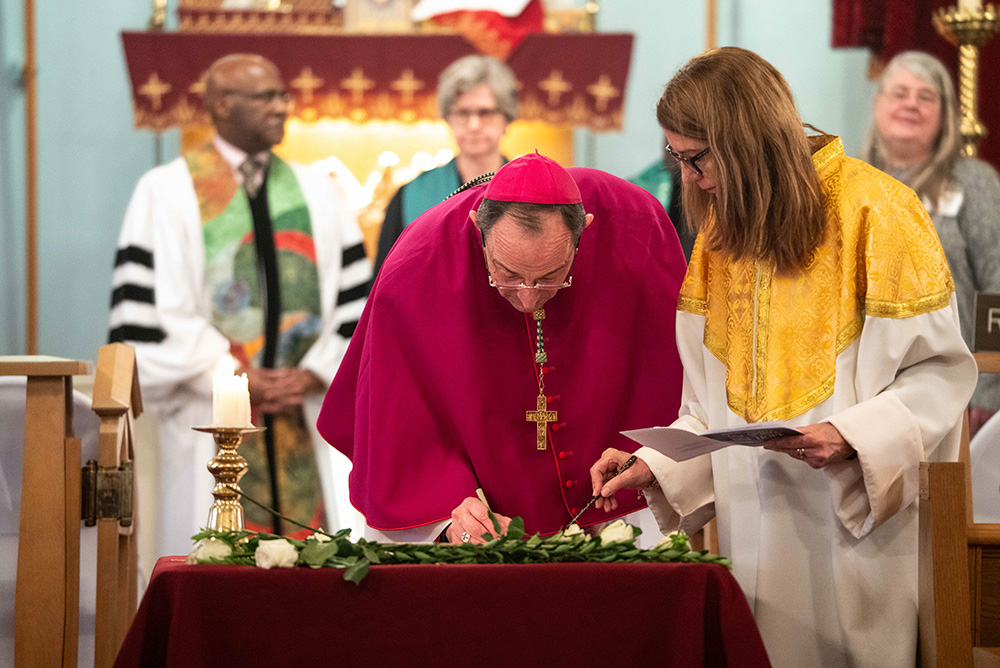
Auxiliary Bishop Mark Bartosic signs on behalf of the Chicago Archdiocese two Christian-organized letters — calling on lawmakers to rapidly replace lead pipes in Illinois and to reenter the Paris Agreement on climate change — during a Jan. 24, 2026, ecumenical prayer service at St. Gregory the Illuminator Armenian Apostolic Church in Chicago. (Deb Winarski)
Given the urgency of climate change and the need to preserve fresh water for present and future generations, "it is God's urgent call to all Christians to raise our voices together on behalf of God's precious creation," said the Rev. Carol McVetty, interim executive minister of the American Baptist Churches of Metro Chicago. "We must work together 'in hope that the creation itself will be set free from its bondage to decay,' " she said, quoting Romans 8:21.
In Laudato Si', Francis wrote that "access to safe drinkable water is a basic and universal human right, since it is essential to human survival and, as such, is a condition for the exercise of other human rights."
Drinking water is one of the main sources of lead exposure in the U.S today, with Illinois alone estimated to have more than 1 million lead service lines, the highest in the nation, according to a 2023 U.S. Environmental Protection Agency report.
Lead is a heavy metal and a neurotoxin. There is no safe level of exposure to lead, which when ingested can cause serious damage for people at all ages but especially children, said Dr. Philip Landrigan, director of the Program for Global Public Health and the Common Good at Boston College.
"The reason infants in the womb and young children are so vulnerable to lead is that their brains are still developing," he told EarthBeat. "Brain development is an extremely delicate, fragile process [that is] easily disrupted."
Advertisement
Lead exposure in children has been linked to lower IQs, shorter attention spans and behavioral problems, which studies have tied to lowered earning potential throughout their lives. Lead has also been found in adults to increase blood pressure, heart disease, kidney damage and cancer. A 2018 study in the journal The Lancet Public Health estimated lead exposure played a role in 412,000 deaths in the U.S. annually.
Landrigan began studying lead's health impacts in the late 1960s and early 1970s as a pediatrician, first at Boston Children's Hospital and then with the Centers for Disease Control and Prevention. His research helped spur federal actions to bar lead in paint (1978) and gasoline (1972). Those advances have led to a 95% drop in childhood lead poisoning and have made the disease a rarity.
But lead remains a danger, Landrigan said, primarily through two sources: old housing where lead paint is still present, and through drinking water serviced through lead pipes. In both cases, economically poor families and minority communities in the U.S. are disproportionately at risk.
That scenario is on display in Chicago.
A joint investigation in August by WBEZ, Inside Climate News and Grist mapped the city's estimated 412,000 lead pipes — tops in the nation — finding lead pipes widespread across Chicago (about 80% of homes) but with the burden greatest in Black and Latino neighborhoods. Roughly nine of every 10 service lines in both Latino and Black neighborhoods require replacement, the news investigation found, compared to 74% of service lines in majority-white neighborhoods and 65% of lines in majority-Asian communities.
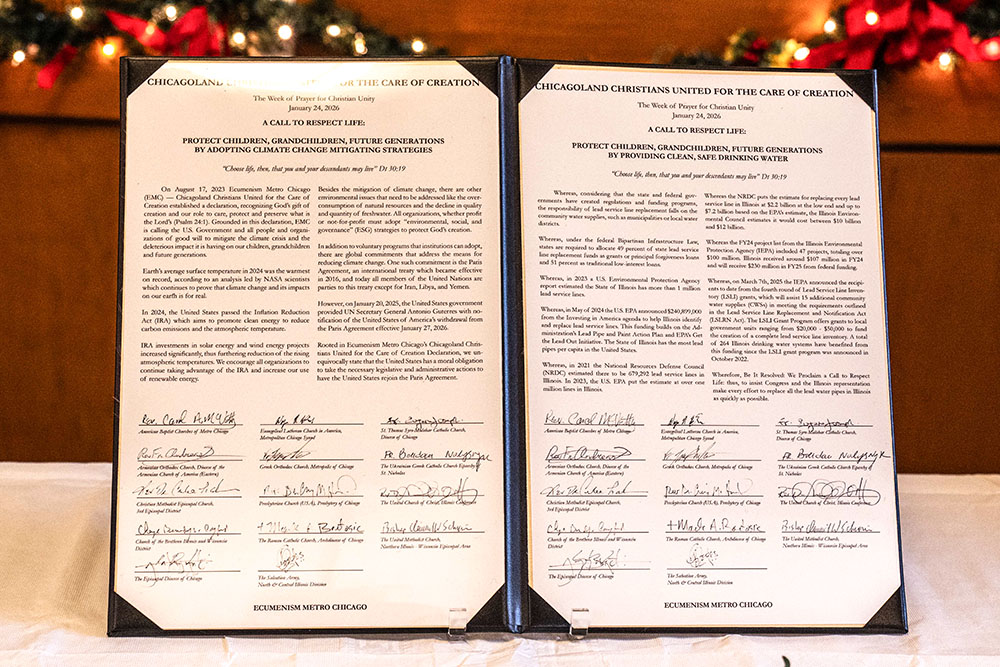
Christian leaders in Chicago gathered Jan. 24, 2026, at St. Gregory the Illuminator Armenian Apostolic Church to hold a prayer service marking the Week of Prayer of Christian Unity. During the service, 14 leaders signed two letters calling for environmental actions. (Deb Winarski)
In 1986, the federal government banned the installation of new lead service lines, but it did not require replacement of old ones. Up until that point, Chicago required the use of lead pipes, a result of political and union dealings.
In October 2024, the U.S. Environmental Protection Agency issued a final rule requiring utilities to identify and replace lead pipes nationwide within a decade. The 2022 bipartisan infrastructure law included $15 billion over five years for replacing lead service lines as part of $50 billion toward improving drinking water.
Both developments were "a huge win," said Roya Alkafaji, an expert in lead with the Healthy Communities program of the Environmental Defense Fund.
"We have seen a lot of momentum across the country, but of course, there is still a lot of progress to be making," she said.
In December, the EPA under the Trump administration released the penultimate $3 billion of that funding six months late. In January, Congress passed an appropriations bill that cut $125 million from the law's final $3 billion allocation.
The EPA late last year also adjusted its estimate for total lead pipes in the country, from 9 million to 4 million. That revision, which reduces by nearly half Illinois' lead pipe estimate, has been questioned by environmental groups. They say the EPA's new estimate relies on incomplete reporting from state utilities, underestimates the percent of service lines of unknown materials likely to contain lead, and omits service lines that include lead-based connecting components.

Geroge Nassos, a member of the Greek Orthodox Church, carries two letters from Chicagoland Christian leaders calling for environmental actions during a Prayer Service Jan. 24, 2026, during the Week of Prayer of Christian Unity at St. Gregory the Illuminator Armenian Apostolic Church in Chicago. (Deb Winarski)
Chicago leaders have projected the city will replace all its lead pipes by 2076 — or several decades after the timeline mandated by EPA's updated lead and copper rule.
The calls by Ecumenism Metro Chicago for rapid replacement of Illinois' lead pipes and a U.S. return to the Paris climate accord stemmed from the group's 2023 Chicagoland Christians United for the Care of Creation Declaration. The declaration stated, "Taking decisive, restorative action for creation is a moral and religious imperative."
George Nassos, a chemical engineer and member of the Greek Orthodox Church who carried the two environmental statements during the opening procession at the Christian unity prayer service, said the documents reflected the shared Christian obligation to care for God's creation "and to make the Earth a better environment for everybody."
"We're looking for the Illinois EPA and the U.S. EPA to do everything possible to fund the removal of these lead water pipes as quickly as possible," he said, "because they're so crucial to everybody living in this area and particularly the young generation."