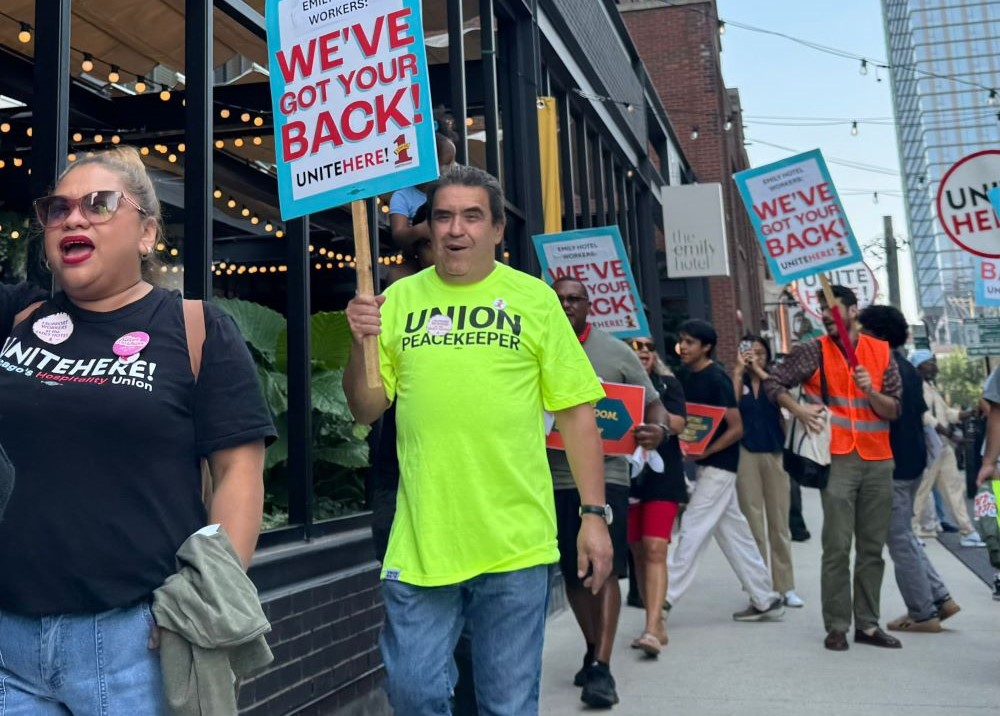
Jesus Morales walks the line with fellow hotel workers asking for a first union contract at the Emily Hotel in Chicago's West Loop this summer. Morales has worked at Chicago's Drake Hotel for nearly 40 years and serves as a vice president of the executive board of Unite Here Local 1 and a delegate to the Chicago Federation of Labor. (Courtesy of Unite Here Local 1)

When Jesus Morales clocks in every morning at Chicago's Drake Hotel, he carries decades of labor history in his posture and his words.
Born on a farm in Guanajuato, Mexico, Morales comes from three generations of laborers who crossed borders for a better life. His grandfather laid railroad tracks in the 1920s, his father worked the fields and Morales has spent nearly 40 years serving guests under the chandeliers of one of Chicago's grandest hotels.
He still remembers the day he first arrived in the United States at 17, balancing school with work, carrying forward a lesson his family had passed down through generations: the value of labor.
"The only thing they taught us is how to work," he said. "I've been working in this country for the last 50 years. I'm still working," he told the National Catholic Reporter on Oct. 28.
By 1986, Morales had joined the Drake Hotel as a room service and banquet attendant. Over the years, he has served presidents, royalty and politicians — including Princess Diana, former President Bill Clinton and Senator John McCain — but the encounters with famous guests are not what give him pride.
It is the solidarity among workers that matters most to Morales. When the hotel workers' union in Chicago Unite Here Local 1 changed direction under the leadership of Henry Tamarin in the early 2000s, workers gained high-quality and affordable health insurance for workers.
'The more fearful a population becomes, the more dangerous the times are.'
—Fr. Clete Kiley
In 2018, health care again took center stage as Chicago hotel workers went on strike to win year-round health insurance. Before, winter layoffs meant many workers lost hours and coverage. "We were fighting for year-round health insurance," Morales recalled. "Because in the winter, the hotel business is slow ... and they had no health insurance, no jobs." The strike worked and the success reshaped the lives of countless hotel employees.
Now serving as a vice president of the executive board of Unite Here Local 1 and a delegate to the Chicago Federation of Labor, Morales is on the frontlines again — but the fight has shifted. It is no longer only about pay and benefits. It is about fear.
In 2025, immigration enforcement has cast a long shadow over Chicago's hospitality workers. Streets in the Chicago Mexican neighborhoods that were once lively now feel deserted. Morales drives past empty sidewalks and quiet cafes advising workers about how to stay safe.
Morales said he makes sure his union workers know their rights and how to access legal assistance by distributing "Know Your Rights" wallet cards and encouraging workers to attend virtual trainings led by trusted immigration attorneys.
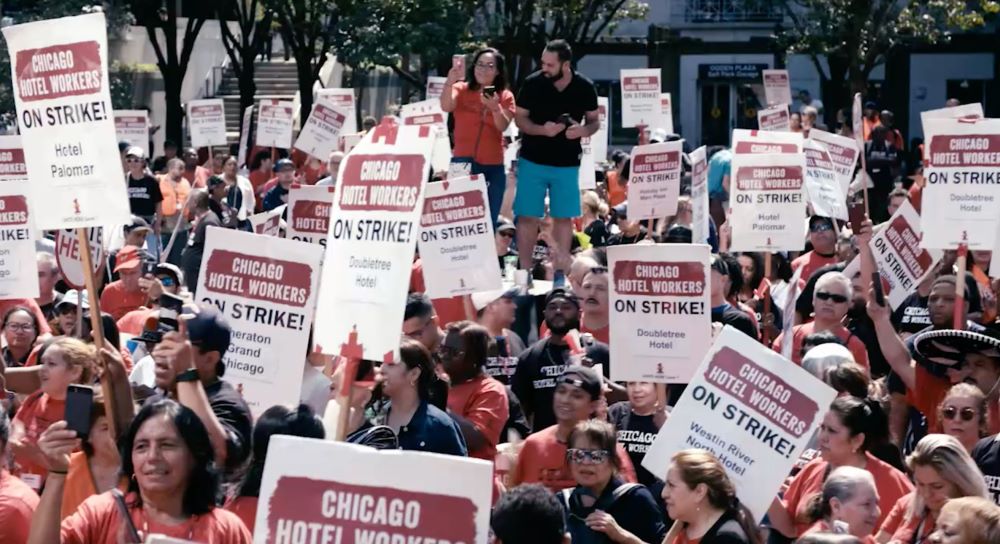
A crowd supports workers during a 2018 Chicago hotel strike. The immigration crackdown has affected the city's hospitality workforce. (Courtesy of Unite Here Local 1)
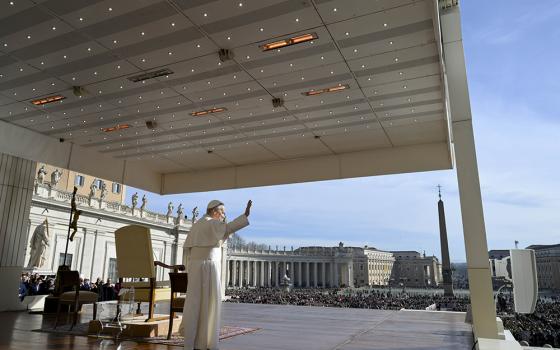
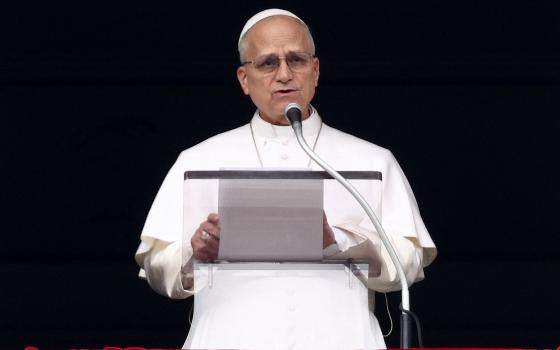
For him, faith offers a counterweight to the current fear. Morales said he has attended the same parish for 50 years and draws strength from the words of Pope Leo, who recently praised labor organizers for their work with the working class.
"He's giving us hope again. A huge hope for the labor movement."
The human cost of this climate of fear is visible across Chicago's restaurants as well. Restaurateur Phil Stefani, whose Italian and seafood restaurants operate in 16 locations, sees firsthand how the city's hospitality sector relies on immigrant labor. "In hospitality, the core of our business is our Hispanic population," he said. Removing them, he said, would shutter restaurants across the city.
But now, even workers with documentation show up in trepidation, and the vibrant energy of kitchens has given way to silence. "They come to work now every day in fear, even if they're legal," Stefani said, looking worried as he sat at a table in the back of one of his most successful restaurants in downtown Chicago, Tavern on Rush.
The threat is both moral and economic. A workforce that is intimidated may threaten the survival of the businesses that rely on it. For Stefani, defending employees is personal as well as practical.
"We support them. They're the backbone of my company. If the foundation cracks, the building falls."
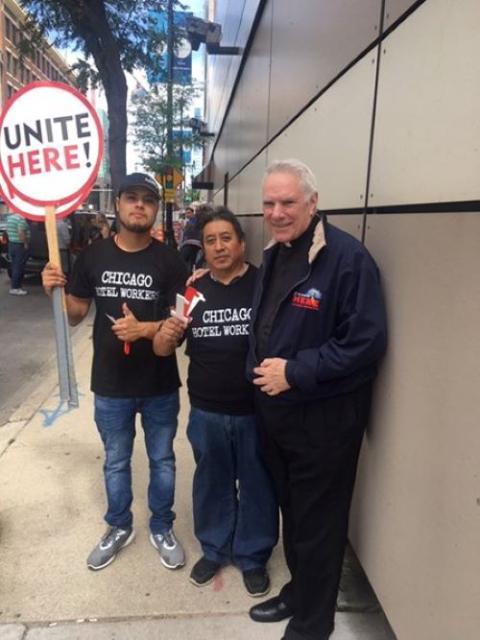
Fr. Clete Kiley, right, accompanies striking hotel workers in Chicago in an undated photo. (CNS /Courtesy Clete Kiley)
In this tense environment, both faith-based advocates and labor leaders have found themselves working in tandem. Fr. Clete Kiley, a priest in the Archdiocese of Chicago for over 50 years, has spent the last 15 closely supporting hotel and restaurant workers. As senior adviser and chaplain for the Chicago Federation of Labor, he has seen the challenges Unite Here members face: predominantly immigrant women from Mexico, El Salvador, Haiti, the Philippines and China, some undocumented, others under temporary protection.
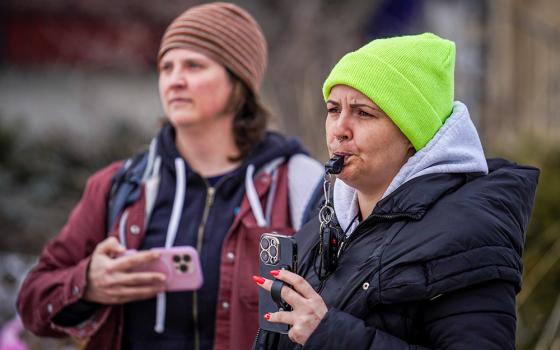
Union agreements can offer temporary shelter from the threat of deportation, providing up to a year to resolve documentation issues without losing seniority. Yet even with these protections, fear persists, he said. Communities create networks to protect children, while neighborhoods organize "whistle brigades" to alert families of raids.
"The more fearful a population becomes, the more dangerous the times are," Kiley said. "It feels very repressing."
The legal system, too, has become an arena of both peril and hope. Richard Velazquez, a first-generation Mexican American attorney, represents many Unite Here members facing immigration challenges, including status adjustments and naturalization. The first months of 2025 were particularly fraught, he said.
Velazquez said some clients were "completely lost" because a loved one had been detained, especially people caught in enforcement sweeps despite legal protections like TPS, or Temporary Protected Status, which allows people from some countries to live and work legally and temporarily in the United States. "I think it could be handled in a very, very dignified manner," he said, adding that the focus should be on individuals who pose actual threats to society, not those who work, pay taxes, and support families.
Yet even amid this uncertainty, victories emerge. Velazquez said a young union member had been detained in mid-October. By carefully navigating visiting procedures, he secured a phone call that evening, and by the next day the client was released under TPS protection.
Advertisement
"What gives me hope," Velazquez said, "is seeing courts push back, demanding accountability and restraining excessive tactics."
He also likes that judges are "calling in high-ranking immigration officials to account and answer," and that courts are dictating guidelines "to not engage in specific tactics," such as aggressive and deceptive methods to arrest immigrants with the use of physical force.
"That also gives me hope," he said.