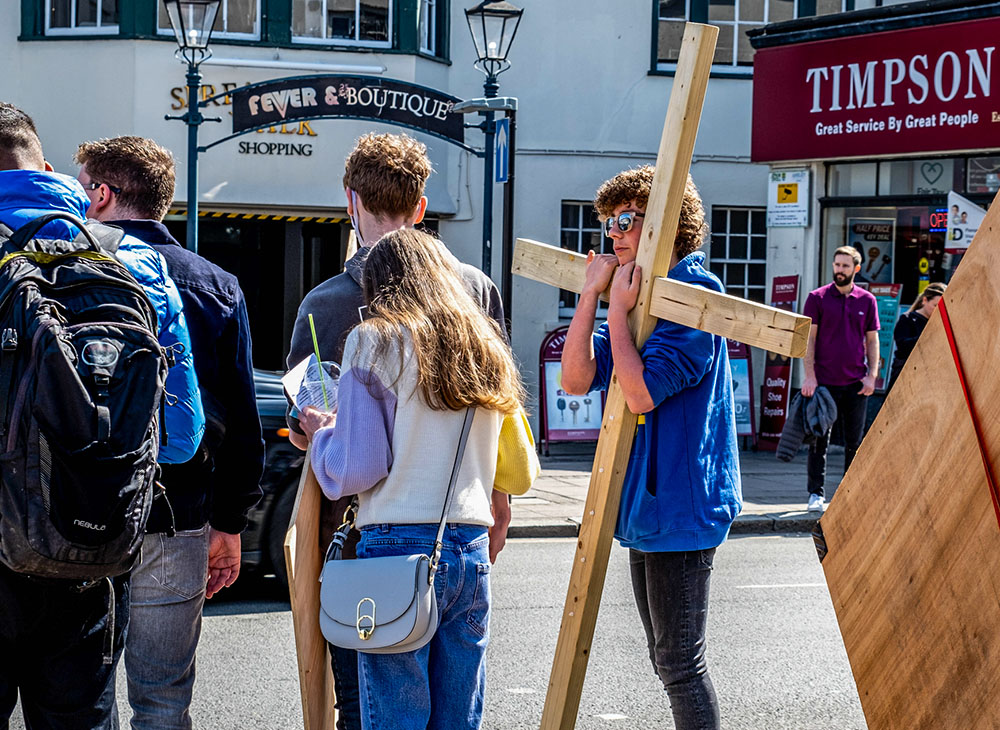
A young man carries a cross as he participates in a Good Friday service in Epsom, Surrey, England, April 15, 2022. (Dreamstime/Martinlee58)

by Jonathan Luxmoore
As reports continue of a "quiet revival" of faith among young people across Europe, something of a struggle seems to be opening up — between those welcoming the findings, and those resolutely dismissing them.
"Free societies are pluralistic, so we shouldn't be surprised," explained Jesuit Fr. Paul Zulehner, a religious sociologist from Austria.
"Although any revival remains low-level, it does seem that young people, especially in urban settings, are actively searching for new forms of meaning. But the picture remains complex — if some are returning to churches, others are still leaving them."
The priest spoke to National Catholic Reporter after a survey in Germany, commissioned by the Catholic Neuer Anfang, or New Beginning, movement, cited a significant increase in religious beliefs and practices among the 18-29 age-group — "Generation Z" — with 53% calling themselves believers, compared to just 33% of those over 50 years old.
Meanwhile, another veteran observer said "clear signs" of a Christian revival were also being reported in Britain but similarly advised caution in assessing the data.
"Some young people may well be overstating their interest in churches — yet this itself is interesting, since it suggests being religious is now becoming fashionable," said Linda Woodhead, a professor in moral and social theology at London's King's College.

Linda Woodhead (Wikimedia Commons/HiraV)
"Whereas being secular and nonbelieving seemed socially acceptable previously, this may no longer be the case. There could now be pressure to claim a religious identity."
Claims of an increase in youth baptisms and church attendance have been heard elsewhere in Europe. They've been sharply contested, however, particularly in Britain, where the term "quiet revival" was coined in an April 2025 Bible Society report. The report said that churchgoing among those aged 18-24, led by young men, had quadrupled from 4% to 16% since 2018.
Critics say the revival surveys have generally been commissioned by Christian organizations and have overrelied on "opt-in panels" where respondents have signed up to participate.
That was the contention of a new January analysis by the Washington-based Pew Research Center, which said an annual British Social Attitudes survey, using more accurate "random samples," suggested youthful church attendance had fallen rather than risen over the same period.
Conrad Hackett, the Pew report's author, insists the "general pattern" across Europe remains one of Christian decline.
Reports of increased youth baptisms, he told NCR, could simply result from more dioceses keeping and reporting data, while claims of exponential Bible sales could reflect "clever marketing efforts" by publishers, as well as mass purchases by evangelical organizations.
Advertisement
"I can see how various groups would wish these narratives to be true — but I hope people across the religious and ideological spectrum will want to know what's really happening," said Hackett, a senior demographer and associate director of research for the Pew Research Center.
"People come to the Christian faith in all kinds of places, and it's understandable that churches wish to celebrate signs of growth. But with other surveys indicating the Christian share is going down, I don't think anyone is served by misleading data."
Humanists UK, which staged a King's College seminar with Hackett Jan. 29, has demanded the Bible Society retract its claims of a "quiet revival."

Conrad Hackett (Pew Research Center)
But the society has defended its findings, insisting there's no evidence that young churchgoers are "lying" or "answering randomly."
Evidence of a revival has been set out in multiple surveys, the group says — most recently in a December King's College report, which put declared belief in God at 52% of 18- to 34-year-olds. By contrast, tracker polls like the British Social Attitudes survey have cited out-of-date figures and failed to include crucial population subgroups, the society said.
Woodhead admits there's no definitive evidence of a quiet revival. She nevertheless thinks a "cultural shift" is occurring and being influenced by multiple factors.
The much-vaunted "New Atheists" who caught media headlines two decades ago have now largely disappeared from the public scene, she points out. Meanwhile, the influential presence in Europe of young Muslims in Gen Z could be helping normalize faith affiliations. So could the externalization of feelings encouraged by social media, along with the perceived imperative of "having an identity," whether in race, gender or religiosity.
"The latest figures could be telling us more about a decline in secularism than about a rise in religiousness," she said."Young people have always tended to say they're spiritual rather than religious, and we may now be witnessing a removal of the cultural stigma attached to expressing sympathy for religion. In any event, we should be ready for an ideological battle — between evangelical Christians who really want to see a revival and sociologists of religion who remain committed to theories of inevitable religious decline."
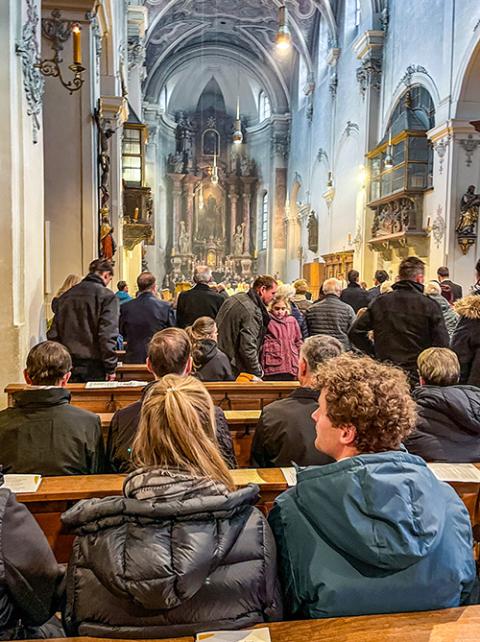
Parishioners attend Mass at a church in Regensburg, Germany, Nov. 15, 2025. (Dreamstime/Jesusfernandez)
The Pew Center's Hackett remains doubtful.
Media stories of a new religious resurgence have been "carefully monitored" by Pew Center researchers, he insists. But the overall long-term picture has been one of religious decline.
"Even if Bible sales have increased, we'd need to know if more people are actually reading them. And if more people are donning crosses, we'd need to know if they're advertising their faith or just wearing jewellery they like," he said.
"I'm ready to assume good intentions all round. But when new stories point to something unexpected among young adults, using the kind of data we've seen up to now, red flags should always go up," he told NCR.
Zulehner sees it differently.
Theories about inevitable religious decline, associated in the 19th century with Karl Marx, Max Weber and Émile Durkheim, have long been challenged, Zulehner points out, by modern thinkers such as Peter Berger and Charles Taylor, while "de-secularizing" and "re-spiritualizing" themes in modern culture have been documented by a long-running European Values Study.
If a quiet revival is really occurring, it would confirm youth disappointment with a materialistic world — and show how today's virtual reality isn't providing for needs and emotions, still less for community and closeness.
"For now, we're likely witnessing rivulets of religious recovery, rather than any great flood — but these small streams may have a capacity to grow," Zulehner said.
"You can have 2,000 friends and followers on Facebook and Instagram but still be very lonely. Although we still don't know how a quiet revival might develop, it seems secularization has reached a saturation point."